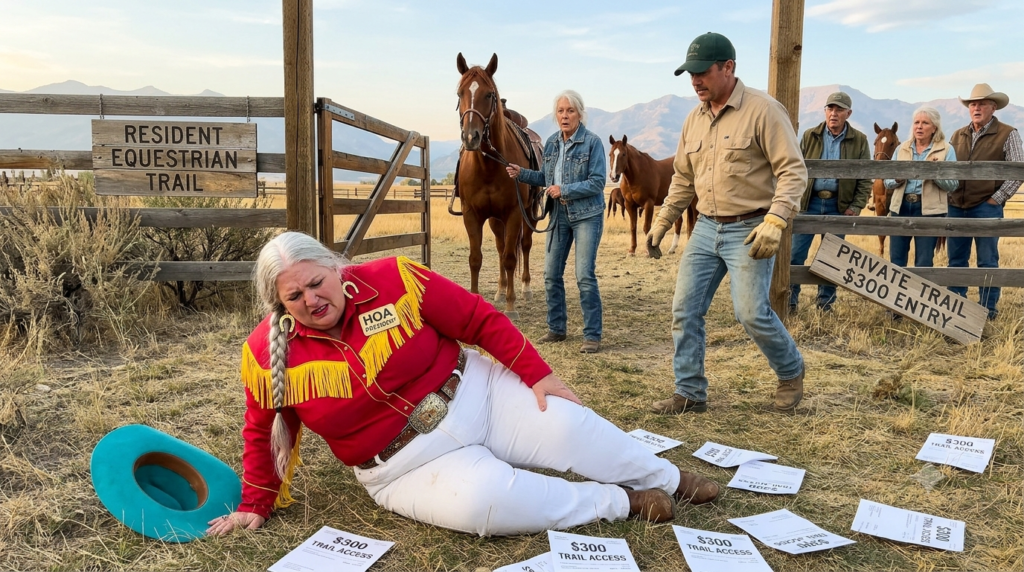
Chapter 4: The Hidden Plan Behind the $300 Fee
The board’s decision to suspend Karen’s authority did not end the investigation.
In fact, it revealed that the trail invoices were only one part of a much larger problem.
Robert Hayes began reviewing the association’s records with Linda Foster.
They examined maintenance budgets, vendor correspondence, access policies, and meeting minutes from the previous eighteen months.
At first, they found nothing particularly unusual.
There were ordinary maintenance expenses, occasional landscaping purchases, and several postponed improvement projects.
Then Robert noticed a pattern.
Karen had repeatedly requested that the board consider transferring certain community maintenance tasks to private vendors.
Most of those vendors were businesses with which she had personal connections.
Some belonged to friends.
Others were operated by people she had met through local business groups.
None of those proposals had been approved.
However, the trail project was different.
Karen had been unusually persistent.
She had asked for measurements of the entrance gate, requested estimates for electronic locks, and discussed the possibility of charging residents for scheduled access.
In one email, she had suggested that the association could generate substantial annual revenue by limiting access to certain hours and offering paid premium reservations.
Robert found the email particularly troubling because the proposal had never appeared on an official board agenda.
Another document was even more revealing.
It was a draft maintenance agreement naming Whitmore Outdoor Services as the preferred contractor.
The document included a proposed monthly management payment and an additional charge for each paid trail reservation.
The agreement was not signed.
There was no evidence that the company had accepted it.
But the document showed that Karen had been considering a financial arrangement that would benefit her son’s business.
Robert also discovered that the HOA office printer had been used to produce the invoices.
The printing records showed that the documents had been generated using the president’s office login.
That alone did not prove financial wrongdoing, but it established that association equipment had been used to prepare a private payment demand.
The board requested a written explanation.
Karen responded with a lengthy letter accusing Robert of conducting a personal vendetta.
She argued that the association needed new revenue sources and claimed that her proposal had been misunderstood.
She also insisted that Tyler had initially supported the concept.
Tyler strongly disputed that claim.
He provided copies of his messages with Karen.
In one exchange, he had written:
Mom, I can’t operate a community amenity without a contract. The residents already pay HOA dues. If the board wants a maintenance proposal, I’ll submit one through the proper process.
Karen had replied that she would handle the approval process herself.
The messages made the situation difficult to dismiss.
Tyler eventually met with the board and answered questions about his company.
He admitted that he had been tempted by the possibility of securing a regular maintenance contract. His business had struggled during the previous winter, and a stable agreement would have helped him retain two employees.
But he explained that he had never agreed to collect access fees or use his company’s name on unauthorized invoices.
He also offered to submit a normal competitive bid if the association ever requested one.
The board thanked him but made clear that the investigation would continue independently of his involvement.
Meanwhile, Margaret was dealing with an uncomfortable side effect of the controversy.
A few residents had begun avoiding her.
Some believed she should apologize for Copper’s kick.
Others thought she had allowed the confrontation to become unnecessarily dangerous.
Margaret understood why people were concerned.
She had been shaken by the incident herself.
Copper was a gentle horse, but even a calm animal could react defensively when someone suddenly entered its space.
She had no interest in celebrating Karen’s injury.
One afternoon, she visited Karen’s home with a small basket of groceries.
Karen opened the door using a walking cane.
For a moment, neither woman spoke.
Then Karen looked at the basket.
“Did the board send you?”
“No,” Margaret replied. “I came because I wanted to make sure you’re recovering.”
Karen gave a bitter laugh.
“How generous.”
Margaret placed the basket on the porch.
“I also want you to understand something. Copper didn’t attack you. You came too close to him after I warned you to move away.”
Karen tightened her grip on the cane.
“So now you’re blaming me for getting kicked?”
“I’m saying the horse reacted to a situation you created. I never wanted you injured.”
Karen looked away.
Margaret continued more softly.
“We’ve lived in the same community for years. You don’t have to like me. But you cannot decide that everyone else’s rights disappear because you have a title.”
Karen said nothing.
Margaret turned to leave.
Before she reached the driveway, Karen spoke again.
“You think everyone would be better off without me.”
Margaret stopped.
“I think everyone would be better off if the rules applied equally to everyone.”
Then she left.
That evening, Tyler visited his mother.
He brought groceries too, but Karen barely acknowledged them.
He asked whether she had spoken to Margaret.
She said she had no intention of apologizing to anyone.
Tyler sat across from her.
“Mom, you could have submitted a proposal. You could have asked the board to consider it. If they said no, that would have been the end of it.”
“They never listen to me.”
“That’s not true.”
“They don’t respect what I do.”
Tyler looked at her for a long moment.
“Respect isn’t something you can collect with an invoice.”
Karen turned toward the window.
For the first time, she seemed unable to find an answer.
But the board still had one important decision to make.
The special membership vote was approaching, and Karen had already announced that she intended to remain HOA president.
She was determined to defend her position.
Even if doing so meant fighting the very people she had been elected to represent.