Chapter 5: The Vote That Changed the Community
The special membership meeting took place three weeks after the incident at the trail gate.
By then, Karen had recovered enough to walk without her cane, although she still complained about the pain in her thigh.
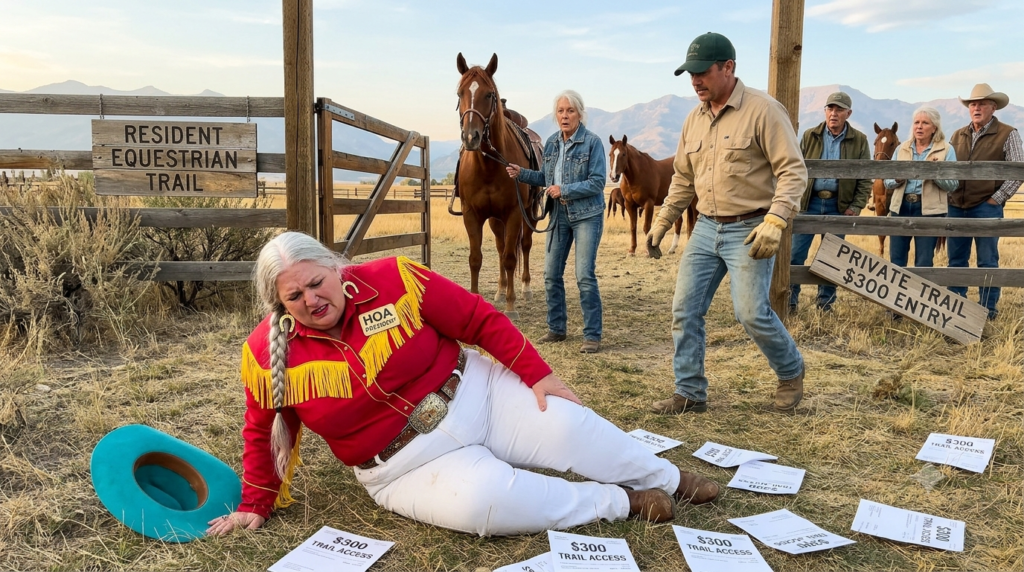
She arrived wearing a bright red coat, black trousers, oversized gold earrings, and the same turquoise cowboy hat she had worn on the day of the confrontation.
She wanted everyone to see that she was not backing down.
But the atmosphere inside the recreation hall was different from the one she had encountered at previous meetings.
Residents were organized.
They had copies of the HOA bylaws, financial records, and the board’s investigation findings. Several had also prepared written statements explaining why the trail mattered to their families.
Margaret was among them.
She had brought photographs of Copper on the trail, including one taken several years earlier when her late husband was still alive.
The picture showed the two of them riding side by side beneath the Montana mountains.
For Margaret, the trail represented something that couldn’t be measured in monthly revenue.
It was a place where neighbors met, older residents stayed active, and families passed their love of horses to younger generations.
She wasn’t willing to lose it because someone wanted to turn it into a business opportunity.
Linda Foster opened the meeting by explaining the voting procedure.
The board had already completed its investigation.
Its findings were straightforward:
-
Karen had replaced the official trail sign without authorization.
-
She had attempted to impose a $300 access fee without a board vote.
-
She had prepared payment invoices using the name of a company that had never accepted the proposed arrangement.
-
She had attempted to arrange changes to the entrance gate without an approved work order.
-
She had used her HOA position to pursue a proposal that could financially benefit a close family member.
The investigation had found no evidence that residents had actually paid the unauthorized invoices.
That was an important distinction.
There would be no need to recover money that had never been collected.
However, the board considered the misuse of authority serious enough to recommend Karen’s removal from office.
Karen requested the floor.
She stood slowly, adjusted her jacket, and looked around the room.
She spoke about the hours she had spent volunteering, the maintenance issues she had tried to solve, and the criticism she believed she had received for simply attempting to improve the community.
She described the $300 fee as an idea that had been taken out of context.
Then she turned toward Margaret.
She suggested that the entire controversy had started because one resident refused to accept reasonable changes.
Margaret did not interrupt.
She waited until Karen finished.
When Linda invited residents to speak, Margaret stood.
“I’ve lived here for fourteen years,” she began. “I’ve paid my HOA dues every year. My husband and I helped raise money for this trail. We helped repair fences, clear fallen branches, and maintain the entrance.”
She paused and looked toward the photographs on the table.
“My husband isn’t here anymore. Riding that trail is one of the ways I still feel close to the life we built together. I don’t expect special treatment. I don’t expect anyone to give me anything for free. I simply expect the things we have all paid for to remain available to the people who own the right to use them.”
She glanced toward Karen.
“And I don’t think a volunteer title gives anyone permission to take those rights away.”
The room remained quiet.
Daniel spoke next.
He explained that maintenance workers could not be expected to follow instructions that had no official authorization. If the president could bypass the board whenever she wanted, there would be no reliable way to manage community property.
Robert Hayes followed with a short financial explanation.
He made it clear that the proposed trail fees had never entered the HOA accounts and that Tyler’s company had not received any money.
He also recommended stronger financial controls, including written approval for vendor contracts and a requirement that board members disclose potential conflicts of interest.
The residents approved those recommendations.
Then came the vote on Karen’s removal.
The ballots were distributed.
Residents marked their choices, folded the papers, and placed them into a sealed box.
Karen sat rigidly in her chair.
Tyler remained near the back wall.
He had not encouraged anyone to vote against his mother, but he had also refused to defend her actions.
When the counting was complete, Linda returned to the microphone.
The result was decisive.
A substantial majority of the membership had voted to remove Karen as HOA president.
The room remained silent for a few seconds.
Then someone began clapping.
Others joined.
Karen stared at the results sheet as though she could somehow change the numbers by refusing to acknowledge them.
She gathered her handbag and stood.
Nobody blocked her.
Nobody shouted insults.
She walked out of the hall with her turquoise hat pulled low over her forehead.
Tyler followed her outside.
“Mom.”
She stopped near the parking lot.
“You’re happy now?” she asked.
“No.”
“You got what you wanted.”
Tyler shook his head.
“I wanted you to stop before it got this far.”
Karen looked at him.
For several seconds, her expression softened.
Then she turned away and continued toward her car.
Tyler didn’t follow.
He had finally understood that loving someone did not mean protecting them from every consequence of their decisions.
And Karen had finally lost the one thing she had believed made her untouchable.
Her position.