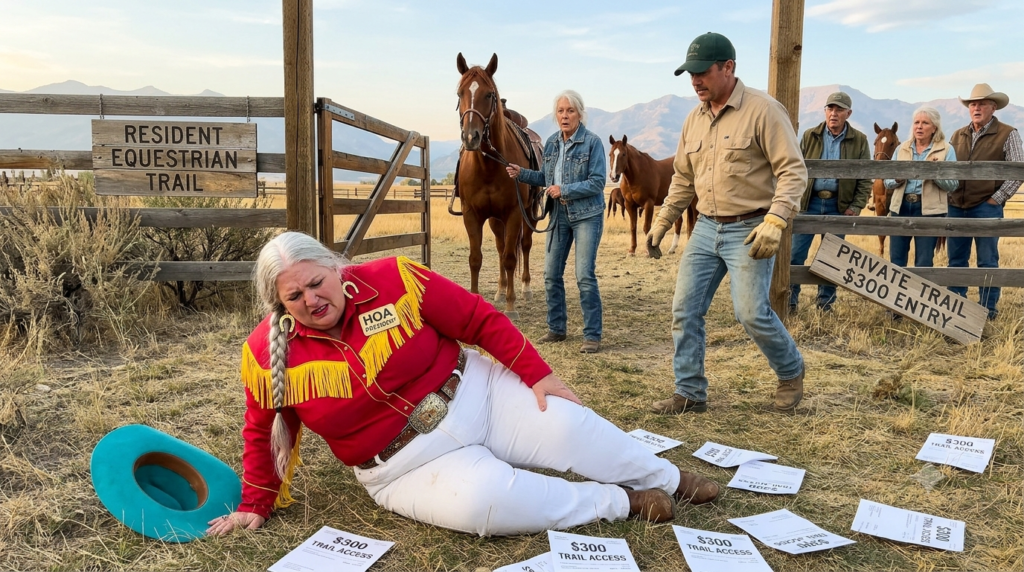
Chapter 2: The Invoices Nobody Had Authorized
By Monday morning, the story had spread through the equestrian community.
Karen had been transported to a nearby hospital after the fall. Medical examinations revealed a painful thigh injury and extensive bruising, but no broken bones. Doctors advised her to rest and avoid putting too much weight on the injured leg for several days.
She was furious about the injury.
She was even more furious about the fact that residents were discussing the incident.
Her first concern, however, was not the horse or Margaret’s safety.
It was the trail.
On Sunday evening, Karen sent an email to the HOA mailing list declaring that the incident had been an unfortunate misunderstanding. She described Copper as an unpredictable animal and suggested that Margaret should be held responsible for any damage caused by the horse.
She also claimed that the proposed $300 access fee had been part of a preliminary revenue plan.
According to Karen, the plan was intended to improve trail maintenance.
But several residents noticed something unusual.
The invoices she had carried were not estimates or discussion documents.
They were completed payment demands.
Each contained a due date, a payment address, and the name of Whitmore Outdoor Services.
The company belonged to Karen’s thirty-four-year-old son, Tyler.
Tyler had started his landscaping and outdoor maintenance business three years earlier. He had a modest workshop outside town and a small crew of employees. His company had occasionally performed private landscaping work for residents, but it had never been hired by the HOA to manage the equestrian trail.
That distinction mattered.
Margaret had known Tyler since he was a teenager. She remembered him helping his father repair fences and occasionally riding horses with the neighborhood children.
She couldn’t believe he would knowingly participate in Karen’s scheme.
So she called him.
Tyler answered on the fourth ring.
“Margaret? Everything okay?”
“I’m calling about the invoices your mother was handing out.”
There was a long pause.
“What invoices?”
Margaret explained what had happened.
She described the replacement sign, the $300 demand, and the company name printed on the papers.
Tyler went quiet.
Then he asked her to send him a photograph.
Margaret took one of the invoices Daniel had collected after the incident and forwarded it.
Ten minutes later, Tyler called again.
“I didn’t authorize this,” he said.
His voice sounded strained.
He explained that Karen had approached him two weeks earlier with an idea. She wanted his company to submit a proposal for trail maintenance and possibly handle bookings if the community ever approved paid access.
Tyler had told her that a proposal would need to go through the HOA board.
He had never agreed to collect money.
He had certainly never agreed to charge residents for using property they already helped maintain.
“I told her I couldn’t touch it without a contract,” he said. “I thought that was the end of it.”
Margaret felt a mixture of relief and anger.
“Then why is your company name on these invoices?”
Tyler didn’t have an answer.
He promised to investigate.
The following morning, he visited the HOA office and requested copies of any documents connected to his business.
The property manager, Linda Foster, was equally surprised.
There was no approved contract.
There was no board resolution.
There was no recorded vote changing the trail’s access policy.
There was not even a formal maintenance proposal from Whitmore Outdoor Services.
Linda showed Tyler the association’s official records.
The trail was listed as a common recreational amenity, funded through annual assessments. Its maintenance budget had been approved at the previous year’s board meeting.
Karen had attended that meeting.
She had voted in favor of the budget.
Tyler stared at the paperwork.
“So she knew it was already paid for.”
Linda nodded.
“Everyone on the board knew.”
That afternoon, Tyler sent a written statement to the property manager confirming that his company had never accepted the proposed contract and had never authorized the collection of trail-access payments.
He also asked that the company name be removed from any unauthorized invoices.
But the situation was already bigger than a misunderstanding between a mother and son.
Several residents began comparing notes.
One remembered receiving an email from Karen asking whether the trail could be used for private riding lessons.
Another had been told that certain residents would soon need to purchase seasonal access passes.
A third had seen Karen measuring the gate and asking whether a keypad could be installed.
Individually, each incident seemed insignificant.
Together, they suggested that Karen had been planning something for weeks.
Daniel remembered another detail.
On the morning of the confrontation, Karen had asked him to install a heavy metal latch and a lockbox beside the entrance gate.
She had claimed that the association was introducing a new reservation system.
He had refused because he had received no work order.
Now he understood why she had been so angry.
She had not simply wanted to replace a sign.
She had wanted to take control of the entrance itself.
By Wednesday, Linda had scheduled an emergency board meeting.
The agenda included the unauthorized invoices, the attempted restriction of trail access, and Karen’s conduct as HOA president.
Karen received the notice while recovering at home.
She read it twice.
Then she called the other board members, insisting that they were making a serious mistake.
She told them the meeting was unnecessary.
She said the residents were exaggerating.
And she warned that removing her would create chaos.
But one thing was different now.
The residents had documents.
They had photographs.
They had Daniel’s account.
And they had Tyler’s written statement.
Karen had spent years convincing the community that questioning her decisions was the same as challenging the association itself.
This time, the community was preparing to ask a much more uncomfortable question.
Had the HOA president been using her position to create a business opportunity for her own family?