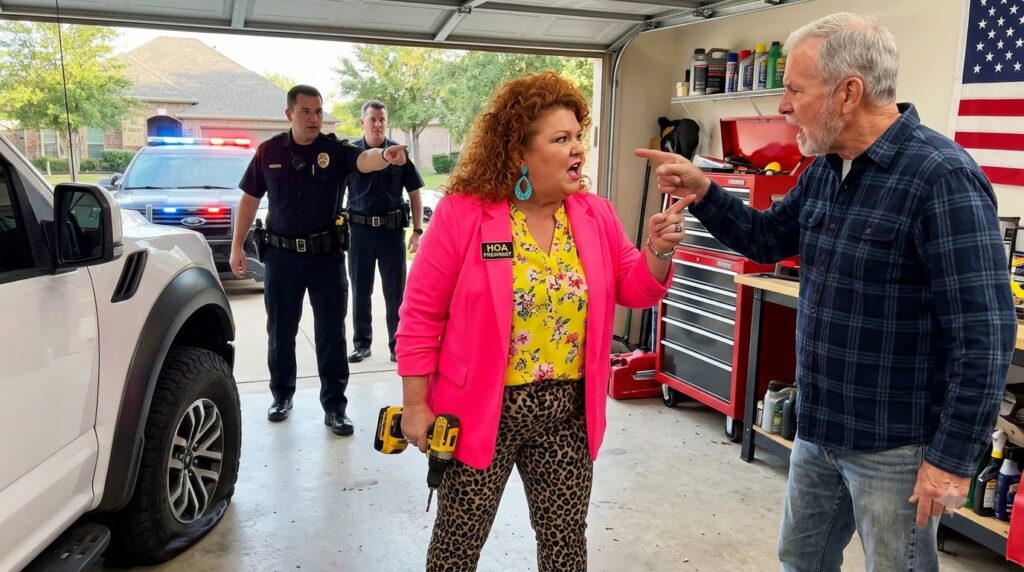
Chapter 3: The Neighbors Who Had Been Afraid to Speak
Margaret Ellis arrived at Robert’s house carrying a homemade apple pie and a thick folder.
At seventy-one, Margaret had lived in Willow Creek Estates longer than almost anyone else.
She was a retired elementary school teacher, a widow, and the sort of neighbor who remembered birthdays without needing a calendar.
Robert thanked her for calling the police.
Margaret dismissed his gratitude.
She had done what any decent neighbor should have done.
But as they sat together at his kitchen table, she admitted that she had nearly hesitated.
Karen had spent years convincing residents that opposing her would bring financial consequences.
Margaret opened the folder.
Inside were violation notices, photographs, payment receipts, and handwritten notes documenting her own experiences with the association.
Two years earlier, Karen had ordered Margaret to remove a small wooden bench from her front porch.
The bench had belonged to Margaret’s late husband.
He had built it himself during their forty-second year of marriage.
Karen claimed it did not match the neighborhood’s approved appearance.
Margaret appealed.
The fines accumulated until she finally paid $900 and moved the bench into her backyard.
She had cried while doing it.
Not because the bench was particularly valuable, but because someone had made her feel powerless inside the home where she had spent most of her adult life.
Robert listened with growing anger.
Margaret explained that other residents had similar stories.
There was Frank Holloway, a seventy-four-year-old Vietnam veteran who had received repeated warnings over a flagpole.
There was Patricia Gomez, a retired nurse who had been fined after installing a temporary wheelchair ramp for her husband following surgery.
There was James Carter, a widower who had been charged hundreds of dollars because his grandchildren left bicycles beside his garage during a weekend visit.
Each dispute appeared small when considered individually.
Together, they revealed a pattern.
Karen targeted people who were unlikely to fight back.
Older residents. Widows. Homeowners dealing with illness. People who valued peace and did not want expensive legal disputes.
Robert contacted Susan.
She encouraged the residents to preserve their records and provide written accounts of what had happened.
Over the following week, Margaret quietly contacted neighbors she trusted.
Robert’s kitchen table became an informal gathering place.
One evening, eight homeowners arrived carrying envelopes and folders.
The following evening, eleven more came.
Several admitted that they had paid fines they knew were questionable simply because Karen had threatened additional charges.
Others had been warned that unpaid assessments might eventually affect their homes.
Some had stopped attending community meetings altogether.
Robert was particularly disturbed by the story of Harold Simmons, a seventy-eight-year-old retired postal worker.
Harold had received fines for failing to maintain his lawn during a period when he was undergoing medical treatment.
His daughter had arranged for a landscaping company to visit, but the work had been delayed by heavy rain.
Karen continued issuing notices.
Harold eventually paid nearly $2,000.
He had taken the money from savings intended to replace his failing air-conditioning system.
Robert thought about the Texas summer and wondered how anyone could justify such cruelty.
The association was supposed to help maintain the community.
It had become a source of fear.
As the residents compared documents, they noticed another troubling detail.
Many of the violation notices included an additional administrative charge.
The amount varied, but the description was usually identical.
Several payments had been directed to an entity called Willow Creek Compliance Services.
Robert had never heard of it.
Neither had Margaret.
Susan requested information about the company through the association’s records.
Meanwhile, Karen was released pending further legal proceedings concerning the garage incident.
She returned to the neighborhood and immediately began portraying herself as the victim.
A message appeared on the community’s private social media page.
Karen claimed that an aggressive homeowner had attempted to interfere with authorized association business and that the police had misunderstood the situation.
She described the damaged tire as an unfortunate accident.
Robert did not respond.
Susan had advised him against debating the matter publicly.
But Margaret, who had spent decades teaching children the importance of honesty, could not remain silent.
She posted a simple statement explaining that she had personally witnessed Karen enter Robert’s garage carrying a drill.
Other residents began sharing their experiences.
For the first time, Karen could not control the conversation.
Her response was swift.
She removed Margaret from the community page and announced that residents spreading false information could face disciplinary action.
That decision accomplished the opposite of what she intended.
More homeowners contacted Robert.
Within ten days, forty-three residents had expressed concerns about the association’s leadership.
Then an unexpected visitor arrived.
It was Dennis Palmer.
He stood on Robert’s porch shortly before sunset, looking considerably older than he had at the last board meeting.
He carried a brown leather briefcase.
Robert considered refusing to let him inside.
Dennis had signed the retaliatory violation notice. His name had been mentioned in Karen’s recorded telephone conversation.
He was not someone Robert trusted.
But Dennis appeared frightened.
He explained that Karen had instructed him to approve documents he had never properly reviewed.
He admitted that he had allowed her to dominate the board.
Then he placed the briefcase on Robert’s kitchen table.
Inside were financial statements, invoices, meeting records, and copies of correspondence.
Dennis said he had recently discovered something that could expose the association to serious financial and legal consequences.
Robert opened the first folder.
It contained payments totaling more than $38,000.
The recipient was Willow Creek Compliance Services.
And according to the documents Dennis had brought, the company belonged to Karen Whitmore’s younger brother.