Chapter 5: The Night Karen Lost Control
The Willow Creek Estates clubhouse had never been so crowded.
Residents began arriving forty minutes before the special meeting.
Folding chairs filled the main room. Additional homeowners stood along the walls.
Some carried folders. Others brought copies of their violation notices.
Margaret arrived wearing a blue cardigan and holding a carefully organized notebook.
Frank Holloway wore his veterans’ association cap.
Harold Simmons came with his daughter.
Robert entered with Emily and Susan.
He recognized neighbors he had waved to for years without ever learning their names.
The atmosphere was tense, but remarkably orderly.
People were tired.
They wanted answers.
Karen arrived shortly before the meeting began.
She wore a bright purple jacket, large gold earrings, and her familiar HOA president badge.
An attorney accompanied her.
Karen walked directly toward the front table and attempted to take control of the proceedings.
She insisted that the gathering was improper and that any decisions made during it would be invalid.
Susan calmly explained the procedures residents had followed.
The necessary petition had been submitted. Notices had been distributed. The meeting had been organized in accordance with the applicable governing provisions.
An independent moderator had been arranged to oversee the proceedings.
Karen objected.
The moderator proceeded.
The first portion of the meeting concerned the association’s financial condition.
A preliminary review identified payments requiring further examination, undisclosed family connections, and weaknesses in the approval process.
Residents listened as the figures were presented.
More than $38,000 in payments to Willow Creek Compliance Services.
Growing administrative expenses.
Delayed maintenance projects.
Questionable enforcement charges.
Karen defended the expenditures.
She claimed her brother’s company had provided essential services and that residents did not understand the complexity of managing a prestigious community.
Then Margaret stood.
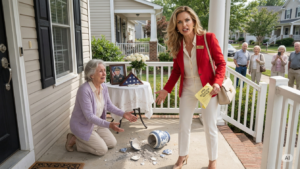
She described the bench her late husband had built.
She explained how the association had fined her until she removed it.
Her voice remained steady until she mentioned her husband.
For a moment, the room became completely silent.
Frank spoke next.
Then Patricia.
Then Harold.
Each homeowner described a different experience, but the underlying message was the same.
They had been treated as problems to be controlled rather than neighbors deserving respect.
Karen attempted to interrupt several times.
The moderator instructed her to wait.
When Robert’s turn arrived, he stood beside the front row.
He did not shout.
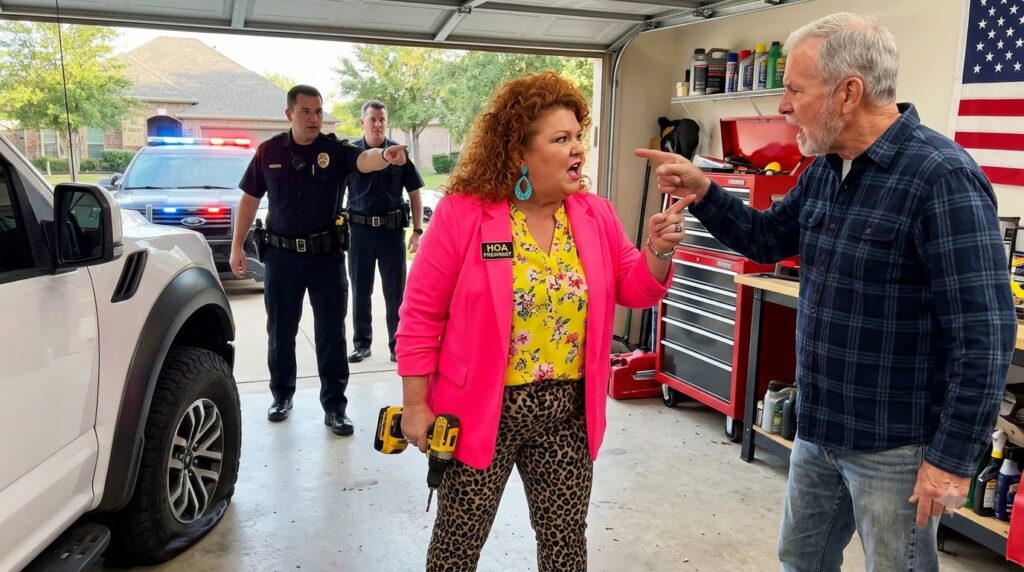
He explained the original vehicle violation, his requests for clarification, the escalating fines, and the incident inside his garage.
Karen immediately claimed that he had misrepresented what happened.
Robert had anticipated that response.
With Susan’s guidance, he had prepared a short presentation using relevant portions of the security footage.
The video appeared on the clubhouse projector.
Residents watched Karen approach the garage carrying the drill.
They watched her enter without permission.
They watched her deliberately damage the tire.
Then they heard her confrontation with Robert.
Finally, the police appeared.
“He owes the HOA! His property is mine!”
The recording ended.
Nobody moved.
Karen’s attorney leaned toward her and spoke quietly.
Karen shook her head.
She insisted that the recording lacked context.
She argued that Robert had forced her into an impossible position by refusing to pay his fines.
Several residents reacted with disbelief.
The moderator reminded everyone that the meeting was not a criminal trial. Its purpose was to determine whether the existing leadership retained the confidence of the homeowners.
That distinction mattered.
The courts would address the legal allegations.
The community could address its governance.
Dennis Palmer then approached the microphone.
He acknowledged that he had approved payments without adequate review and had failed to challenge Karen’s enforcement practices.
He apologized.
He also confirmed that the additional $500 fine issued after the police incident had been prepared at Karen’s direction.
Karen turned toward him.
Her face reddened.
She accused him of betraying the board.
Dennis did not respond.
For once, he refused to defend her.
The moderator explained the voting procedure.
Eligible homeowners received ballots, and independent volunteers supervised the count.
Karen continued insisting that the residents were making a terrible mistake.
She warned that property values would decline without strict enforcement.
Robert looked around the room.
He saw people who maintained their homes, cared for their families, helped their neighbors, and paid their dues.
They did not need to be frightened into behaving responsibly.
When the ballots were counted, the result was overwhelming.
Karen was removed from the board.
Dennis also lost his position.
The remaining vacancies would be filled through the association’s established procedures, and an independent financial review would be commissioned.
Karen stood motionless.
For years, she had behaved as though the neighborhood belonged to her.
Now the neighborhood had rejected her leadership.
She removed her president badge, placed it on the table, and walked toward the exit.
Her attorney followed.
Nobody applauded.
Robert was grateful for that.
The evening was not supposed to be a public humiliation.
It was supposed to restore accountability.
As residents began leaving, Margaret approached Robert and squeezed his hand.
For the first time in years, she said, she felt comfortable attending an association meeting.
Robert smiled.
But the legal consequences of Karen’s actions were still unresolved.
And the independent financial review was about to reveal how much damage her leadership had actually caused.