Chapter 2: The Fine That Never Should Have Existed
Robert had moved into Willow Creek Estates eleven years earlier with his wife, Linda.
Back then, the neighborhood had seemed like everything they wanted for retirement.
The streets were quiet. The lawns were neatly maintained. Children rode bicycles along the sidewalks, and neighbors gathered for cookouts during the summer.
The association existed primarily to maintain landscaping, manage the community pool, and preserve shared spaces.
Nobody seemed particularly interested in controlling anyone else’s life.
That changed when Karen Whitmore became president.
She introduced increasingly aggressive enforcement practices, issued violation notices for minor matters, and treated disagreements as personal challenges to her authority.
Residents received warnings for garden decorations, temporary basketball hoops, mismatched flowerpots, and trash cans left outside for a few extra hours.
Most people paid their fines rather than argue.
Robert understood why.
Retirement was supposed to provide peace, not endless correspondence with a neighborhood committee.
After Linda died following a lengthy illness, Robert became even less interested in neighborhood politics.
He concentrated on his family, his woodworking projects, and the small routines that helped him adjust to living alone.
His garage became his sanctuary.
Linda had helped him organize it years earlier. She had chosen the American flag hanging above the workbench and had insisted that he finally purchase proper storage cabinets instead of keeping his tools in cardboard boxes.
Her handwriting remained visible on several plastic storage containers.
Robert could not bring himself to replace the labels.
When he purchased his white Ford Raptor, his daughter Emily had encouraged him to enjoy it.
He had spent enough years putting everyone else’s needs first.
For once, he deserved something that made him happy.
The trouble began three months after the purchase.
Karen sent him a violation notice claiming that oversized recreational vehicles could not remain visible from the street overnight.
Robert read the notice twice.
His pickup was registered as an ordinary passenger vehicle. It fit comfortably inside his garage and driveway.
It was neither a commercial truck nor a recreational vehicle.
He requested the specific provision authorizing the fine.
Karen responded with a general statement about maintaining neighborhood aesthetics.
Robert examined the association’s governing documents himself.
He found restrictions involving trailers, boats, abandoned vehicles, and commercial equipment. He found nothing prohibiting his pickup.
He appealed the original $150 fine.
Rather than schedule a proper hearing, Karen informed him that his appeal had been denied.
Additional charges followed.
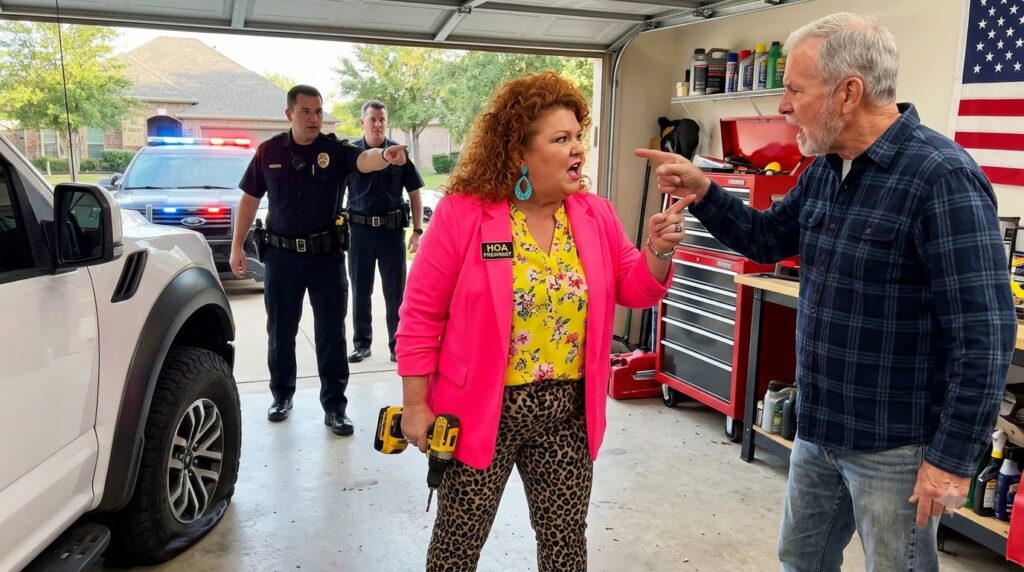
By the time she entered his garage, the association claimed he owed $1,275.
Robert had refused to pay.
Not because he could not afford it, but because he believed paying an unjustified fine would encourage Karen to continue imposing them.
That evening, after the police left and a towing company arranged for the truck to be repaired, Robert sat at his kitchen table reviewing the security footage.
The recording showed Karen approaching his property with the cordless drill already in her hand.
She paused near the garage entrance.
Before entering, she made a telephone call.
The camera’s microphone captured enough of the conversation for Robert to understand that she was discussing his truck and his unpaid fine.
She mentioned making an example of him.
She also referred to someone named Dennis.
Robert recognized the name.
Dennis Palmer was the HOA treasurer.
A retired insurance salesman, Dennis rarely spoke during meetings. He generally sat beside Karen, nodded at her statements, and approved whatever documents she placed in front of him.
Robert had always assumed he was simply a passive board member.
Now he wondered whether Dennis had known what Karen intended to do.
The footage continued.
Karen entered the garage, examined the truck, and positioned herself beside the front wheel.
Her actions appeared deliberate.
There was no argument preceding the damage. No misunderstanding. No emergency.
She had arrived intending to interfere with his vehicle.
Robert saved the recording in several locations and contacted the investigating officer.
Then he called Emily.
His daughter arrived less than an hour later.
At thirty-seven, Emily worked as a physical therapist and lived twenty minutes away with her husband and two children.
She watched the recording in silence.
When it ended, she looked toward the garage.
Her mother had spent years making that house a home. The idea that someone could enter it and treat her father’s belongings as community property deeply disturbed her.
Emily insisted that Robert consult an attorney.
He agreed.
The following morning, he contacted Susan Bennett, a local lawyer experienced in property disputes and homeowners association matters.
Susan listened carefully as Robert described the incident.
She requested the violation notices, his appeal correspondence, the association’s governing documents, and the security footage.
After reviewing the materials, she explained that the dispute involved more than a damaged tire.
An HOA could possess legitimate enforcement powers, depending on its governing documents and applicable law. But those powers did not ordinarily include entering someone’s private garage and destroying a vehicle to collect a disputed fine.
Karen’s position did not provide immunity from ordinary legal consequences.
Susan advised Robert to preserve every document and avoid direct confrontations.
She also requested records concerning the board’s enforcement decisions and financial transactions.
Robert had expected a straightforward property damage case.
Instead, Susan suspected that the association’s procedures might have been compromised.
That afternoon, another envelope appeared in Robert’s mailbox.
It contained an additional HOA violation notice.
This time, he was accused of creating a public disturbance and damaging the association’s reputation by involving the police.
The notice demanded another $500.
At the bottom was Dennis Palmer’s signature.