Chapter 7: A Neighborhood Worth Coming Home To
The following spring, Willow Creek Estates looked much the same as it always had.
The lawns were green.
The sidewalks were clean.
Children rode bicycles beneath the shade of mature oak trees.
American flags appeared on front porches as Memorial Day approached.
But something important had changed.
Residents no longer looked anxiously toward Karen’s house whenever they placed a decoration outside or parked a vehicle in their driveway.
The new board adopted clearer enforcement procedures.
Violation notices were required to identify the relevant governing provision.
Homeowners were provided meaningful opportunities to respond.
Financial reports became more accessible.
Potential conflicts of interest had to be disclosed.
Major contracts received additional review.
The board also established a process for considering reasonable accommodations and unusual personal circumstances.
It did not eliminate every neighborhood rule.
Residents still had responsibilities.
Common areas still needed maintenance, and legitimate violations still required attention.
But enforcement was no longer treated as a competition to see how much money could be collected.
The community began remembering why the association had existed in the first place.
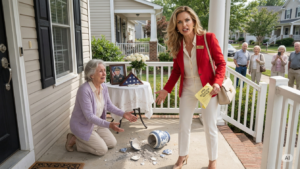
Margaret returned her husband’s wooden bench to the front porch.
Robert helped carry it from the backyard.
The wood had weathered slightly, but it remained sturdy.
He offered to refinish it.
Margaret declined.
Her husband had built it with his own hands, and she liked the marks that showed its age.
They positioned it beneath the porch window.
Margaret sat down and looked toward the street.
For several moments, she said nothing.
Then she told Robert that she finally felt as though the house belonged to her again.
That afternoon, Robert returned home thinking about Linda.
She had loved the neighborhood during its early years.
She had organized holiday gatherings, welcomed new families, and delivered meals when neighbors became ill.
Robert believed she would have been pleased to see people rediscovering those traditions.
The community organized a spring cookout.
Residents brought folding tables, homemade desserts, barbecue, and lawn chairs.
Frank helped raise the flag near the clubhouse.
Patricia volunteered at the food table.
Harold arrived carrying a large container of homemade lemonade.
Emily brought her family.
For the first time in a long while, Robert attended a neighborhood gathering without expecting an argument.
Several residents encouraged him to run for HOA president.
He politely declined.
He had spent enough years supervising people during his working life.
Retirement was supposed to provide time for fishing, woodworking, family, and occasional drives through the Texas countryside.
However, he agreed to serve temporarily on a homeowner advisory committee that reviewed community concerns.
He wanted to help establish a culture in which residents could speak openly without fearing retaliation.
Karen did not attend the cookout.
By then, a real estate sign stood outside her house.
She had decided to move.
Robert heard several different explanations, but he did not speculate about her reasons.
Her departure was her own decision.
One afternoon, shortly before the moving truck arrived, Robert saw her standing near her driveway.
She looked different without the bright clothing, oversized jewelry, and president badge.
For a moment, their eyes met.
Karen looked away.
Robert continued walking.
He did not need an apology to understand that what had happened was wrong.
Nor did he need one to move forward.
The court proceedings, financial settlements, and community decisions had established accountability.
His remaining responsibility was to reclaim his peace.
Several weeks later, Robert drove his white Ford Raptor to a lake outside town.
His grandson accompanied him.
They spent the morning fishing, eating sandwiches, and discussing whether the fish were deliberately avoiding their bait.
On the drive home, Robert realized that he had gone an entire day without thinking about Karen Whitmore.
It felt wonderful.
When they arrived, he parked the truck inside the garage.
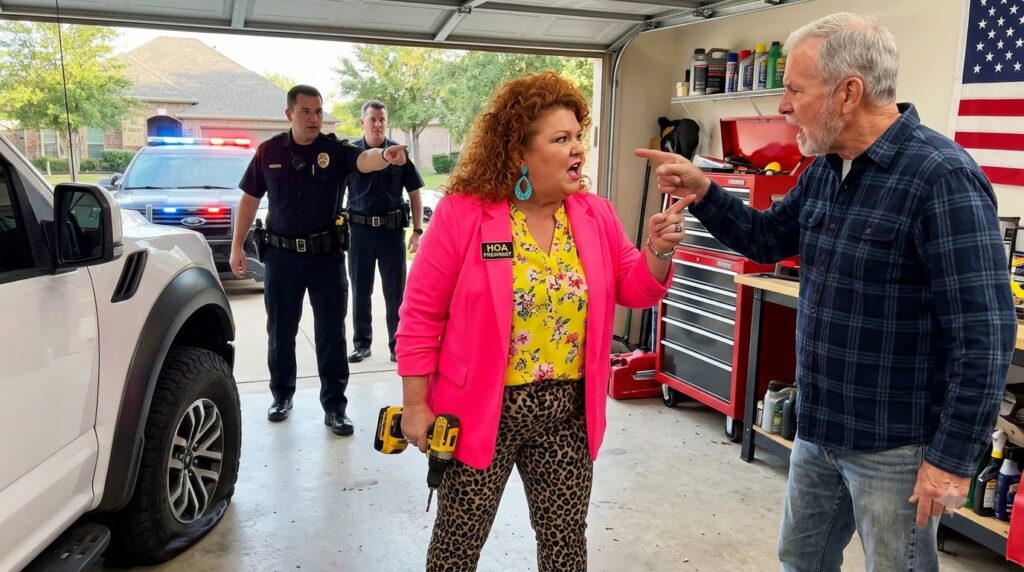
Sunlight illuminated the red tool cabinets and the American flag above the workbench.
Linda’s handwritten labels remained on the storage containers.
Everything was familiar again.
Robert had installed improved security measures following the incident, but he no longer checked the cameras constantly.
He no longer felt uneasy every time someone approached his driveway.
The garage had become his sanctuary once more.
Later that evening, Emily joined him on the front porch.
Across the street, Margaret sat on her husband’s bench.
Frank walked his dog along the sidewalk.
A young family waved as they passed.
Robert thought about how easily the neighborhood had surrendered its voice to someone who spoke louder than everyone else.
Karen had not gained her power overnight.
She had accumulated it gradually, through small acts of intimidation that people tolerated because resisting seemed inconvenient.
The damaged truck tire had finally made the consequences impossible to ignore.
But the real victory was not Karen’s removal, the restitution payment, or the cancellation of his fines.
It was watching his neighbors regain the confidence to protect their homes and speak for themselves.
Robert had worked his entire life to provide a safe place for his family.
He believed every homeowner deserved that same sense of security, regardless of age, income, or willingness to argue with a committee.
An association could maintain a neighborhood.
It could establish reasonable standards.
It could collect legitimate dues and protect shared property.
But it could never replace the dignity of the people who lived there.
As the evening sun disappeared behind the Texas rooftops, Robert finished his coffee and walked inside.
He lowered the garage door, turned off the lights, and headed toward the kitchen.
There were no threatening letters waiting for him.
No unauthorized fines.
No angry woman demanding control over his belongings.
Just a quiet house filled with memories, a repaired truck, and the peace he had spent decades earning.
Karen Whitmore had once stood inside his garage and declared that his property belonged to her.
She had been wrong.
His home belonged to him. His dignity belonged to him. And neither had ever been hers to take.
THE END