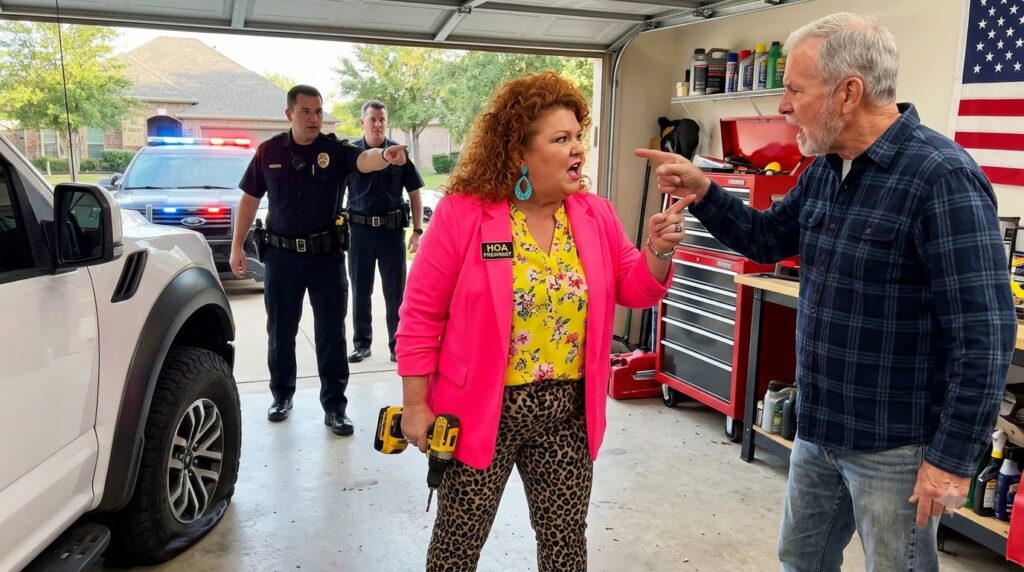
Chapter 4: Following the Money
Susan Bennett arrived at Robert’s house the following morning.
She spent nearly three hours reviewing the documents Dennis had provided.
Robert watched her separate invoices into different piles, compare dates, and examine the signatures authorizing payments.
The records suggested that Willow Creek Compliance Services had received money for property inspections, violation processing, administrative enforcement, and other neighborhood compliance activities.
Some invoices described work that appeared vague or repetitive.
Others listed charges for inspections that residents insisted had never occurred.
The company had received thousands of dollars over two years.
Its owner, Michael Whitmore, was Karen’s younger brother.
That relationship had not been clearly disclosed in the association’s annual financial reports.
Susan explained that hiring a relative’s company was not automatically unlawful in every circumstance. However, undisclosed conflicts of interest, questionable payments, and inadequate approval procedures deserved careful investigation.
The association’s money belonged to the community.
Board members were responsible for handling it appropriately.
Dennis admitted that Karen had presented the arrangement as a cost-saving measure.
She claimed outside compliance companies were too expensive and that her brother could provide more efficient services.
Dennis had accepted her explanation without conducting independent research.
He had also signed payment authorizations.
Robert asked why he had never questioned the increasing number of fines.
Dennis stared at the floor.
He explained that Karen controlled meetings, discouraged disagreement, and frequently threatened to replace anyone who opposed her.
He had convinced himself that remaining cooperative was easier than creating conflict.
Robert understood the explanation.
He did not consider it an excuse.
Dennis’s silence had helped Karen hurt people.
Susan advised Dennis to obtain independent legal advice because his own actions might require examination.
She also arranged for the financial records to be preserved.
Over the next several days, additional documents became available.
The association’s reserve account, which was intended to help cover major maintenance expenses, contained significantly less money than residents had been led to believe.
A planned drainage improvement had been postponed.
Repairs to the community pool had been delayed.
Several streetlights remained broken.
Yet administrative enforcement expenses had increased dramatically.
The financial consequences were becoming impossible to ignore.
Residents who had faithfully paid their annual dues discovered that the neighborhood might need additional assessments to address neglected maintenance.
Margaret was furious.
She had spent her career teaching children that responsibility meant taking care of what belonged to everyone.
Karen appeared to have transformed that responsibility into an opportunity to reward her own family.
Robert began receiving telephone calls from residents he had never met.
Many wanted to know whether their fines could be refunded.
Others wanted Karen removed.
Some wanted the entire association dissolved.
Robert understood their frustration, but he remained cautious.
He was not interested in replacing one angry faction with another.
The neighborhood still needed shared spaces maintained, bills paid, and reasonable rules enforced.
The problem was not necessarily the existence of an HOA.
The problem was leadership that had forgotten whom it served.
Susan reviewed the governing documents and identified the procedures available for calling a special membership meeting and seeking the removal of board members.
Residents began collecting the required signatures.
Karen responded by insisting that the petition was unauthorized.
She circulated a notice claiming that only the president could approve meetings involving association leadership.
Susan examined the relevant provisions.
They did not support Karen’s interpretation.
The petition continued.
Within a week, the homeowners had collected more than enough signatures to initiate the process.
Karen’s supporters began distancing themselves from her.
One board member resigned.
Another claimed she had never been informed about the payments to Michael Whitmore’s company.
Dennis agreed to cooperate with the financial review.
For Robert, however, the most disturbing discovery came from an old enforcement file.
It contained a document describing proposed collection measures for residents with outstanding fines.
Several suggestions involved restricting access to community amenities.
Others discussed towing vehicles from areas where the association might possess enforcement authority.
But one handwritten note referred to immobilizing vehicles on private property.
Robert recognized Karen’s distinctive handwriting from previous notices.
His address appeared beside the note.
Susan examined the document carefully.
It suggested that Karen had considered taking action against his truck before the afternoon she entered his garage.
The security recording supported that interpretation.
The damage was not the result of a spontaneous argument.
It appeared to be part of a deliberate attempt to intimidate him into paying.
Robert felt sick.
He wondered how far Karen might have gone if Margaret had not called the police.
Would she have returned?
Would she have targeted another resident?
Would someone eventually have been injured?
That evening, Robert stood inside his garage beside the repaired truck.
The damaged tire had been replaced, but the memory remained.
Emily joined him.
She reminded him that Linda had always admired his willingness to stand up for people who could not defend themselves.
Robert smiled sadly.
He had not intended to lead a neighborhood movement.
He had simply wanted to protect his home.
Yet the dispute had exposed something much larger.
And when the special meeting was finally scheduled, Karen announced that she would attend with an attorney.
She also made a promise to her remaining supporters.
Before the meeting ended, she intended to make Robert Mitchell regret ever challenging her.