Chapter 4: A Fine Meant to Frighten a Family
Karen returned to her usual activities sooner than her doctor recommended.
She appeared at the community clubhouse wearing a walking boot, leaning heavily on a cane, and complaining that her injury had disrupted her entire summer.
She expected sympathy.
Instead, residents began asking questions about drainage repairs.
Karen dismissed them.
She claimed that no maintenance company could guarantee every metal grate would remain secure forever.
She insisted that the accident had resulted from an unusual combination of circumstances.
When someone mentioned the invoice, her expression hardened.
She demanded to know who had obtained confidential association documents.
That question troubled several residents more than her explanation.
They were homeowners paying mandatory assessments. They had every reason to want accurate information about how their money was being spent.
Karen appeared to believe that asking for accountability was an act of disloyalty.
Meanwhile, the Carter family’s violation notice escalated.
A second letter warned that failure to pay could result in additional collection expenses.
Susan read it after returning home from a twelve-hour shift.
She sat at the kitchen table long after midnight, calculating expenses.
Her mortgage payment was due.
Emily needed replacement wheelchair tires.
Their air-conditioning system had begun making an unfamiliar noise during one of the hottest weeks of the year.
A $350 penalty was not financially devastating by itself, but it represented uncertainty.
Would another fine follow?
Would Karen begin inspecting their property for unrelated violations?
Could the association make their lives increasingly difficult?
Emily found her mother sitting in the dark kitchen.
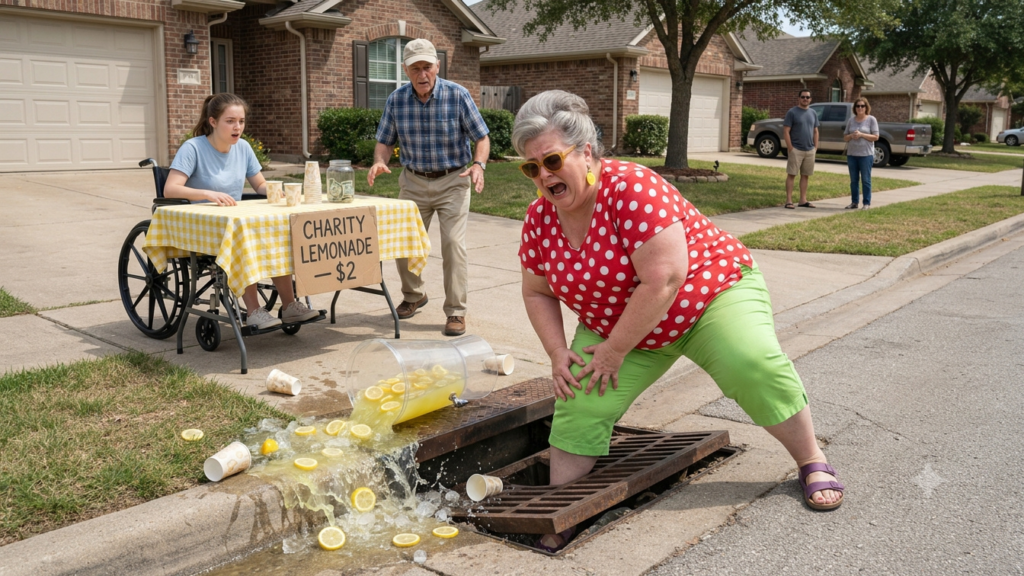
For the first time since the lemonade stand incident, she regretted organizing the fundraiser.
Not because she believed she had done anything wrong, but because she feared the consequences for someone she loved.
Susan took her daughter’s hand.
She reminded Emily that their house was their home, not a privilege granted by Karen Whitmore.
They would defend it together.
The following day, Walter arranged a consultation with a local attorney named Patricia Monroe.
Patricia was fifty-eight and had spent much of her career handling property disputes and homeowners association matters.
She reviewed the notices, the governing documents, and the association’s published rules.
She found no clear provision specifically prohibiting the temporary charity stand on the Carter driveway.
More importantly, the enforcement process appeared questionable.
There had been no advance warning before Karen confiscated the lemonade.
The fine had been issued without a meaningful opportunity for the family to contest the allegations beforehand.
Patricia explained that the precise legal remedies would depend on the governing documents and applicable Texas law, but the family had substantial grounds to challenge the association’s actions.
She prepared a formal response demanding that collection activity be suspended while the dispute was reviewed.
She also requested preservation of records concerning the drainage contract.
Karen received the letter on Friday morning.
By lunchtime, Walter had received his own violation notice.
His front porch contained an unauthorized decorative bench.
The bench had been there for seventeen years.
Margaret Ellis received another notice concerning her flowerpots.
Frank Dawson was warned about the color of his mailbox.
The pattern was difficult to ignore.
Instead of intimidating the residents, however, the notices began bringing them together.
Margaret organized a gathering at her house.
Twenty-three homeowners attended.
Some brought years of violation letters. Others brought photographs, receipts, and unanswered requests for information.
One elderly couple described paying hundreds of dollars in fines because they feared losing their home.
A retired mechanic explained that he had been ordered to remove a temporary accessibility ramp installed for his wife following surgery.
Another homeowner had abandoned plans to place a memorial bench beneath a tree because Karen threatened penalties.
Emily listened quietly.
She realized that her experience was not an isolated incident.
For years, people had been surrendering small pieces of their independence to avoid confrontation.
Each incident seemed minor when considered alone.
Together, they revealed something much larger.
The neighborhood was supposed to belong to its residents.
Instead, many had begun behaving like guests who could be punished for displeasing their host.
Walter proposed circulating a petition for a special association meeting, following the procedures outlined in the governing documents.
The purpose would be to review the disputed maintenance contract, discuss enforcement practices, and consider changes in leadership.
The residents agreed.
By Sunday evening, the petition had collected more signatures than required.
Karen learned about it when someone forwarded her a photograph of the signed pages.
She immediately called several homeowners, warning them that removing experienced leadership could damage property values.
Then she contacted her son.
Daniel Whitmore had been operating his maintenance business from a small commercial property outside town.
When Karen told him that residents were demanding access to his drainage invoices, he became unusually quiet.
He asked whether they had obtained the final inspection report.
Karen said she did not know.
Daniel told her they needed to meet.
For the first time since the accident, Karen appeared genuinely frightened.
Her injured leg was healing.
The consequences of the paperwork she had signed were only beginning.