Chapter 7: What an Apology Cannot Buy
Emily was uncertain whether she wanted to meet Karen.
She had spent weeks dealing with the consequences of the lemonade stand confrontation.
The fundraiser had become public.
Her mother had lost sleep.
Neighbors had been forced to revisit years of frustrating experiences.
An apology could not erase those things.
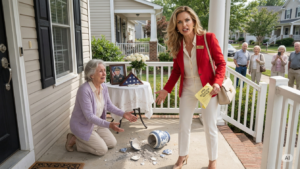
Still, Emily agreed to meet her on the Carter family’s front porch, with Susan nearby.
Karen arrived on a Thursday afternoon.
She wore a simple cream-colored blouse and dark trousers. Her elaborate hairstyle had been replaced by neatly combed silver-gray hair.
Without the colorful clothing, oversized glasses, and official binder, she looked remarkably ordinary.
She lowered herself carefully into a porch chair.
For several moments, she watched the street.
Then she began speaking.
Karen explained that she had initially joined the HOA board after her husband died.
Her children were grown, her house felt empty, and she wanted something meaningful to occupy her time.
At first, she enjoyed helping.
She organized neighborhood gatherings, welcomed new residents, and assisted with community improvement projects.
Over time, however, being needed had become something different.
She began expecting obedience.
Disagreement felt like disrespect.
Questions felt like attacks.
She gradually confused her position with her identity.
Emily listened without interrupting.
Karen admitted that she had known the drainage work was incomplete.
She had convinced herself that the remaining repairs could wait.
She had also convinced herself that helping Daniel justified overlooking normal procedures.
Neither explanation made her decisions acceptable.
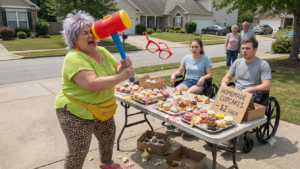
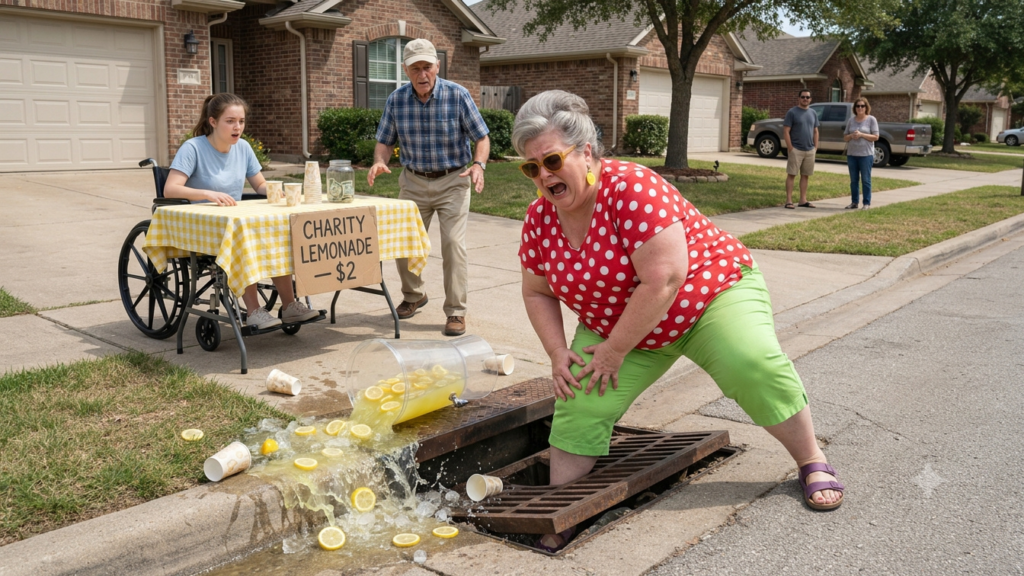
When she approached the lemonade stand that Saturday, she had been angry because Emily had not asked her permission.
Destroying the lemonade had been deliberate.
Karen finally looked at Emily.
“I was wrong. You didn’t deserve what I did.”
Emily appreciated hearing those words.
But she did not immediately offer forgiveness.
She explained that the worst part had not been losing the lemonade.
It had been watching her mother become frightened of what the HOA might do next.
Karen had used her position to make a family feel insecure in its own home.
That damage could not be repaired with a single conversation.
Karen nodded.
She had brought an envelope containing a check for the destroyed supplies and an additional donation to the fundraiser.
Emily accepted reimbursement for the lemonade and cups.
She directed the charitable contribution through the nonprofit’s official donation process, where it would be recorded like any other gift.
She did not want Karen’s donation treated as payment for forgiveness.
Karen understood.
Before leaving, she mentioned that Daniel had agreed to cooperate with the association’s efforts to resolve the unfinished contract.
His business was facing difficult months.
He would need to repay disputed amounts under whatever final agreement was reached.
Karen admitted that she had once believed protecting her son meant shielding him from consequences.
Now she was beginning to understand that she had encouraged decisions that endangered his future.
After Karen left, Emily remained on the porch.
Susan joined her.
Neither woman felt triumphant.
The conversation had been painful, but it had also provided something the formal meetings could not.
Karen had acknowledged that Emily was a person deserving respect, not an obstacle to her authority.
That mattered.
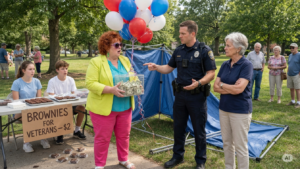
The following Saturday, the charity event opened beneath a bright Texas sky.
Frank’s accessible serving table stood at the center of the driveway.
Margaret’s pies sold out before noon.
Walter managed the donation records while Susan welcomed visitors.
Families arrived from neighboring communities.
Several people brought relatives who used wheelchairs, walkers, or mobility scooters.
A retired carpenter volunteered to help install ramps for qualified families.
A physical therapist distributed information about local accessibility resources.
Emily spent the morning moving between tables, answering questions, and thanking donors.
The event was larger than anything she had imagined.
Around midday, she noticed Karen standing across the street.
Karen remained there for several minutes, watching.
Then she crossed the road and approached the lemonade table.
The surrounding conversations grew quieter.
Karen placed ten dollars into the donation container.
She purchased a cup of lemonade.
There was no speech.
No demand for recognition.
No attempt to explain herself to the gathered neighbors.
She thanked the volunteer and stepped aside.
Walter watched her leave.
It was a small gesture, but perhaps that was precisely what made it meaningful.
For once, Karen had participated in a community activity without needing to control it.
By the end of the afternoon, the fundraiser had collected $12,860.
The nonprofit’s director announced that the money would help several local households obtain accessibility improvements and mobility equipment.
Emily looked at the total with disbelief.
The original fundraiser had been intended to purchase one portable ramp.
Now it would help multiple families.
Susan embraced her daughter.
Walter removed his glasses and quietly wiped his eyes.
Across the driveway, the storm drain had been temporarily secured behind protective barriers while permanent repairs were being arranged.
Emily looked toward it.
She remembered the lemonade disappearing through the grate.
She remembered Karen screaming for help.
Most of all, she remembered believing that her small project had been ruined.
She had been wrong about that.
Something much more important had survived.