Chapter 2: The Neighborhood That Had Learned to Stay Quiet
By Sunday morning, nearly everyone in Willow Creek Estates had heard about the lemonade stand.
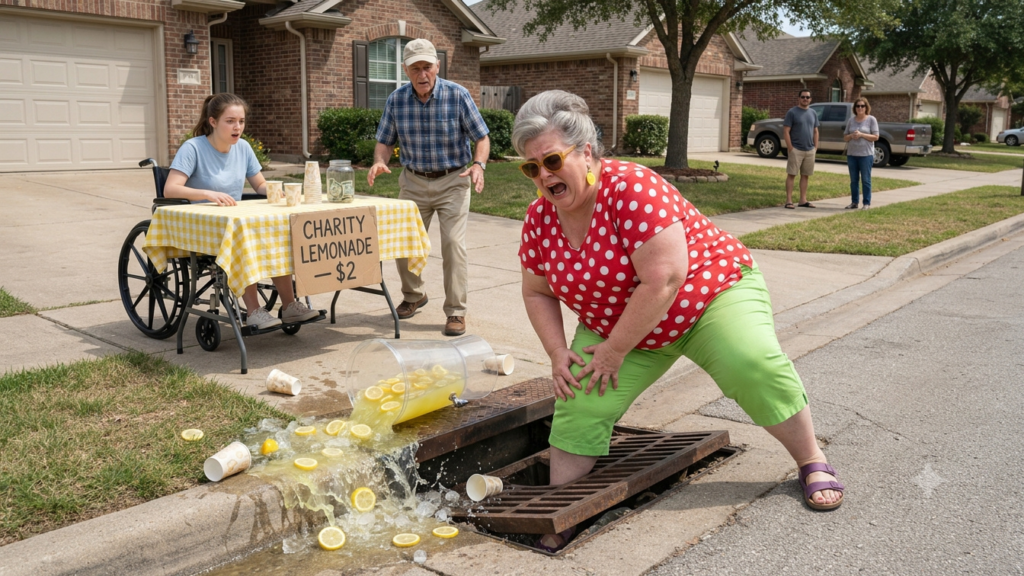
Several neighbors had recorded portions of the confrontation. One video captured Karen confiscating the dispenser. Another showed her pouring lemonade into the drain before the metal cover collapsed.
Emily’s mother, Susan Carter, watched the footage at their kitchen table with trembling hands.
She had been working at a local pharmacy when the incident occurred.
Seeing someone deliberately destroy her daughter’s fundraiser filled her with anger.
Seeing Emily calmly assist that same woman afterward filled her with something else.
Pride.
Susan knew how much work had gone into the lemonade stand.
Emily had spent three weeks organizing the fundraiser. She had contacted a regional nonprofit, prepared signs, purchased supplies, and arranged for Walter to help.
She had even calculated how many cups they needed to sell to purchase a portable wheelchair ramp for a local family.
The project represented more than charity.
It represented independence.
Following her accident at sixteen, Emily had endured months of rehabilitation and years of adjustments. People often treated her as someone who needed help rather than someone capable of providing it.
The fundraiser was her opportunity to demonstrate otherwise.
Karen had attempted to take that away.
Nevertheless, Emily refused to publish the footage herself. She did not want the fundraiser transformed into entertainment about an injured woman.
She wanted people to understand what had happened without forgetting why the lemonade stand existed.
That afternoon, Walter visited the Carter home carrying a folder.
Inside were copies of maintenance requests, HOA newsletters, and annual financial summaries.
He spread the documents across the kitchen table.
The first maintenance complaint concerning the storm drain was dated eleven months earlier.
The second was dated four months earlier.
Both had been submitted through the association’s official website.
Both had been marked resolved.
Walter had assumed someone had inspected the drain and determined that it was safe. He had been wrong.
More troubling was an entry in the previous year’s financial report.
The association had allocated $28,400 for drainage improvements and stormwater infrastructure maintenance.
A newsletter published shortly afterward celebrated the project’s completion.
Karen’s photograph appeared beside the announcement.
Walter remembered the newsletter clearly. Karen had described the repairs as evidence of her responsible leadership.
Yet the grate remained loose.
Susan asked whether the money might have been spent elsewhere in the neighborhood.
Walter admitted that it was possible.
The report provided no detailed breakdown.
That lack of information was precisely the problem.
Over the years, Karen had gradually discouraged residents from asking questions about HOA finances. Meetings became shorter. Financial summaries became less detailed. Requests for supporting documents were frequently delayed.
Residents who challenged her often received violation notices shortly afterward.
A retired nurse named Margaret Ellis had questioned a landscaping contract. Two weeks later, she was fined for having flowerpots that allegedly exceeded approved dimensions.
A widower named Frank Dawson had complained about rising assessments. Karen subsequently demanded that he repaint his mailbox.
Most residents eventually stopped arguing.
They had purchased homes in Willow Creek Estates expecting peaceful retirement years, not endless battles over grass height, porch decorations, and garbage containers.
Karen understood their reluctance.
She had built her authority around it.
On Monday morning, Emily received an official email from the HOA.
The subject line read:
Unauthorized Commercial Activity — Notice of Violation.
Susan could scarcely believe what she was reading.
The association claimed the lemonade stand constituted an unapproved business operation.
It demanded a $350 penalty and reimbursement for emergency expenses allegedly caused by the event.
The notice further suggested that Emily’s fundraiser had contributed to an unsafe condition near the storm drain.
There was no acknowledgment of Karen’s actions.
No mention of the destroyed lemonade.
No explanation for the defective grate.
The email had been authorized by Karen Whitmore, who had returned home from the hospital with a severe sprain and instructions to rest.
Walter read the notice twice.
Then he removed his glasses.
He had spent forty years teaching teenagers about civic responsibility, constitutional principles, and the importance of challenging unfair authority.
Now he was watching a nineteen-year-old neighbor receive punishment because an adult in power refused to accept responsibility.
Emily was frightened by the possibility that the fine could affect her mother’s home.
Susan was already managing medical expenses, insurance paperwork, and household bills.
The last thing Emily wanted was to create another financial burden.
She considered paying the fine using her savings.
Walter immediately discouraged her.
Not because he wanted a confrontation, but because paying an unsupported penalty would allow the association to avoid answering legitimate questions.
He offered to help Susan prepare a formal appeal.
Before leaving, he photographed the violation notice and contacted two former HOA board members.
One agreed to meet him.
The other responded with a message that Walter found deeply unsettling.
He advised Walter to examine the association’s drainage contracts before submitting any further complaints.
Then he added that the lemonade stand was probably not the real reason Karen was worried.