Chapter 1: The Money That Was Never Hers
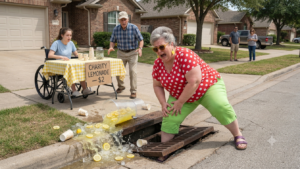
The transparent donation box scraped violently across the folding table before fifteen-year-old Emily Carter could reach for it.
Several individually wrapped brownies scattered across the pavement. A stack of paper napkins fluttered into the summer breeze, and the enormous cluster of red, white, and blue balloons jerked forward.
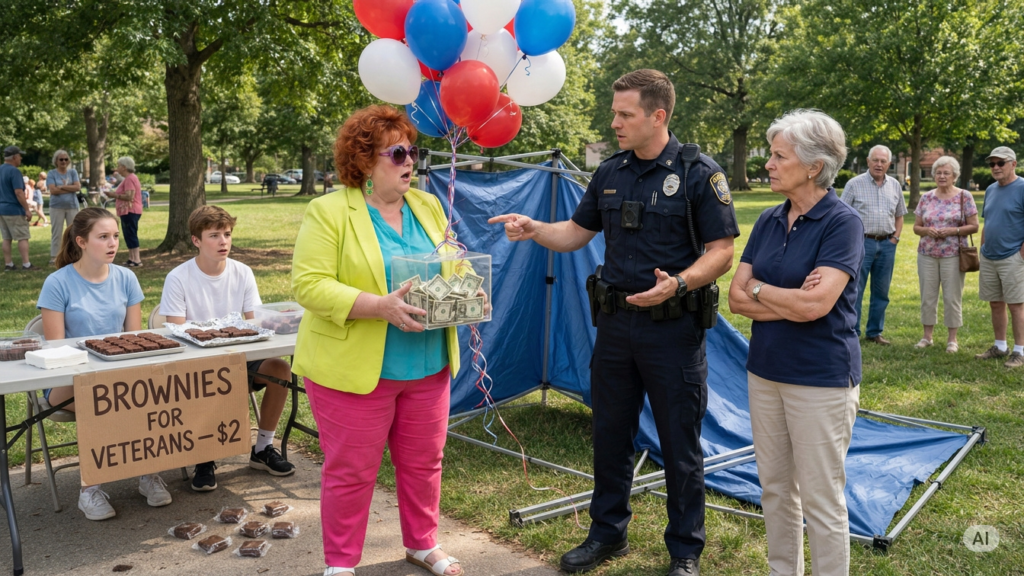
Karen Whitmore clutched the donation box against her stomach.
“I’m taking every dollar! Consider it your HOA fine!”
Her voice carried across the community park in suburban Virginia, attracting the attention of several elderly visitors standing near the refreshments.
Dressed in a neon-yellow blazer, turquoise blouse, hot-pink pants, and oversized purple sunglasses, Karen looked more like someone attending a costume party than the president of a homeowners association.
But there was nothing amusing about what she had just done.
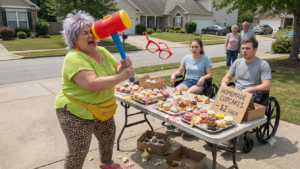
Inside the transparent box were dozens of American dollar bills, carefully collected throughout the morning by Emily and her fourteen-year-old brother, Noah.
The handmade sign behind them explained exactly what the money was for.
BROWNIES FOR VETERANS — $2.
The siblings had spent three evenings baking with their grandmother. They had purchased ingredients with their allowance, wrapped every brownie by hand, and arrived at the park before sunrise to help prepare for the fundraiser.
Every dollar was supposed to support local veterans experiencing financial hardship.
Karen apparently considered that irrelevant.
She had arrived less than a minute earlier, demanding to see a fundraising permit issued by the Maple Ridge Homeowners Association.
Emily had politely explained that the fundraiser was organized through a local veterans’ assistance group and had permission from the county.
Karen hadn’t bothered examining the paperwork.
Instead, she had seized the donation box.
Now she turned away from the table, holding the money tightly against her enormous belly as though she had just recovered something that rightfully belonged to her.
What Karen failed to notice was the long decorative ribbon trailing behind the balloon cluster.
Earlier that morning, a gust of wind had tangled the ribbon around the edge of a lightweight blue fabric partition beside the brownie stand.
As Karen marched forward, the ribbon stretched tight.
The partition trembled.
Then came a loud ripping sound, followed by the metallic clatter of lightweight supports falling onto the grass.
Karen stopped.
Standing directly behind the collapsed partition were two people she certainly hadn’t expected to encounter.
One was Margaret Ellis, the sixty-five-year-old organizer of the fundraiser.
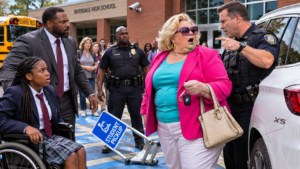
The other was Officer Daniel Brooks, a uniformed county police officer who had been discussing the event’s traffic arrangements with Margaret.
Neither looked pleased.
Karen’s balloons continued bouncing above her head.
For several seconds, the only sounds were the fluttering fabric and the distant chatter of families enjoying the fundraiser.
Officer Brooks stepped forward and extended his hand.
“Put it back. That money belongs to the veterans.”
Karen’s expression changed.
The confidence disappeared from her face. Her shoulders stiffened, and she looked toward the elderly witnesses gathering around the stand.
Instead of surrendering the box, she hugged it even tighter.
“But I’m the HOA president!”
Nobody responded.
Margaret stared at her with the particular disappointment that comes from witnessing an adult behave worse than the children standing nearby.
Officer Brooks repeated his instruction.
This time, Karen reluctantly placed the donation box on the table.
Emily immediately pulled it toward herself.
Noah began gathering the fallen brownies, his cheeks burning with embarrassment.
Karen adjusted her sunglasses and attempted to explain that she had merely been enforcing community regulations. She insisted that unauthorized commercial activities damaged property values and created legal liabilities for homeowners.
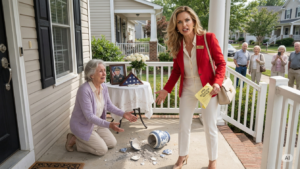
Margaret retrieved the county-issued event permit from a folder beneath the table.
Officer Brooks examined it.
Everything was in order.
More importantly, the community park belonged to the county. It was not HOA property.
Karen had no authority there.
Officer Brooks requested her identification and began documenting the incident. Margaret provided her account, and several witnesses volunteered their names.
Karen’s voice gradually became quieter.
For the first time that morning, she appeared to understand that announcing her position as HOA president would not make the problem disappear.
When the officer finished gathering the initial information, he explained that the incident would be documented and referred for further review.
Karen left the park without the donation money.
She did not apologize.
Emily watched her disappear toward the parking lot before turning to her grandmother, who had hurried over from another booth.
The teenager tried to smile, but her eyes filled with tears.
She wasn’t frightened anymore.
She was humiliated.
She had wanted to do something meaningful for people like her grandfather, who had served in the United States Army and spent his final years helping other veterans.
Instead, a grown woman had treated her charity work like a criminal enterprise.
Margaret placed a reassuring hand on Emily’s shoulder.
Then she noticed something unusual.
An elderly man standing beside the brownie table had been watching Karen’s departure with a deeply troubled expression.
His name was Walter Bennett, a seventy-eight-year-old retired Army mechanic.
He reached into his shirt pocket and removed a folded piece of paper.
It was an HOA violation notice.
At the bottom was Karen Whitmore’s signature.
Walter looked at Margaret.
He had something he needed to tell her.
And it concerned considerably more money than the contents of a children’s donation box.