Chapter 3: The Neighborhood That Had Learned to Stay Quiet
By Monday morning, a video of the brownie stand incident was circulating among Maple Ridge residents.
One of the elderly visitors had recorded the confrontation on her smartphone.
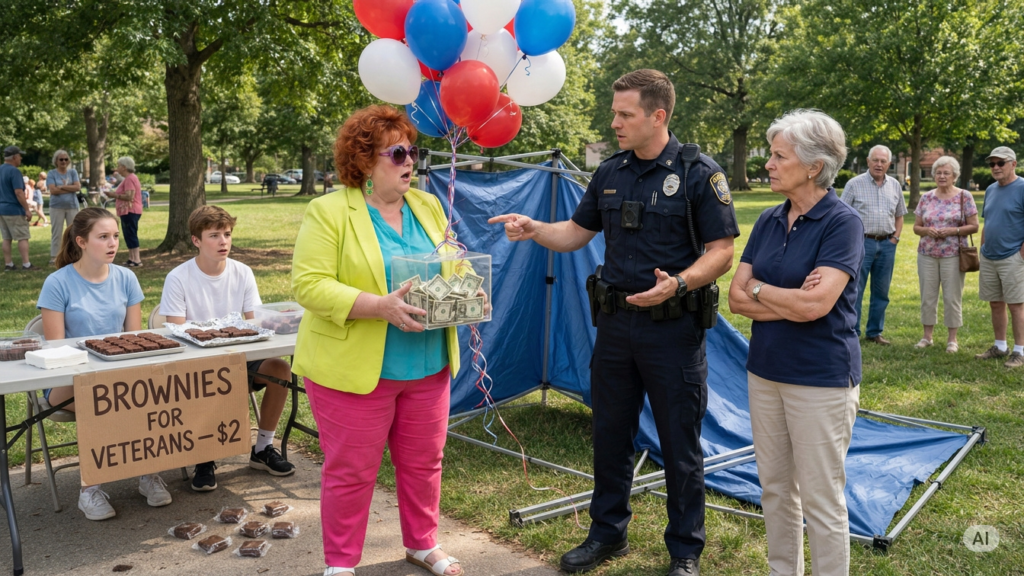
The footage showed Karen grabbing the donation box, knocking brownies onto the pavement, and accidentally pulling down the blue partition.
It also captured the moment she found herself standing directly in front of Officer Brooks.
Many viewers laughed at the bouncing balloons.
But others recognized something more disturbing.
They had seen Karen behave that way before.
Over the next several days, Margaret began receiving telephone calls from neighbors she barely knew.
Some spoke cautiously, asking her not to mention their names.
Others sounded relieved to finally discuss what had happened to them.
One caller was seventy-one-year-old Patricia Monroe, a widow who had received a $400 penalty for keeping a portable storage container in her driveway while moving her late husband’s belongings.
Another was Charles Dawson, a retired postal worker who had been charged $300 because his grandson’s pickup truck remained outside overnight.
A third resident, Susan Miller, had received repeated notices concerning a vegetable garden that had existed long before Karen became HOA president.
Each notice instructed residents to pay Ridgeview Community Compliance Services.
Some homeowners had paid immediately.
Others had disputed the penalties, only to receive additional charges.
Margaret began organizing copies of the documents in separate folders.
She recorded dates, amounts, payment methods, and whether residents had been offered hearings.
Patterns emerged.
Several notices contained nearly identical language despite involving entirely different alleged violations.
Some referenced sections of the governing documents that appeared unrelated to the supposed offense.
Others threatened collection action without clearly explaining how residents could appeal.
The most troubling cases involved elderly homeowners living on fixed incomes.
Karen seemed to understand that people who had spent their lives paying bills responsibly were especially frightened by official-looking demands.
Many would rather sacrifice groceries or postpone repairs than risk being accused of failing to meet their obligations.
Meanwhile, Karen was attempting to repair her public image.
She distributed a neighborhood email claiming that the fundraiser confrontation had been deliberately misrepresented.
According to her version, she had been investigating unauthorized commercial activity when an organizer created an unnecessary disturbance.
She described the donation box as evidence of improper fundraising.
She made no mention of the county permit.
She also failed to acknowledge that two teenagers had been operating the stand.
The email ended with a warning against spreading defamatory statements about elected HOA officials.
That warning frightened several residents into silence.
But it had the opposite effect on Robert Hayes.
As treasurer, Robert had a professional responsibility to understand where association money was going.
He requested copies of Ridgeview’s contract, board approvals, invoices, and supporting financial records.
Karen responded that enforcement documents were confidential and that his request exceeded the responsibilities of the treasurer.
Robert knew better.
He had spent thirty-eight years working in accounting.
He understood the difference between protecting private homeowner information and withholding financial records from the people responsible for overseeing an organization.
He sent a second written request.
This time, he copied the other board members.
Two days later, Karen called an emergency executive meeting.
Robert attended, expecting to discuss the missing records.
Instead, Karen accused him of undermining board unity.
She suggested that his continued inquiries were damaging the association’s relationship with its contractors.
One board member remained silent throughout the meeting.
Another, a retired insurance agent named Linda Foster, finally asked whether Ridgeview was owned by Karen’s husband.
Karen acknowledged the connection but insisted that the arrangement saved the neighborhood money.
Linda requested the contract.
Karen said she would provide it later.
No contract appeared.
While the adults struggled over records, Emily was dealing with consequences of her own.
She had become reluctant to participate in another fundraiser.
Although most people praised her for helping veterans, she disliked being recognized as the girl whose donation box had been stolen.
Her grandmother, Ruth Carter, understood.
Ruth had been married to an Army veteran for forty-two years. She knew that service often meant doing difficult things without receiving recognition.
She reminded Emily that the fundraiser had succeeded because of her efforts, not because of Karen’s behavior.
Then Ruth showed her a photograph of Walter’s accessibility ramp.
She explained how financial assistance from the veterans’ organization might help him recover from his unexpected expenses.
Emily studied the photograph.
For the first time since the incident, she understood that Karen’s behavior had affected people far beyond the brownie stand.
She asked whether Walter would be able to keep his ramp.
Ruth admitted that nobody knew yet.
That uncertainty stayed with Emily.
The following weekend, she and Noah visited Walter with a small container of homemade brownies.
He welcomed them onto his porch and told them stories about repairing military vehicles, meeting Helen, and purchasing the house after retirement.
Before they left, Walter thanked them for their fundraiser.
He did not tell them that Karen had sent him another violation notice that very morning.
This one demanded removal of the accessibility ramp within thirty days.