Chapter 2: The Veteran With the Folded Notice
Walter Bennett had lived in Maple Ridge for twenty-three years.
He had purchased his modest brick ranch house after retiring from a civilian maintenance job, using savings accumulated through decades of careful spending.
His wife, Helen, had planted rosebushes along the front walkway. Together, they had built a comfortable life among neighbors who exchanged Christmas cards, borrowed gardening tools, and checked on one another during winter storms.
After Helen passed away, Walter remained in the house.
It was where he felt closest to her.
Unfortunately, maintaining the property had become more difficult as he grew older.
A deteriorating hip made climbing stairs painful. His doctor had recommended installing a short accessibility ramp beside his front porch.
Walter hired a licensed contractor and submitted the necessary architectural request to the homeowners association.
He waited six weeks without receiving a decision.
When his mobility worsened, he proceeded with the installation after confirming that the contractor had obtained the applicable county approvals.
Three days later, Karen delivered a violation notice.
The fine was $750.
According to the notice, the ramp violated Maple Ridge’s architectural standards and had been installed without board authorization.
Walter had attempted to explain his circumstances.
Karen responded that exceptions created precedents and that the neighborhood could not maintain its appearance if residents were allowed to disregard regulations.
Additional penalties followed.
By the time Walter attended the veterans’ fundraiser, the amount Karen claimed he owed had grown to $1,350.
Margaret examined the notice.
She recognized the HOA’s letterhead, but something about the payment instructions immediately caught her attention.
The document directed Walter to submit payment through a company called Ridgeview Community Compliance Services.
Margaret had served on Maple Ridge’s board several years earlier.
She had never heard of that company.
She asked Walter whether he had paid anything.
He admitted that he had already sent $750 because he feared the association might place a lien against his home.
The remaining amount was still outstanding.
Margaret felt a familiar anger rising inside her.
She had organized the veterans’ assistance fundraiser precisely because too many older Americans faced financial emergencies they were embarrassed to discuss.
Some needed help purchasing groceries. Others struggled with transportation to medical appointments or unexpected home repairs.
Walter had quietly requested assistance with his utility bills the previous month.
Now she understood why.
Money intended for electricity, groceries, and medication had been diverted toward an HOA penalty that might never have been properly authorized.
Margaret asked permission to photograph the notice.
Walter agreed.
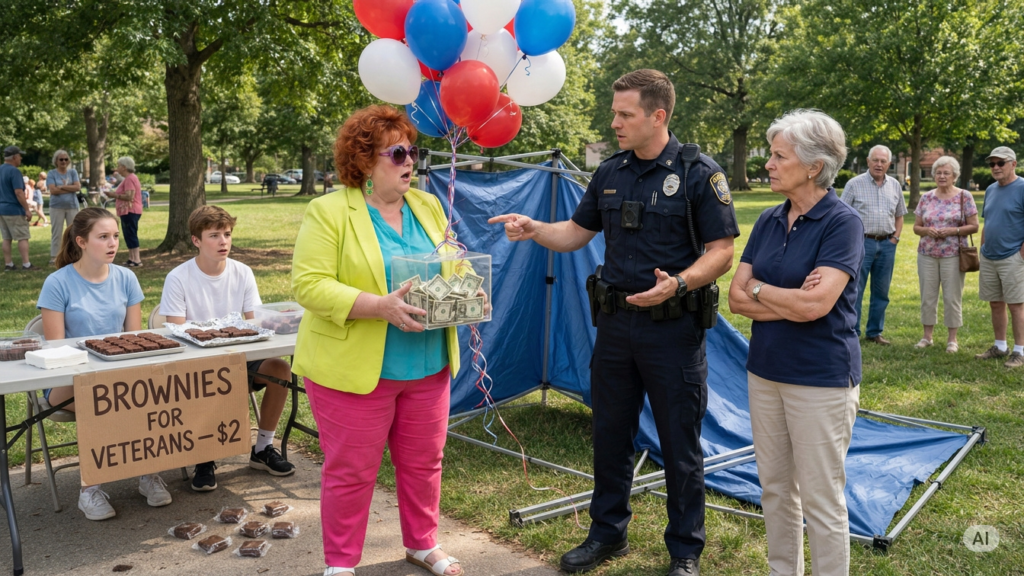
Meanwhile, the brownie stand was recovering.
Visitors who had witnessed Karen’s behavior began purchasing brownies in larger quantities. Several people donated without taking anything.
A retired schoolteacher placed a twenty-dollar bill inside the box.
Another visitor contributed fifty.
Emily and Noah gradually returned to their work.
By the end of the afternoon, the fundraiser had collected substantially more than expected.
The brownie stand alone raised $1,286.
Yet Margaret couldn’t stop thinking about Walter’s notice.
That evening, she sat at her kitchen table with her reading glasses, a cup of tea, and a binder containing old HOA documents.
She reviewed the association’s governing rules.
There were procedures for issuing violations, providing residents with notice, and allowing homeowners an opportunity to contest certain penalties.
Walter’s account suggested that several of those procedures might not have been followed.
Margaret also searched Virginia’s public business records.
Ridgeview Community Compliance Services was registered.
The company had been established fourteen months earlier.
Its registered agent was a man named Brian Whitmore.
Karen’s husband.
Margaret leaned back in her chair.
The discovery did not automatically prove wrongdoing. Homeowners associations could legitimately contract with outside companies, including businesses connected to board members, provided appropriate disclosures and approvals were made.
But Margaret knew that conflicts of interest deserved scrutiny.
She called Walter and asked him to preserve every notice, receipt, email, and envelope he had received.
Then she contacted Robert Hayes, a retired accountant who lived three streets away and currently served as the HOA’s treasurer.
Robert sounded uncomfortable when Margaret mentioned Ridgeview.
He explained that Karen handled most enforcement matters herself. He had repeatedly requested supporting documentation for compliance expenses, but the records provided to him were incomplete.
Margaret asked whether the board had approved the company’s contract.
Robert hesitated.
He could not remember voting on one.
The following morning, Margaret visited Walter’s house.
His accessibility ramp was sturdy, professionally constructed, and painted to match the porch.
There was nothing unsightly about it.
More importantly, it allowed an elderly veteran to enter and leave his own home without risking a fall.
Walter stood beside the ramp, apologizing for involving her in his problems.
Margaret told him he had nothing to apologize for.
Before leaving, she asked whether he knew anyone else who had received notices from Ridgeview.
Walter pointed toward the house across the street.
Then toward another property farther down the block.
And finally toward a small blue house near the neighborhood entrance.
Margaret realized that Karen’s confrontation at the brownie stand might not have been an isolated display of arrogance.
It might have been the first public glimpse of something that had been happening behind closed doors for months.