Chapter 5: The Emails Karen Never Expected Anyone to Read
Linda Foster had joined the Maple Ridge HOA board because she believed neighborhoods functioned best when residents volunteered their time.
She had never sought influence.
She simply wanted the community pool maintained, the landscaping contracts reviewed, and the annual budget prepared responsibly.
When Karen became president, Linda initially appreciated her energy.
Karen attended every meeting, responded quickly to complaints, and promised to enforce rules consistently.
But over time, Linda noticed a change.
Karen began treating ordinary questions as personal challenges.
She discouraged discussion of certain expenses and increasingly communicated with contractors without involving the full board.
Linda had kept copies of her correspondence because decades in the insurance industry had taught her the importance of documentation.
Now those emails were becoming valuable.
One exchange concerned Ridgeview Community Compliance Services.
Karen had announced that she intended to hire a new compliance contractor.
Linda had responded by requesting proposals from competing companies and disclosure of any personal relationships.
Karen never answered those questions.
Another email showed Robert asking whether the contractor would collect fines directly from homeowners.
Karen responded that direct collection would simplify enforcement.
There was no accompanying explanation of how the money would be accounted for.
A third exchange concerned Walter Bennett.
Linda had forwarded his accessibility request to Karen and recommended prompt review because of his medical circumstances.
Karen’s reply dismissed the matter as an architectural issue.
She instructed Linda not to communicate further with Walter until enforcement was completed.
Linda regretted complying.
She had assumed Karen possessed information she did not.
Now she realized that trusting someone in authority did not relieve her of responsibility.
She provided the emails to Robert and Elizabeth.
The attorney recommended preserving the original electronic records and avoiding public accusations before the facts could be independently examined.
Margaret agreed.
She wanted accountability, not a neighborhood consumed by rumors.
The special membership meeting was eventually scheduled for a Thursday evening at the community clubhouse.
Notice was distributed according to the applicable procedures.
Karen immediately began campaigning against her removal.
She visited homeowners who had previously supported her, warning that a leadership change could lead to higher assessments and declining property values.
She suggested that residents demanding an audit wanted to dismantle the association entirely.
But Margaret’s group had no intention of eliminating reasonable community standards.
They wanted transparent finances, fair enforcement, and leadership that understood the limits of its authority.
Three days before the meeting, Karen’s husband contacted Robert.
Brian Whitmore sounded exhausted.
He explained that Ridgeview had originally been established to provide administrative services to small residential associations.
Karen had encouraged him to accept Maple Ridge as a client.
He acknowledged that the arrangement had been handled informally.
Robert requested a complete accounting of the money received from Maple Ridge homeowners and the association itself.
Brian promised to cooperate.
The records he supplied the following afternoon were incomplete but significant.
They showed that some homeowner payments had been deposited into Ridgeview’s business account.
Several were subsequently categorized as administrative revenue.
Whether those classifications were authorized remained unclear.
Robert identified Walter’s $750 payment among the transactions.
There was no corresponding record showing that the association had received it.
Margaret felt sick when Robert told her.
Walter had sacrificed essential household expenses because he believed he was paying a legitimate HOA obligation.
The money had instead gone into a business owned by the HOA president’s husband, under an arrangement that lacked adequate documentation.
An independent examination was clearly necessary.
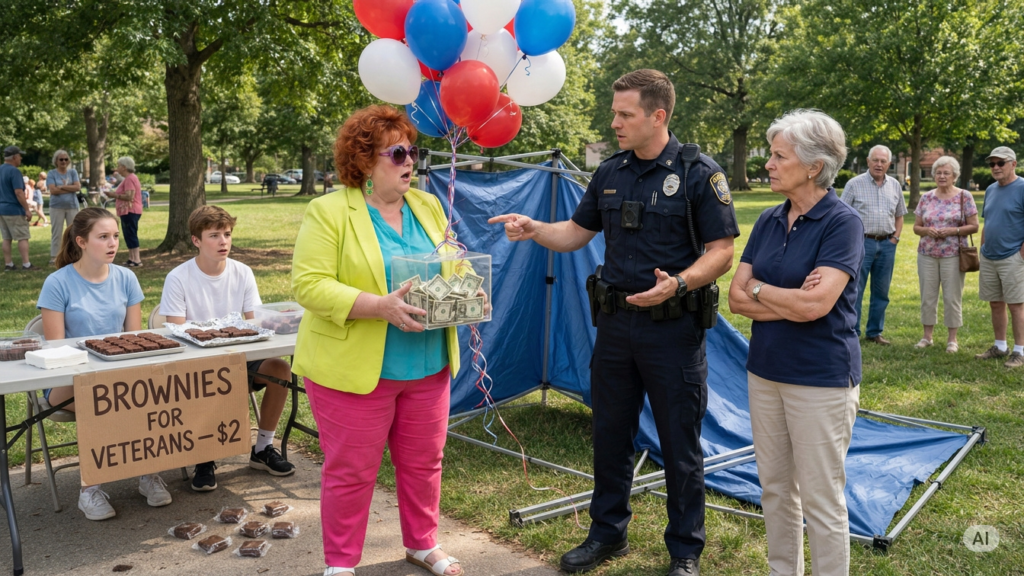
Meanwhile, Officer Brooks contacted Margaret regarding the fundraiser incident.
The matter had been reviewed, and Karen would face a misdemeanor charge related to her unauthorized taking of the donation box.
The precise outcome would be determined through the legal process.
Margaret provided the requested witness information.
Emily and Noah’s grandmother was informed as well.
Ruth was relieved that the incident was being taken seriously, but she did not celebrate.
She understood that criminal proceedings could be difficult for everyone involved.
Her primary concern was ensuring that the teenagers were treated respectfully.
That evening, Emily helped her grandmother prepare dinner.
She asked why someone who already owned a comfortable home and expensive belongings would want to take money intended for struggling veterans.
Ruth considered the question.
She explained that sometimes people became so accustomed to being obeyed that they stopped distinguishing between what they controlled and what actually belonged to them.
Authority could become a habit.
So could entitlement.
But neither made wrongdoing acceptable.
Emily thought about Karen standing beneath the balloons, insisting she was the HOA president.
For the first time, the memory seemed less embarrassing than revealing.
Karen had told everyone exactly how she viewed her position.
She believed it placed her above ordinary rules.
The upcoming membership meeting would determine whether her neighbors agreed.