Chapter 6: The Night the Homeowners Took Back Their Voice
The Maple Ridge clubhouse had never been so crowded.
Residents arrived carrying folders, reading glasses, notebooks, and copies of the association’s governing documents.
Extra chairs were brought from a storage room.
Walter Bennett arrived with his cane, accompanied by Margaret.
Emily and Noah came with their grandmother, who was a homeowner entitled to participate.
Karen sat at the front of the room wearing a bright red blazer.
Her husband was absent.
An independent meeting facilitator had been arranged to help ensure that the proceedings followed the association’s rules.
Karen appeared irritated by his presence.
She had become accustomed to controlling meetings, deciding who could speak and when discussions would end.
Tonight, those decisions would not belong exclusively to her.
Robert presented his financial summary first.
He carefully distinguished verified transactions from unresolved questions.
He explained the payments to Ridgeview, the missing documentation, and the homeowner fines that could not be reconciled with the association’s accounts.
He recommended suspending the contractor’s services and commissioning an independent audit.
Karen objected.
She insisted that Ridgeview had performed valuable work and that minor bookkeeping irregularities did not justify public criticism.
Robert did not argue.
He simply displayed the records.
Next, Linda explained the board’s failure to properly review certain contracts and enforcement decisions.
She acknowledged her own mistakes.
That admission mattered.
The residents were accustomed to hearing officials defend themselves.
They were less accustomed to hearing someone accept responsibility.
Then homeowners were invited to speak.
Patricia described paying a penalty while grieving her husband’s death.
Charles explained how repeated notices had damaged his relationship with his grandson.
Susan presented photographs demonstrating that her vegetable garden had existed for years.
Finally, Walter stood.
The room became quiet.
He spoke slowly, describing his military service, his retirement, and the home he had shared with Helen.
He explained that the accessibility ramp allowed him to remain independent.
He had paid the initial fine because he feared losing everything he had worked for.
He did not ask for sympathy.
He asked to be treated fairly.
Several residents lowered their eyes.
They had seen Walter’s ramp.
Some had walked past his house every morning.
Few had realized what he was experiencing.
Karen attempted to interrupt, insisting that personal circumstances did not eliminate architectural obligations.
The facilitator reminded her that Walter was entitled to finish speaking.
Walter returned to his seat.
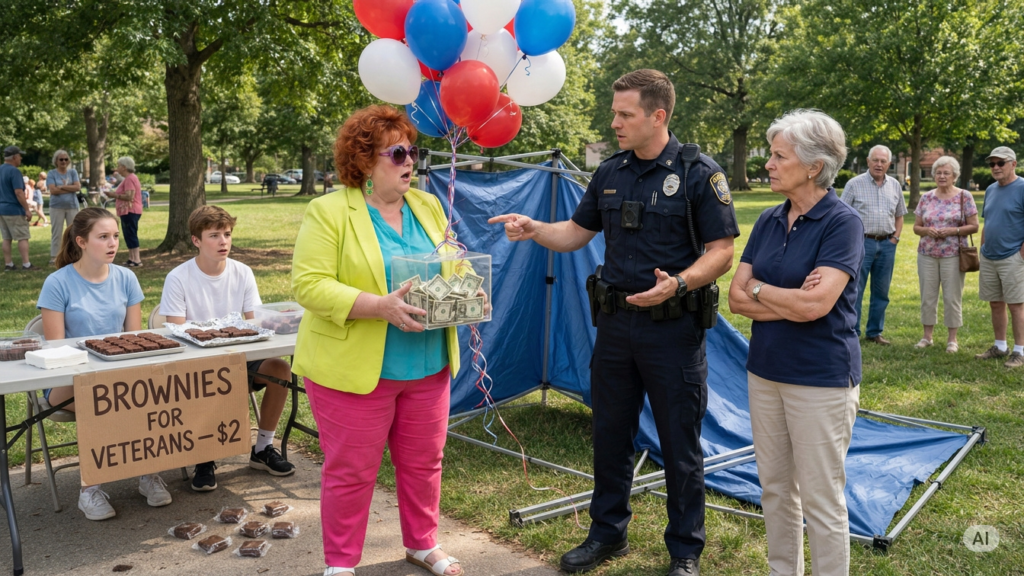
Margaret then addressed the fundraiser incident.
She explained that the county had authorized the event and that the donation box belonged to a charitable effort supporting local veterans.
The association had possessed no authority to confiscate it.
Karen maintained that she had acted in the neighborhood’s interests.
Margaret did not debate her.
Instead, she described the teenagers’ preparation, their expenses, and their determination to help people they had never met.
She explained that the fundraiser was supposed to teach young people the value of community service.
Karen’s behavior had nearly taught them that kindness made them vulnerable.
The room remained silent.
The facilitator eventually moved to the scheduled vote.
Eligible homeowners received ballots, and designated volunteers supervised the collection and counting process.
Karen sat rigidly at the front table.
For nearly twenty minutes, she watched residents speak quietly among themselves.
When the results were announced, the required threshold for her removal had been exceeded by a substantial margin.
Karen was no longer a director.
Under the association’s governing structure, she could no longer serve as its president.
She stared at the facilitator.
Then she gathered her handbag and documents.
Without addressing the homeowners, she walked out.
Nobody applauded.
The silence was more meaningful.
This was not a celebration of someone’s humiliation.
It was a community reclaiming responsibility for its own affairs.
The remaining directors arranged for temporary leadership and began the process of filling the vacant board position.
They also voted to suspend Ridgeview’s contract pending legal and financial review.
Disputed enforcement actions associated with the contractor would be examined individually.
Walter’s ramp would remain in place while his accommodation request received proper consideration.
For the first time in months, he felt comfortable returning home.
Outside the clubhouse, Emily watched neighbors shake hands with her grandmother.
She had expected the meeting to resemble Karen’s confrontation at the park.
Instead, she had witnessed something entirely different.
People had challenged wrongdoing without shouting, threatening, or taking anything that did not belong to them.
They had used evidence, patience, and their right to participate.
It was the kind of lesson no classroom could have taught quite as effectively.