Chapter 8: The Brownies That Brought a Neighborhood Together
The autumn fundraiser took place on a clear Saturday morning.
The trees surrounding the Virginia community park had begun turning gold and crimson.
Volunteers arranged folding chairs, decorated booths, and carried boxes of supplies across the grass.
Margaret arrived before sunrise.
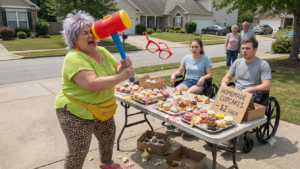
When Emily and Noah appeared with their grandmother, they brought six large trays of homemade brownies.
Their new sign was larger than the original.
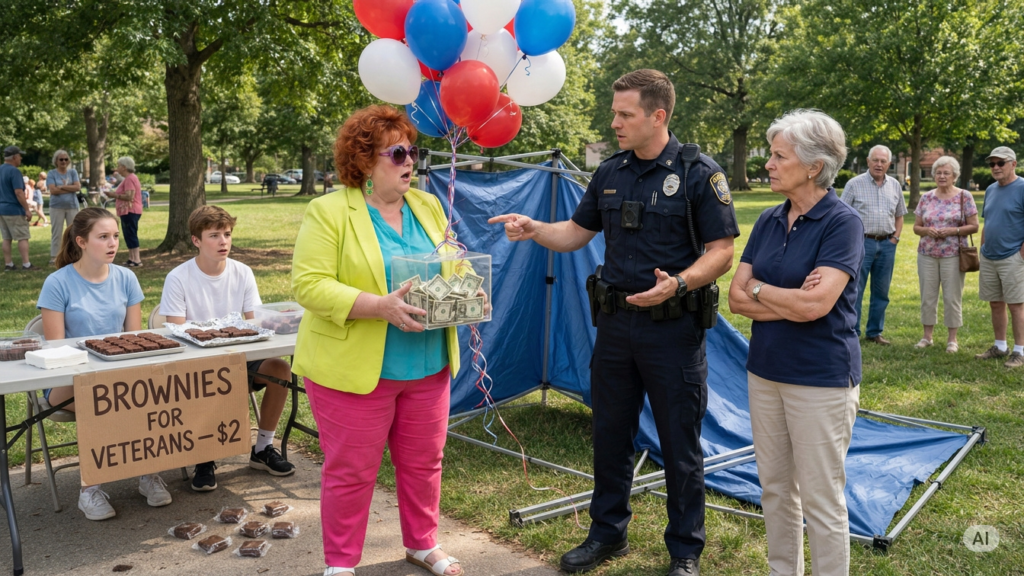
BROWNIES FOR VETERANS — EVERY DOLLAR HELPS SOMEONE STAY HOME.
Beside the sign stood a transparent donation box.
Above it floated a familiar cluster of red, white, and blue balloons.
This time, Noah carefully secured the decorative ribbons so they could not become tangled around anything nearby.
Emily laughed when she noticed.
Some memories, she had discovered, eventually became easier to carry.
Walter arrived shortly after the fundraiser opened.
He wore his old Army veteran cap and carried a small wooden display stand he had built in his garage.
Attached to it was a photograph of his accessibility ramp.
Below the photograph was a handwritten message thanking the community for helping him remain in his home.
He placed the display beside the brownies.
Throughout the morning, visitors stopped to read it.
Some shared stories about parents who had struggled with mobility.
Others spoke about spouses who had served in the military.
A woman whose husband had recently passed away donated a hundred dollars.
A retired carpenter volunteered to help construct accessibility improvements for veterans who needed them.
A local hardware store offered discounted materials.
What had begun as a simple fundraiser was becoming a network of practical support.
Officer Brooks stopped by during his patrol.
Emily recognized him immediately.
He purchased two brownies and placed additional money inside the donation box.
Noah thanked him for helping them during the summer.
The officer smiled and told the siblings they were doing good work.
Then he continued along the park pathway.
There was no dramatic confrontation.
No falling partition.
No angry woman claiming ownership over someone else’s money.
Just neighbors helping neighbors.
By midday, the brownie stand had nearly sold out.
Margaret announced that the fundraiser had already exceeded its original financial goal.
The new HOA leadership had contributed through an appropriately approved community sponsorship, with the expenditure clearly documented and disclosed.
Several local businesses had made donations.
Residents who had once been afraid to question their association were now volunteering together.
Near the end of the afternoon, Karen appeared at the park.
She wore ordinary jeans and a pale blue blouse.
For a moment, Emily felt the familiar tension return.
But Karen did not approach aggressively.
She waited until the customers ahead of her had finished.
Then she purchased two brownies.
She placed a fifty-dollar bill inside the donation box.
Emily thanked her politely.
Karen looked toward Walter’s photograph.
She remained there for several seconds before quietly walking away.
Margaret witnessed the exchange from a nearby table.
She did not interpret it as proof that every problem had been solved or that Karen had completely changed.
Trust required more than one apology or donation.
But she appreciated that Karen had finally approached the fundraiser as an ordinary member of the community rather than someone entitled to control it.
That was a beginning.
Later, Walter invited Emily, Noah, and Ruth to visit his house.
He wanted to show them something.
When they arrived, he was waiting beside his accessibility ramp.
The rosebushes had been trimmed.
His porch had been freshly painted.
A small American flag stood near the front steps.
Walter had also installed a new wooden bench overlooking the garden.
He explained that he intended to spend more afternoons outside, greeting neighbors and enjoying the sunshine.
Ruth sat beside him.
Emily and Noah placed their remaining brownies on a small porch table.
For the next hour, they listened to Walter tell stories about Helen, his military years, and the neighborhood as it had existed decades earlier.
There was laughter.
There were moments of sadness.
There was also a quiet appreciation for something that could easily be taken for granted.
The freedom to sit outside one’s own home without fear.
The ability to grow older with dignity.
The comfort of knowing that neighbors would stand beside you when someone attempted to misuse authority.
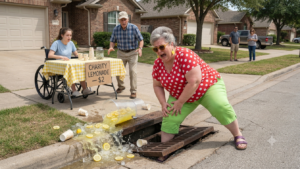
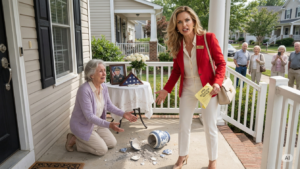
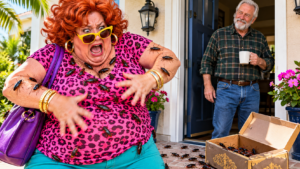
Months earlier, Karen had seized a donation box because she believed her title entitled her to other people’s money.
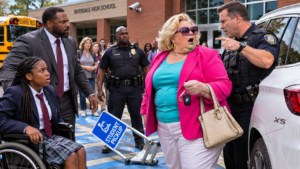
She had frightened two teenagers, embarrassed herself in front of a police officer, and inadvertently exposed a pattern of questionable enforcement that had harmed vulnerable homeowners.
The consequences had cost her position, money, and the trust of her neighbors.
But her actions had also produced something she never intended.
People who had remained silent began speaking.
Homeowners who had felt powerless discovered the strength of acting together.
Two teenagers learned that kindness was worth protecting, even when someone tried to exploit it.
And an elderly veteran recovered something more valuable than the money he had lost.
Peace of mind.
As the afternoon sunlight settled across Walter’s porch, Emily looked at the little American flag beside the ramp.
She thought about her grandfather and the values he had taught her.
Respect was not something a person could demand simply because they held a title.
Authority was not permission to take advantage of others.
And a community was not defined by how strictly its most powerful resident could enforce the rules.
It was defined by how faithfully its people protected those who needed their help.
Emily reached for another brownie and smiled.
This time, nobody could take that lesson away from her.