Chapter 5: The Son Who Could No Longer Protect His Mother
Daniel Whitmore was thirty-eight years old and had spent most of his adult life trying to establish a successful business.
He was not wealthy.
His company employed four workers, owned two aging pickup trucks, and survived through a combination of landscaping contracts, minor repairs, and property maintenance assignments.
When his mother helped him obtain the HOA drainage contract, he believed it would provide financial stability.
The agreement was larger than most projects his company had previously handled.
Unfortunately, he had underestimated the work.
Several drainage structures required more extensive repairs than he anticipated. Replacement components were expensive, and specialized equipment would have consumed much of the contract’s value.
Daniel completed some cleaning, cleared debris from several drainage channels, and performed limited repairs.
But he did not replace all the damaged covers.
He informed Karen that additional money would be necessary to finish the project properly.
She refused to request another allocation from the board.
An increase would attract attention, she told him.
Residents would complain about expenses.
Instead, she instructed him to submit the final invoice and promised that the remaining work could be addressed later.
Daniel knew the invoice overstated what his company had completed.
He submitted it anyway.
The association paid him.
Months passed.
Other contracts demanded his attention, and the unfinished drainage work remained unfinished.
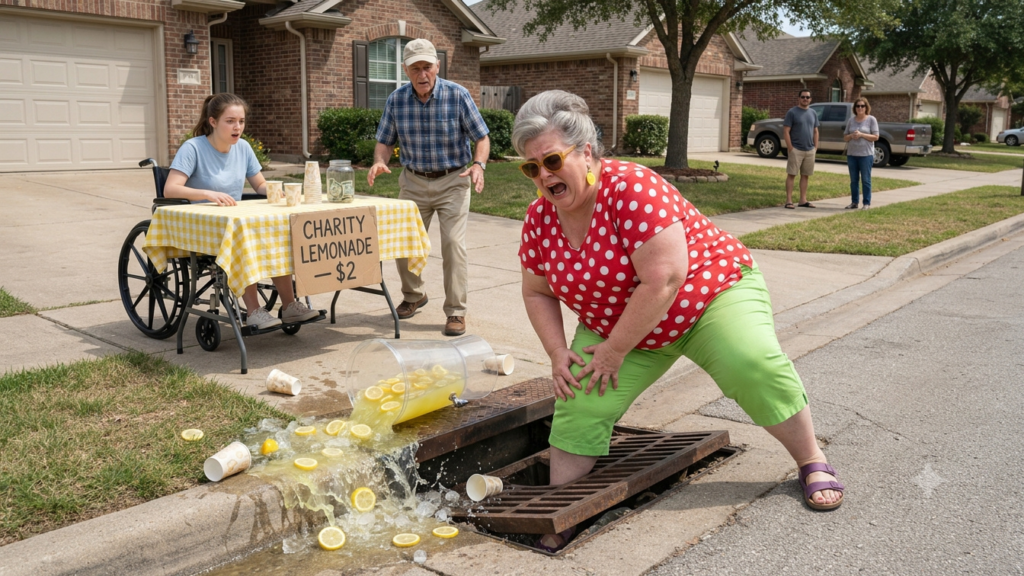
Then his mother fell into the very storm drain his company had supposedly repaired.
Daniel understood the seriousness of the situation immediately.
He also understood that allowing his mother to blame Emily would make matters worse.
At Karen’s house, he urged her to withdraw the fine and cooperate with the residents’ records request.
Karen refused.
She insisted that admitting any problem would destroy her reputation.
Daniel pointed out that the invoice already existed.
The maintenance complaints existed.
The videos existed.
Her reputation was no longer something she could preserve by demanding silence.
Their conversation ended badly.
Karen accused him of being ungrateful after everything she had done for his business.
Daniel left without finishing his coffee.
Two days later, he contacted Patricia Monroe.
He did not offer to confess to a crime or speculate about legal consequences. He simply said he possessed information relevant to the drainage dispute and wanted to provide accurate records.
Patricia advised him to obtain independent legal advice before making formal statements.
After doing so, Daniel supplied copies of correspondence, work logs, photographs, and subcontractor estimates through his attorney.
The documents confirmed that the drainage project had not been completed as represented.
They also revealed that Karen had been informed of the unfinished work.
The revelation spread quickly once the association’s board received the material.
Several board members were stunned.
They had relied on Karen’s assurances that the contract had been fulfilled.
One member, Linda Foster, admitted that she had voted to approve the final payment without independently verifying the work.
She was ashamed.
Linda had joined the board to help maintain the neighborhood’s appearance. She had never intended to participate in questionable financial decisions.
But she had gradually allowed Karen to handle matters without sufficient oversight.
She now understood that avoiding conflict was not the same as fulfilling her responsibilities.
Linda contacted the other board members.
An emergency board meeting was scheduled.
Karen arrived wearing a purple blouse, black slacks, and her orthopedic walking boot.
She expected to control the discussion as usual.
Instead, Linda presented the maintenance records.
Another board member introduced the county inspector’s findings.
The association’s manager confirmed that the Carter family’s fine had been disputed and recommended suspending further enforcement while the matter was investigated.
Karen attempted to redirect the conversation toward the lemonade stand.
Nobody followed her.
For nearly two hours, the board reviewed documents and discussed its obligations.
By the end of the meeting, it had voted to commission an independent financial and maintenance review.
It also temporarily removed Karen’s authority to issue individual enforcement directives.
The Carter family’s fine was suspended.
The board agreed to proceed with the homeowners’ requested special meeting.
Karen left the clubhouse without speaking to anyone.
For Emily, the development brought relief.
But it also raised an uncomfortable question.
She had never wanted Karen to lose her position or Daniel to face financial consequences.
She had wanted to sell lemonade.
Walter reminded her that accountability did not become cruelty simply because the consequences were uncomfortable.
The residents were not responsible for the decisions Karen and Daniel had made.
They were responsible for ensuring those decisions could not continue harming others.
That weekend, Emily agreed to organize the larger charity event proposed by the nonprofit.
She selected a date in late summer and began recruiting volunteers.
The event would include lemonade, baked goods, donated crafts, and information about accessibility resources.
Walter offered to help.
Susan arranged her work schedule.
Margaret volunteered to bake pies.
Frank promised to build a sturdy, wheelchair-accessible serving table.
For the first time in weeks, Emily felt excited rather than anxious.
Then, three days before the special HOA meeting, Karen’s attorney delivered a letter to the association.
Karen intended to seek compensation for her injury.
She claimed the association had failed to maintain the storm drain.
The very maintenance failure she had helped conceal had become the foundation of her own demand.