
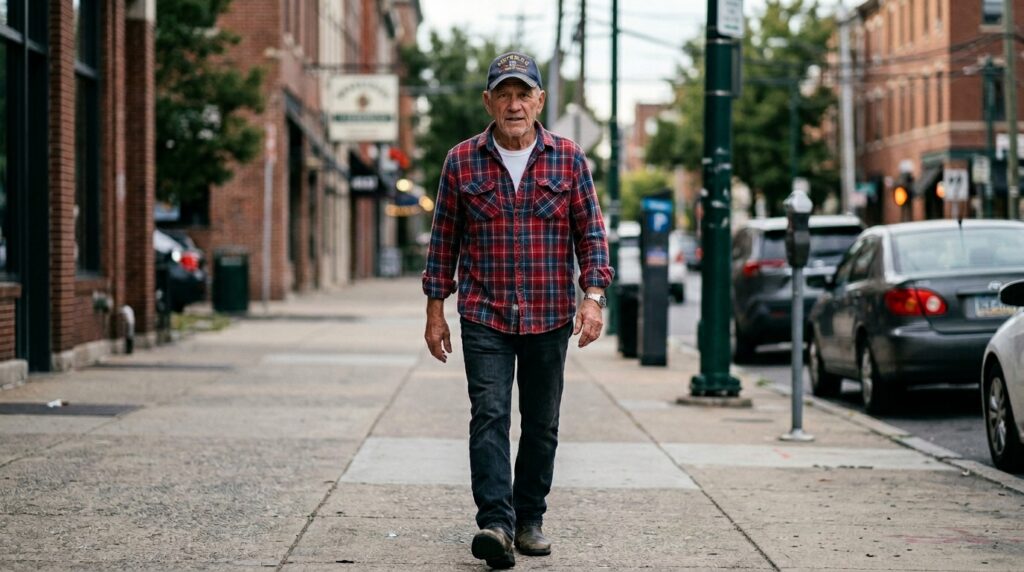
CHAPTER 8: THE VOID MATRIX
The gray dawn didn’t bring warmth; it broke over the city like a cracked pane of industrial glass, throwing sharp, desaturated light across the muddy tire tracks of the Apex flatbeds. The city marshal’s black utility cruiser pulled up to the curb with a low, hydraulic hiss. Its roof lights didn’t flash—they sat cold, reflecting the gray sky. A single man stepped out from the back seat: regional auditor Vance, his suit replaced by a dark, tactical windbreaker, flanked by a city attorney holding a leather-bound legal case.
Arthur didn’t shift his stance. He stood exactly where the asphalt met the perimeter gravel, his boots anchored into the ground. His plaid shirt was stiff with dried sweat and the dust of the shattered window, but his posture was a steel framework that refused to settle. Behind him, fifty old men stood in a silent column, their faces lined with the geometry of old wars, their eyes fixed on the man with the leather case.
“The time is five AM, Arthur,” Vance said, his voice flat, devoid of the previous night’s desperation. He didn’t look at Marcus’s phone camera anymore; he looked at the city attorney, who stepped forward and opened the brass latches of the leather file. “The temporary injunction you filed with your copied notes was rejected at the municipal level two hours ago. The administrative discretionary clause overrides local historic claims when a sector is declared an infrastructure vacancy. The bulldozers have clearance.”
The city attorney pulled out a heavy parchment sheet, its bottom edge stamped with three thick, purple corporate seals from the Apex Development Group and the municipal housing authority. “By order of the state development board, this property is condemned. Any individual remaining within twenty feet of the iron line after the count of sixty will be processed for criminal obstruction.”
Arthur looked at the seals. He didn’t look at the text; his eyes analyzed the purple ink, identifying the specific crest of the 1974 neighborhood charter buried beneath the modern corporate stamps. The decoy secret—the idea that this was just a contractor land grab—dissolved entirely into the final, systemic truth. The city hadn’t forgotten these men; the city had systematically traded their existence for an expanded commercial transit tax base, using Vance to erase the physical records so the legal matrix could close without a single red line appearing on a public ledger.
“You have the paper,” Arthur said, his voice a low, gravelly grinding sound that seemed to come from the pavement itself. He reached into his pocket and pulled out his brass Zippo, his thumb rolling over the split hinge, feeling the precise point where the metal had almost failed but held. “But you don’t have the ledger.”
“The ledger was scrubbed from the main server last night, old man,” Vance sneered, stepping closer under the protection of the marshal’s presence. “There is no record of Miller’s pension. There is no record of these deeds. The system recognizes this block as empty ground.”
Arthur didn’t argue. He reached down to his waist, his hand catching the heavy, iron crowbar he had carried from the pool hall. He didn’t raise it to strike; he drove the flat edge deep into the concrete seam at the base of the gatepost, using the weight of his body to lever a single, loose flagstone upward. The stone cracked with a sharp, dry snap, releasing a cloud of gray alkaline dust that smelled of ancient cement and dry earth.
Beneath the stone lay a flat, corroded zinc cylinder—the original 1974 municipal foundation capsule, placed there when the complex was built for the returning veterans of the 9th Infantry.
Arthur reached down, his large, scarred fingers twisting the oxidized cap of the cylinder until the metal threads sheared off with a screech of high friction. He pulled out a thick roll of heavy, blue-backed linen sheets—the original, un-digitized corporate charter of the neighborhood, signed by the governor and witnessed by the names of every man standing behind him on the gravel.
“The city didn’t buy this ground from a development company, Vance,” Arthur said, holding the blue linen up to the gray dawn light. The text was crisp, untouched by the modern digital scrubbers. “The state deeded it directly to the veterans’ union as a sovereign trust in perpetuity. It can’t be dissolved by an administrative discretionary clause. It can’t be reallocated by a municipal board. It takes a full act of the legislature to touch these bricks, and you don’t have that signature on your clipboard.”
The city attorney’s hand froze mid-air, his eyes locking onto the faded gold seal at the center of the linen sheet. The legal architecture he had spent three weeks building fell apart in a single micro-second, exposed as a shallow, unauthorized fraud that violated the baseline foundation of the city’s own charter. He looked at Vance, his professional composure shattering into a twitchy, bureaucratic panic.
“Is this valid?” the attorney whispered, his voice cracking against the morning air.
Vance didn’t answer. His face went gray, his eyes staring at the blue linen as if it were a ghost rising from the red clay of the Delta. The absolute authority of his suit, his tablets, and his corporate connections evaporated under the weight of an old piece of cloth preserved beneath a cracked stone by a man who refused to look away.
Arthur took a step forward, his boots crushing a piece of broken glass into the dust. He didn’t shout. He didn’t call for an arrest. He simply held the line, his upright frame casting a long, shadow that extended all the way to the door of the marshal’s cruiser.
“The warrior is still standing,” Arthur said to the silence of the street, his words a final accounting that froze the foreman, the workers, and the trucks where they stood. “Now pack your chains. We’re done moving.”
The foreman didn’t wait for Vance’s order. He signaled his men, the heavy steel links clattering back onto the flatbeds as the yellow trucks began to back out of the alley, their exhaust plumes dissolving into the gray sky. The line had held. The neighborhood’s living history remained anchored into the concrete, unwritten by the matrix, protected by the unyielding discipline of a true survivor.








