
CHAPTER 5: THE SOVEREIGN ACCOUNTING
The iron bar didn’t strike the plywood center; it found the seam where the steel bolt met the rotting frame. Arthur swung with the weight of a man who spent forty years matching his bones against industrial presses. Splinters of dry pine bit into his neck as the frame groaned, a high, screaming protest of metal tearing through fibrous wood. On the third impact, the bolt sheared through its casing, the door giving way with a concussive bang that echoed across the smoky expanse of the pool hall pool room.
Arthur stepped through the dust cloud, his breath a disciplined whistle through his teeth. Marcus stumbled behind him, clutching the stolen silver signet ring like a talisman.
The main floor of the hall had gone dead. The regulars had abandoned their tables, gathered in a loose semicircle near the front windows. Outside on the concrete sidewalk, the glare of the afternoon sun hit the plate glass, silhouetting Vance. The coordinator was standing near his idling sedan, his thumb working the black tablet with a furious, jagged rhythm. The digital siphon was active; the green light on his vehicle’s dashboard transceiver was pulsing a rapid, steady amber.
Arthur didn’t run. A warrior doesn’t give up his posture to a ticking clock. He maintained his long, calculated strides, his boots striking the linoleum with an unhurried, terrifying weight. Every step was a commitment. His left knee flared with an oily, sharp agony, but he suppressed it, sliding his fingers over the cracked hinge of the Zippo in his coat pocket. The metal was hot now, warmed by the friction of his palm.
He pushed through the front door, the city’s heat hitting him like an abrasive sheet of sandpaper.
“Vance,” Arthur said. The name wasn’t shouted. It was thrown like a handful of gravel against a zinc roof.
The coordinator froze, his thumb hovering three inches above the tablet’s glass screen. His sharp face twisted as he looked at the splinters clinging to Arthur’s plaid overshirt, his eyes wide with the sudden realization that the local muscle hadn’t even delayed the old man. The two hired drivers were nowhere to be seen—likely slipping out through the kitchen alley.
“It’s done, Arthur,” Vance said, his voice rising an octave as he backed toward the open door of his car. The gold eagle key on his belt chain rattled against the door frame. “The authorization codes are submitted. The regional database is locking the ledger alterations. In exactly sixty seconds, the discretionary redistribution becomes permanent. You can’t stop the code.”
Arthur kept advancing. He didn’t look at the tablet. He looked at Vance’s throat. “Code is just ink on a screen. But the names on those papers are men. You think because our hands shake and our boots move slow, we don’t know how to defend our perimeter?”
“You don’t understand the scale here!” Vance yelled, his back hitting the car’s roof pillar. “This isn’t just your block! The municipal development board approved the reallocation weeks ago. The community center is being cleared for a transit hub. The old timers are being relocated to state facilities anyway. I’m just taking the administrative residue before the city dissolves the charter! If it isn’t me, it’s the contractors!”
The core truth lay bare under the white-hot glare of the afternoon sky. It wasn’t a petty thief or a lone bureaucrat; it was a structural eviction of an entire generation’s memory, authorized by signatures in air-conditioned offices three miles away. Vance was just the blade. The system itself was the handle.
Arthur stopped five feet from the sedan. He reached into his breast pocket and pulled out the folded ledger sheet containing Miller’s name. The paper was worn, the edges flaking into gray dust between his calloused fingers.
“Then we change the ledger,” Arthur said quietly.
He didn’t use violence. He reached out and gripped the top edge of the tablet with his left hand. Vance pulled back, but Arthur’s grip was an anchor forged in the ironworks of another era. With his right hand, Arthur didn’t strike Vance; he reached down and yanked the gold eagle key chain from the coordinator’s belt loop. The small metal clip snapped with a clean, sharp ping.
“Marcus,” Arthur called out without breaking eye contact with Vance.
The youth stepped out from the shade of the pool hall awning, his face pale but his jaw set. He was holding his phone out, the screen recording every word, every line of the ledger sheet Arthur held against Vance’s chest, and the active transfer screen on the coordinator’s tablet.
“The local news desk has a tip line,” Arthur said, his voice dropping into that heavy, gravelly register that left no room for negotiation. “And the federal district attorney’s office still keeps an ombudsman down on 8th Street. Tell them the supervisor of the 4th Street Center just gave a full confession on the sidewalk.”
Vance’s face went the color of wet lime. He looked at the phone in Marcus’s hand, then at the ledger sheet, then at the small crowd of neighborhood commuters and street vendors who had closed a circle around his car. These weren’t indifferent bystanders anymore. They were the children and grandchildren of the men Vance had written off as “residue.” Their faces were hard, their arms crossed, their silence an indictment.
The transfer light on the dashboard transceiver flickered, then died as Vance’s hand shook, his fingers slipping off the validation sequence. The screen read: SESSION TIMEOUT – RE-AUTHENTICATION REQUIRED.
Arthur released his grip on the tablet. He took the silver signet ring from Marcus’s open palm and dropped it onto the hood of Vance’s car with a heavy, metallic clink.
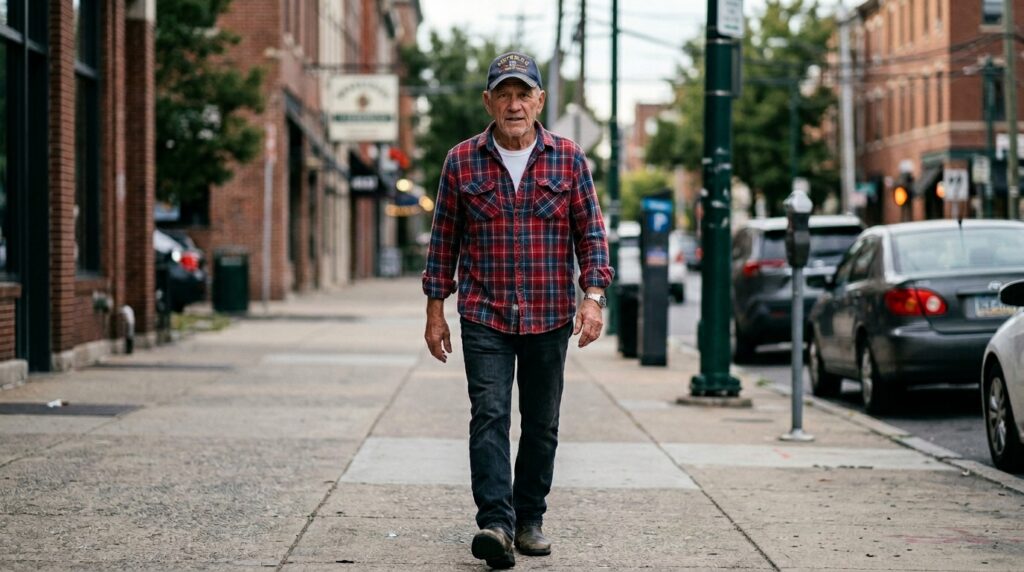
“Keep the ring on the metal where everyone can see it,” Arthur said, adjusting his navy veteran cap, pulling the brim down until the gold lettering caught the direct rays of the sun. “Let them know the warrior is still standing. Every single one of us.”
He turned his back on the coordinator, not waiting for the police sirens that were already beginning to wail three blocks to the east. He started his walk back down the center depth of the asphalt, his gait slow, his posture perfectly upright, his boots marking the rhythm of a long, unbroken march through the heart of his own city.








