
CHAPTER 4: THE ARCHITECTURE OF BETRAYAL
The storage room door didn’t just open; it was kicked. The thin plywood shuddered against the cinderblock wall, sending a shower of dry-rot dust over the rusted utility racks. Vance stood in the frame, his tailored suit a sharp, jarring contrast to the grease-stained atmosphere of the pool hall backroom. Behind him loomed two men—muscle for hire, wearing the faces of people who were paid to ignore the weight of their own actions.
Vance’s gaze swept the room, landing on the broken lock of the ledger box, then finally settling on Arthur. His professional smile was gone, replaced by a cold, bureaucratic disdain. He didn’t look like a man afraid of being caught; he looked like a man annoyed by a clerical error.
“You’ve got a real talent for trespassing, old man,” Vance said, his voice smooth and devoid of the gravel that defined Arthur’s world. He stepped into the room, the gold eagle key on his belt chain jingling with a hollow, metallic sound. “I suppose that’s what happens when we let people like you linger too long. You start thinking you still own the pavement.”
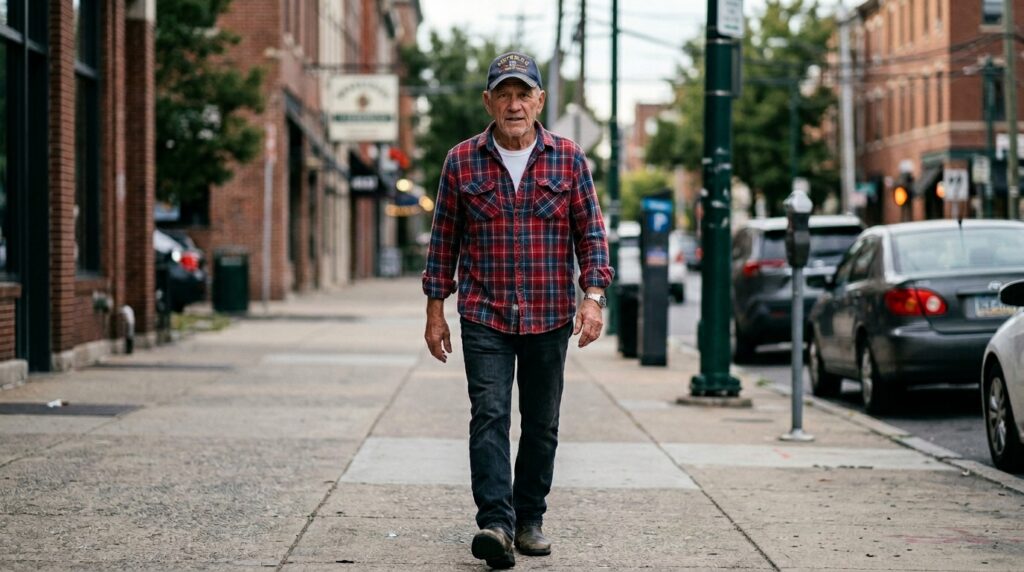
Arthur didn’t flinch. He stood his ground in the center of the cramped space, his feet planted wide, his posture as unyielding as a support beam. Marcus was a huddled shadow in the corner, but Arthur was a monolith. He felt the folded ledger sheet in his breast pocket—the paper evidence of a betrayal that spanned decades.
“I don’t own the pavement,” Arthur said, the rasp in his voice sounding like iron dragging over concrete. “But I know the men who paid for it. Men like Miller. Men whose names you’ve been crossing out with red ink while you collect the interest.”
Vance chuckled, a dry, joyless sound. He signaled to the two men behind him. They stepped into the room, the space suddenly feeling claustrophobic. The air grew thick with the smell of stale tobacco and the impending friction of violence.
“Miller was a ghost,” Vance spat. “Most of them are. They sit in those rent-controlled rooms, waiting for checks they don’t even remember how to spend. I’m just optimizing the local economy, Arthur. Putting stagnant capital back into circulation. The neighborhood is changing. It needs development, not a museum of broken soldiers.”
“You aren’t optimizing anything,” Arthur countered. He reached into his pocket, his fingers closing around the brass Zippo. The metal was cold, but the internal heat of his resolve was rising. “You’re a scavenger. You wait for the pulse to get weak enough, then you start picking. But I’m still breathing, Vance. And I still remember how to hold a line.”
The largest of the two hired men moved first. He didn’t use a weapon; he used his weight, lunging forward with a heavy, swinging hook intended to put the old man down quickly. Arthur didn’t meet the force head-on. He used the economy of motion he’d learned in the dense brush of the Long Hai hills—a slight pivot, a sharp drop of his shoulder, and a thrust of his palm into the man’s solar plexus.
It wasn’t a movie punch. It was a tactical strike, focusing on environmental disruption and momentum. The man gasped, his air leaving him in a ragged burst, and stumbled back into the utility rack. The iron shelf groaned, a stack of soda crates sliding off and shattering on the linoleum in a chaotic spray of glass and sugar.
The second man hesitated, surprised by the speed of the “old timer.” Vance’s face contorted with a sudden, sharp rage.
“End this,” Vance commanded, backing toward the door. “Now.”
Arthur felt the sting of a knuckles-to-cheek impact as the second man landed a desperate jab. The world blurred for a micro-second, the phantom pains in his knees flaring like white-hot needles, but he refused to buckle. He leaned into the friction, his heavy wool overshirt absorbing the brunt of the follow-up strike. He grabbed the man’s lapel, using his own weight to pull the aggressor into the edge of the corroded zinc table.
The sound of the impact—flesh against metal—was dull and final. The man slumped to the floor, grasping at his ribs.
But the victory was a false flag. As Arthur turned back to Vance, he saw the man in the suit holding a small, black device—a modern tablet. Vance’s thumb hovered over the screen.
“You think a few ledger sheets mean anything in the digital age?” Vance sneered, his voice trembling with a mixture of fear and triumph. “I’ve already initiated the final transfer. By the time you get to the authorities, those funds will be buried in three different offshore shells. And as for your friend Miller’s family? I’ve already filed the paperwork for a ‘voluntary’ forfeiture of their remaining claims due to lack of proof. You’re fighting for a past that’s already been deleted.”
Arthur felt a sudden, devastating weight in his chest. It wasn’t the physical exhaustion; it was the realization that the decoy secret—the physical boxes and paper logs—was just the shell. The core truth was deeper, a digital siphon he couldn’t stop with a crowbar or a well-placed strike.
Vance stepped out of the room, slamming the plywood door shut. Arthur heard the metallic slide of a heavy bolt being thrown from the outside.
“Enjoy the dust, Arthur,” Vance’s muffled voice came through the wood. “It’s all you have left.”
The room fell into a heavy, suffocating silence, broken only by the sound of Marcus’s ragged breathing and the hum of the dying light fixture. Arthur stood among the wreckage of glass and paper, his veteran cap slightly askew for the first time in years. He pulled the Zippo from his pocket and looked at the hairline fracture. He had lost the tactical engagement. The decoy was shattered, and the deeper reality of the theft was accelerating toward a total, irreversible conclusion.
He looked at Marcus. The boy was staring at the silver ring on his finger, his face a mask of sudden, profound shame.
“The warrior is still standing,” Arthur whispered to the empty, rusted room, his voice more a promise than a statement. “But the battlefield just got a whole lot bigger.”
He reached for the iron crowbar again. He didn’t have much time, and he had a neighborhood to wake up.








