
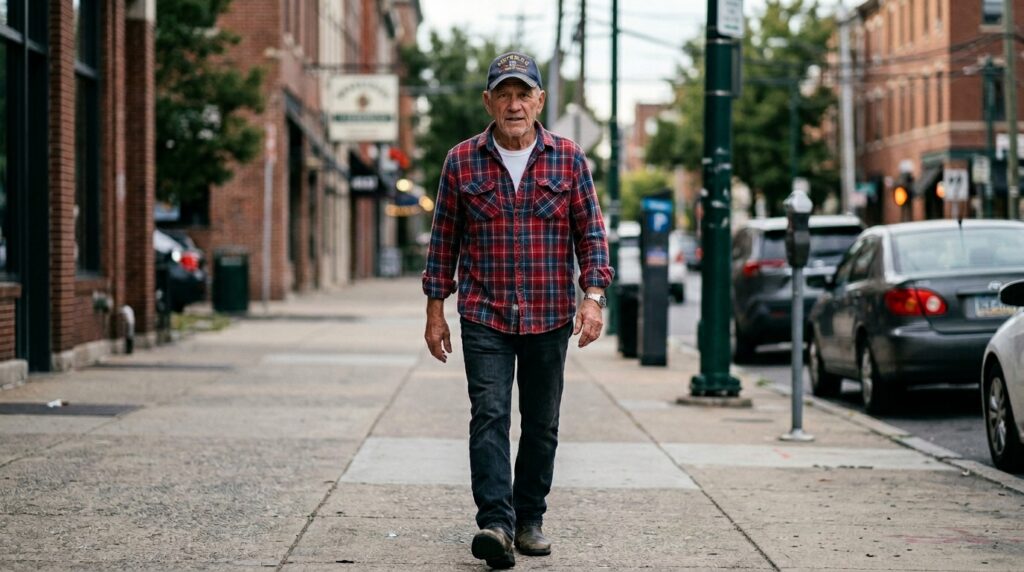
CHAPTER 2: THE ECHO OF THE DELTA
“Where did you get that ring?”
Arthur’s voice didn’t just break the silence; it ground through it. The gravel in his throat sounded like a landslide. He didn’t move his hands, but his entire frame tightened, a coiled spring of rusted iron. The youth in the nylon jacket—the one who had been so tall and loud seconds ago—stiffened. His eyes darted to the silver band on his finger, then back to Arthur’s weathered face. The arrogance was leaking out of him, replaced by a twitchy, modern brand of fear.
“What’s it to you, old man?” the youth spat, but the bravado was thin. He tried to pull his hand back, to tuck it into his pocket, but Arthur’s gaze acted like a physical tether.
“I saw that ring pulled out of the red clay of the Long Hai hills,” Arthur said. He took a half-step forward, closing the remaining distance until he could smell the stale energy drink on the boy’s breath. “It belonged to a man named Miller. A man who didn’t make it back to see the city grow this ugly. Now, I’m going to ask you one more time, and the quality of your afternoon depends entirely on the truth: Where. Did. You. Get it?”
The bystanders—the small-time crowd that had gathered for a laugh—were backed up against the security grate now. The “Urban Witness Layer” had frozen. A street vendor twenty feet away stopped mid-transaction, sensing the shift in atmospheric pressure. This wasn’t a senile rant; this was a tactical interrogation happening in the middle of a Tuesday.
The youth swallowed hard. He looked at his friends, but they were busy looking at their own shoes. The unyielding discipline in Arthur’s posture—the way he didn’t fidget, the way his eyes never left the boy’s pupils—was a weapon they had no defense against.
“I… I found it, okay?” the boy stammered. “In a box. Down at the Community Center on 4th. My grandad… he’s got a room there. They were clearing out some old lockers. Said the stuff was abandoned.”
Arthur felt a cold prickle at the base of his neck that had nothing to do with the city heat. The Community Center on 4th wasn’t just a local hub; it was the primary administrative office for the neighborhood’s veteran outreach programs. It was where the checks were processed, where the housing vouchers were filed, and where men like Miller’s survivors were supposed to be looked after.
“Abandoned?” Arthur repeated the word like it was a curse. “Nothing is abandoned. Everything has a ledger.”
He reached into his pocket and pulled out the brass Zippo. He didn’t light it. He simply held it up between them, the sunlight reflecting off the scarred metal and the hairline fracture. “My friend Miller had a son. That son had a daughter. That ring doesn’t belong in a locker, and it certainly doesn’t belong on the hand of someone who mocks the uniform it represents.”
Arthur didn’t wait for a reply. He reached out—a move so fast and economical it bypassed the youth’s reflexes—and gripped the boy’s wrist. It wasn’t a violent grab; it was a secure, military-grade hold. He didn’t squeeze, but the youth felt the immovable strength in the old man’s calloused palm.
“You’re going to walk with me,” Arthur commanded.
“Hey! You can’t just—” the youth started, but Arthur leaned in, his voice dropping to a terrifying, intimate whisper.
“I’ve walked through monsoon rains with a forty-pound pack and a hole in my shoulder, son. Walking three blocks to 4th Street with you is the easiest thing I’ll do today. You can come willingly, or I can treat you like a prisoner of war. Your choice.”
The youth looked at Arthur’s eyes—deep-set, shadowed, and utterly devoid of hesitation. He nodded once, a sharp, jerky movement.
They began to move. It was a strange procession: the aging veteran, back straight as a bayonet, and the lanky youth in the nylon jacket, walking side-by-side. The crowd parted like water before a prow. Arthur noticed the friction of the city differently now. Every rusted trash can, every peeling piece of industrial paint, every shuttered window felt like a symptom of a larger rot.
As they crossed the intersection of 5th and Main, Arthur felt the rhythmic rolling of the Zippo against his thigh. He wasn’t just thinking about Miller anymore. He was thinking about the other lockers. He was thinking about the “abandoned” boxes. He had spent years maintaining his own dignity, keeping his apartment spotless and his cap centered, but he realized now he had been blind to the slow-motion scavengers picking at the bones of his generation.
They reached the Community Center—a brutalist slab of concrete and stained glass. A group of men in suits stood near the entrance, holding clipboards and talking to a foreman in a hard hat. They looked efficient. They looked clean. They looked like the kind of men who never had grease under their fingernails or red clay in their boots.
Arthur felt the youth’s wrist twitch in his grip. The boy wasn’t looking at the building; he was looking at one of the men in suits—a man with a sharp, predatory smile and a gold tie bar.
“That’s him,” the boy whispered, his voice trembling. “That’s Mr. Vance. He’s the one who gave me the ring. He said it was a ‘bonus’ for helping him move the files out of the basement.”
Arthur slowed his pace, his eyes narrowing as he analyzed the scene. The “decoy” was simple: a messy locker room, a bit of light looting by a bored kid. But the truth was sitting right there in a gold tie bar, overseeing the removal of “files” from a sanctuary for the forgotten.
He didn’t let go of the boy. Instead, he adjusted his cap, feeling the weight of the warrior still standing within him. He wasn’t just a pedestrian anymore. He was on a reconnaissance mission, and he had just spotted the primary target.
“Stay quiet,” Arthur muttered, his gaze fixed on Vance. “The mission just changed.”
The man in the suit looked up, his professional smile faltering as he caught sight of the weathered man in the navy cap advancing toward him with the relentless, grinding momentum of a tank.








