
CHAPTER 7: THE BARRICADE LINE
The magnetic lock on the internal fire door didn’t just engage; it slammed home with a deep, echoing thud that vibrated through the floorboards under Arthur’s boots. The primary exit was dead. High-voltage security plates had sealed the frame, trapping the hum of the dying terminal within the narrow office.
Arthur didn’t pivot into a panic. He stuffed the pencil-scrawled notepad into his plaid shirt pocket, snapping the button down with an even, economical press of his thumb. He checked the spatial geometry of the room. A single ventilation shaft ran along the upper seam of the drywall, but its aperture was too narrow for a grown man’s shoulders. That left the window—shatter-resistant laminate framed in heavily oxidized steel brackets.
“Marcus. Grab the base of that filing cabinet,” Arthur ordered, his voice dropping into the low, gravelly rasp of an artillery instructor.
The boy was already trembling, his fingers white where they gripped his phone. “Arthur, those are armored glass panes. The city put them in during the riots. You can’t just kick them out.”
“Everything breaks under the right lever, son.” Arthur moved to the utility rack, his palms catching the cold, flaking paint of a heavy iron strut. He didn’t strain his lower back; he bent his knees, aligning his posture directly with the center of gravity of the steel unit. With a single, explosive thrust of his legs, he drove the top corner of the frame into the corner of the window glass.
The sound was a high-frequency spike—a sharp CRACK that webbed the laminate film with thousands of silver fractures but didn’t puncture the core. The second strike was mechanical physics. Arthur hit the exact same structural point, adding the momentum of his shoulder. The frame tore loose from the rotting brickwork, the entire glass unit tumbling outward onto the alley gravel with a wet, heavy smash.
“Out,” Arthur grunted, hoisting Marcus by the belt before the boy could calculate the drop. He followed immediately after, his boots hitting the debris with a crunch that sent a sharp, white flash of agony up his left patella. He didn’t stop to nurse it. He adjusted his navy cap, his fingers identifying the split hinge of the brass Zippo in his coat pocket to steady his internal rhythm.
The alley was freezing, the air smelling of stagnant water and cold diesel exhaust. But as they emerged onto the main avenue of 4th Street, the night wasn’t empty.
Three yellow flatbed transport trucks from the Apex Development Group were already idling along the curb, their heavy air brakes hissing in the dark like iron vipers. A crew of workers in reflective orange vests was unrolling heavy steel barricade chains across the entrance of the veteran housing complex across the street. The eviction wasn’t scheduled for next month; the digital audit Arthur had triggered had forced their hand. They were closing the perimeter before sunrise.
“They’re locking them in,” Marcus whispered, his teeth clicking together. “They’re putting up the demolition fencing while everyone’s asleep.”
Arthur looked down the line. At the center of the complex gate stood a foreman—a thick-necked man with a clipboard and a heavy zinc padlock chain slung over his shoulder. He was directing two security guards who were pushing a mobile iron wire screen into place across the driveway.
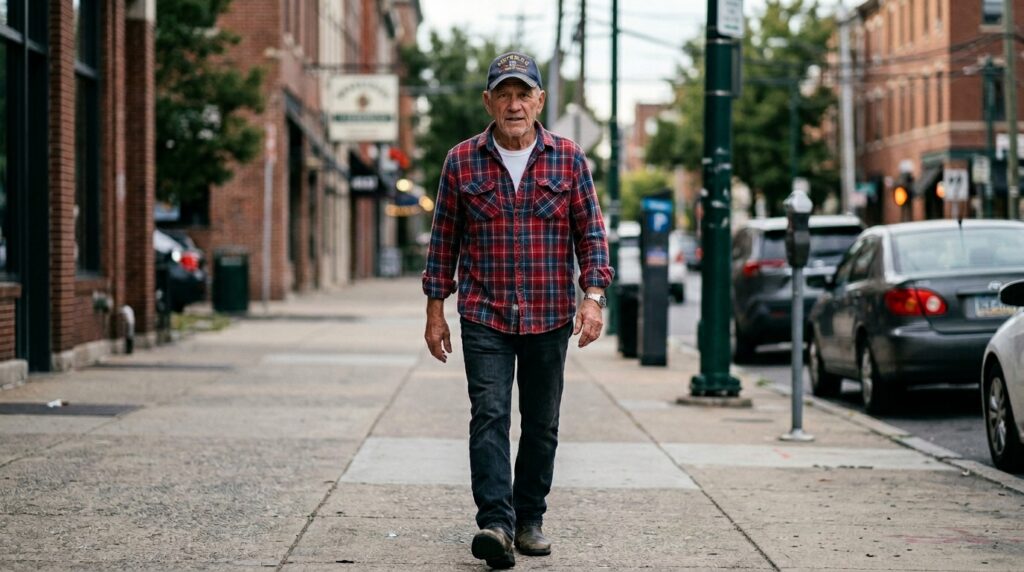
Arthur started moving. He didn’t run—running ruined the sight picture and wasted tactical energy. He walked with that long, upright military gait, his silhouette cutting through the amber streetlamp beams like a shadow on an old map. His plaid overshirt flapped slightly against the white cotton of his tee, the cold air hitting his skin but failing to cool the hot iron in his chest.
“Hey! Old timer! Sidewalk’s closed!” the foreman shouted as Arthur crossed the centerline of the asphalt. “This is a private development sector now. Turn around.”
Arthur didn’t alter his trajectory by a single degree. He walked straight up to the iron gate, stopping exactly where the foreman’s shadow met the gravel. The surrounding workers stopped, the clatter of the heavy steel chain links dying away as they recognized the total composure of the man in the navy cap.
“This gate was paid for by the men who live inside those doors,” Arthur said, his gravelly voice carrying across the empty street with absolute, unyielding clarity. “It stays open.”
“I have a signed municipal clearance right here,” the foreman said, tapping his clipboard with a heavy, grease-stained thumb. “The residents were notified. The relocation transport arrives at five AM. We’re just securing the property lines. Move along before we have the city marshals remove you for vagrancy.”
Arthur looked at the clipboard, then raised his gaze to meet the foreman’s eyes. There was zero panic in Arthur’s face—only the quiet, terrifying discipline of a survivor who had seen lines drawn in blood, not ink.
“The notification was a fraud,” Arthur said, stepping closer until his chest was inches from the iron wire mesh. “The deeds were rerouted through an administrative shell. You’re not moving residents; you’re clearing a crime scene.”
The foreman’s expression hardened, his posture shifting as he prepared to signal the two guards. But before he could raise his hand, a light went on in the second-floor window of the complex. Then another. The sound of Arthur’s voice—that low, carrying rasp—had penetrated the thin glass of the single-room occupancies.
Old faces began to appear in the amber frames. Men with gray hair and weathered cheeks, men who had spent their lives maintaining a quiet, forgotten dignity in the corners of the city, looked down at the streetlamp light. They saw the navy cap. They saw the upright posture of the warrior still standing in the center of the roadway.
“Arthur?” a voice called out from above—old Miller’s brother, Thomas, his hand leaning heavily on the window sill.
“Hold your rooms, Thomas!” Arthur called back, his gaze never leaving the foreman’s pupils. “Don’t sign the logs. The perimeter isn’t broken.”
Marcus stepped up behind Arthur, holding his phone high, the lens capturing the foreman’s name badge and the logo on the side of the yellow trucks. “The stream’s active,” the boy said, his voice finding a strange, steady strength it hadn’t possessed yesterday. “There are four thousand people watching this fence right now.”
The foreman looked at the phone, then at the windows filling with old soldiers, then at the unmoving monolith of the old man standing before him. The legal authority he had carried on his clipboard suddenly felt thin, a fragile piece of paper facing an army that had already survived the worst the world could throw at them.
The foreman didn’t drop the clipboard, but he didn’t throw the lock either. He stepped back a half-inch, his thumb twitching against the metal clip. “We’re just doing our job, old man.”
“So am I,” Arthur said, his hand dropping into his pocket to roll the Zippo. “And my shift isn’t over.”
The sky to the east was turning the color of oxidized iron, the first gray light of morning catching the webbed cracks in the center window across the street. The first phase of the siege was set.








