CHAPTER 6: THE IRON THRESHOLD
“The tumblers are mechanical. The modern facility was built directly over the foundations of the nineteen-seventy bunker line.”
The colonel didn’t use his flashlight. He stayed at Elias’s left shoulder as they moved into the sub-level cage, his formal dress uniform trousers catching the gray dust of thirty years of dead storage. The air down here carried no highway heat; it was cold, thick with the sharp tang of floor sealant and the heavy, grease-laden scent of cosmoline preservative from long-forgotten crates.
The notched brass key went into the iron lockbox plate with a dry, precise scrape. Elias didn’t rush his fingers. The tremble in his left wrist had slowed down, the rusted silver dog-tag links remaining dead against his skin as the double-bolt mechanism finally yielded with a leaden, solid thud. He pulled the heavy drawer outward until the iron runners reached their limit, revealing three bound books of heavy, unruled fiber paper.
The colonel reached into his pocket, his hand emerging not with a regulation document or an identification scanner, but with a small, worn piece of silver—his father’s old administrative signet ring. The baseline of the seal bore the exact three-notched pattern cut into the teeth of the key Elias had carried across two miles of blistering asphalt. The realization didn’t drop into the room with an explosion; it came like the slow settling of winter frost over a field of dry grass.
“He didn’t erase the names to deny the medicine, Mr. Vance,” the colonel said softly. His voice was flat, stripped of the command echo that had cleared the transit lane upstairs. “He cleared the index because the secondary team was still operational in the eastern corridors until eighty-four. If the network had pulled the names into the standard personnel ledger, the line would have broken.”
Elias turned the brittle cover of the topmost ledger. The paper made a dry, splintering sound under his calloused thumb, a small puff of paper-dust rising into the light of the overhead utility tube. His fingers traced down the hand-ruled vertical margins until they stopped on the blue carbon line near the base of the sheet. There was the stamped unit designation, the unadorned skull mark, and his own distinctive signature, written in the black ink of an old fountain pen. Directly beneath it, in a neat, regular hand, his wife’s name was entered into the dependent health allocation column.
“The work was done under the old ground rules,” Elias said. He didn’t look up from the page. His thumb pressed flat against the carbon mark, his skin picking up a faint trace of forty-year-old ink dust. “The clerks at the Annex don’t understand the ground rules. They only know the screen.”
“The screen changes today,” the colonel replied. He reached across the table, his hand settling firmly against the top margin of the ledger, his signet ring clicking against the iron binding screw. “The operational credit will be transferred to the active VA ledger under my authorization code. The young man at the gate will be the one who delivers the digital validation to your residence before the shift change.”
Elias closed the ledger. The heavy thud of the binding settling onto the wooden bench table sounded like the closing of a cell door. He looked up, his eyes taking in the colonel’s formal cap, the sharp lines of his uniform, and the distinct family likeness that time had failed to blur from the old commander’s profile. The friction of the long highway walk was gone from his joints, replaced by a cold, heavy sense of finished business.
“Thank you for hearing me,” Elias said, his voice dropping into the small, dark space between them. “That’s all I wanted from the beginning.”
The colonel stepped back, his boots aligning perfectly against the concrete floor as he raised his right hand to the brim of his cap. It wasn’t a ceremonial salute for a parade ground; it was the sharp, abbreviated movement of an operator acknowledging the senior man on the line.
“The perimeter is clear, Sergeant Vance,” the colonel said. “You’ve held the ground long enough. Go home.”
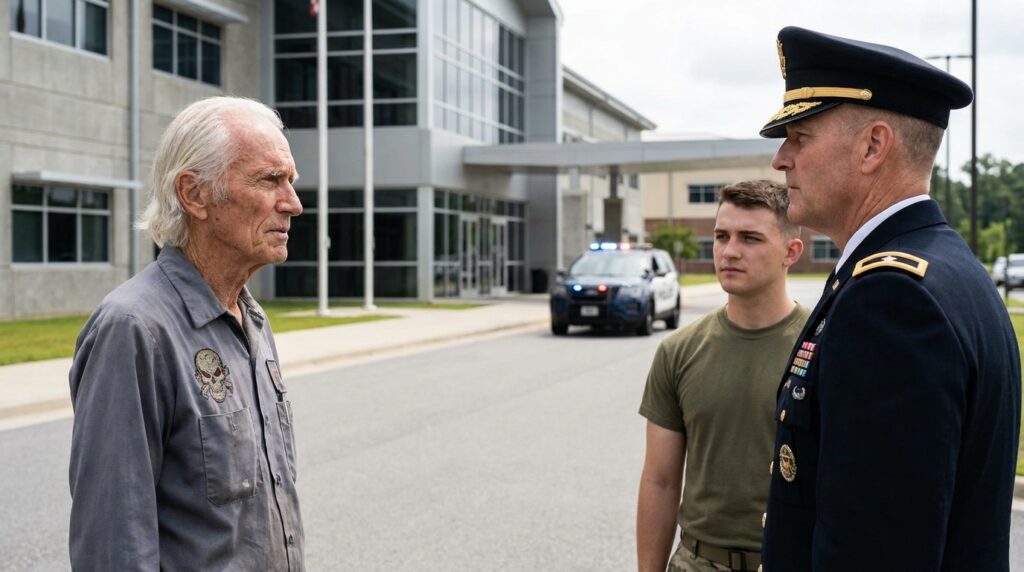
Elias pulled his utility cap down, the worn brim setting a familiar shadow over his lined face. He hooked the strap of his canvas bag over his shoulder, his fingers leaving the brass key inside the lock of the iron box for the colonel to clear. When he walked out past the security turnstiles into the late afternoon sun, the gate guard didn’t move from his station. The young soldier stood at a rigid, uncomfortable attention, his eyes fixed straight ahead on the empty highway, his face still pale under the fading glare of the Texas sky.