CHAPTER 3: THE PERIMETER LINE
“Identify your business at this installation or step back across the yellow line immediately.”
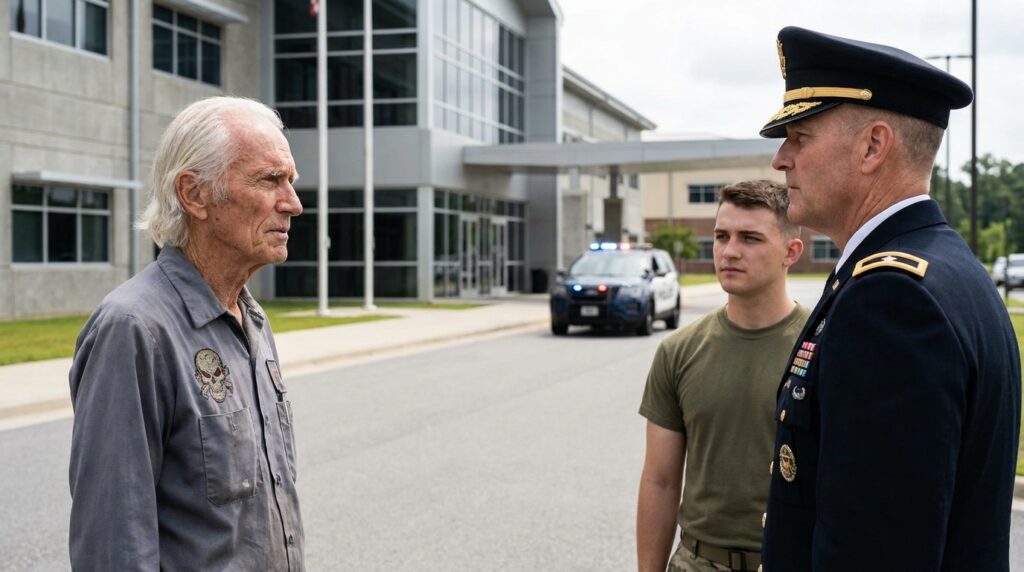
The voice didn’t come from a throat; it came through a gray horn-speaker mounted above the turnstile, distorted by a bad ground-wire that left a low, electrical hum trailing after the words. The young guard stepped out from behind the reinforced glass structure. His olive training shirt was stretched tight across a broad, athletic chest, the fabric unmarked by sweat despite the dry heat rising off the road bed. His hand stayed flat against the black retention hood of his sidearm holster, his fingers curved, checking the mechanical latch with a repetitive, unconscious twitch.
Elias Vance kept his hand extended, holding the paper-laminated identification card between his index and middle fingers. The heat-brittled plastic edges scraped faintly against the coarse grain of his skin as the wind tried to catch it. He could feel the small, notched brass key tucked deep inside his bifold wallet, pressing hard against his hip through his denim pocket like a blunt iron nail.
“I need the officer of the day,” Elias said. He didn’t yell. He let the flat timbre of his voice run underneath the mechanical drone of a nearby climate control compressor. “My name is Elias Vance. I am here to correct an administration failure on the vanguard manifest from nineteen seventy-four.”
The guard took two steps forward, his black combat boots clicking against the limestone dust that had drifted onto the asphalt lane. His eyes didn’t look at Elias’s face; they skimmed down the faded gray work shirt, taking in the frayed buttonholes, the white hair lifting in the draft from the highway, and stopped directly on the black skull patch sewn onto the sleeve. A small, cold crease formed between the young soldier’s eyebrows—not a look of recognition, but of sharp, bureaucratic distaste for a civilian wearing military-coded imagery.
“Sir, this isn’t a museum, and it’s not a pension office,” the guard said. His voice was lower now, stripped of the megaphone’s distance, carrying the rigid, thin authority of a man who had memorized a security manual but had never seen an unpaved road. “The regional veterans administration handles all records claims. If you don’t possess a current common access card or a pre-cleared biometric token, you are technically obstructing a secure military transit lane. Step back behind the yellow boundary marker.”
“The regional office uses a digital network,” Elias replied, his boots remaining fixed in the groove worn into the hot asphalt. “The digital network doesn’t have the paper books. The paper books were moved to the old logistics locker here when the regiment deactivated the second platoon. The key is right here.” He reached his left hand toward his pocket, his wrist turning. The rusted silver links of his dog-tag chain slid down his arm with a dry, iron rattle.
The guard’s posture changed instantly. He dropped into a shallow defensive stance, his heel sliding back into the dust, his thumb snapping the security hood off his holster with a clean, plastic click. “Keep your hands visible, sir. Do not reach into your pockets. I will not warn you a second time.”
Inside the security shack, a second figure moved—a younger clerk with a headset, her face pale behind the tinted green glass, her fingers striking a red console key. From the secondary access lane behind the barriers, a low, rhythmic thrumming began to shake the parched earth. It was the heavy, unhurried idle of a diesel engine. A white-and-blue security vehicle rolled out from behind the aggregate concrete wall, its rooftop light-bar dark for now, but its bull-bar angled directly toward the yellow line where Elias stood.
Elias didn’t drop his hand. He kept the faded card leveled between them, his eyes locked on the guard’s pupils. He could see the reflection of the chain-link fence and his own long white hair mirrored in the soldier’s protective glasses. The friction between his splitting boot heel and the soft tar beneath him felt like the only steady anchor left on the base.
“I’m not looking for trouble, son,” Elias said softly, his thumb tracing the frayed edge of his canvas bag where the carbon manifest copy lay hidden in the seam. “I’m just looking for the ledger. It has my wife’s name on the line.”
“Step back,” the guard repeated, his voice rising an octave as the patrol vehicle stopped ten feet behind him, its transmission whining as the driver dropped it into park. “Final warning.”