CHAPTER 5: THE CORE REVERSAL
“Hold your movement, Sergeant.”
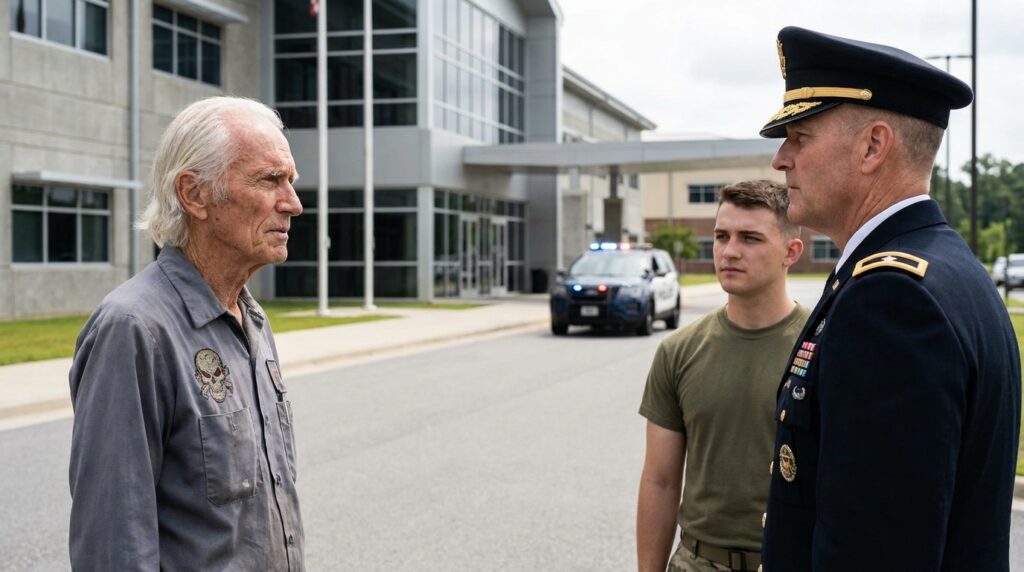
The colonel’s voice didn’t bounce off the concrete barriers; it dropped like an iron sheet across the lane, flat and unyielding. The patrolman’s leather gloved hand froze two inches from Elias Vance’s collar, the coarse material of the uniform sleeve brushing against the faded gray twill of Elias’s shoulder. The red and blue strobes continued their violent, rhythmic sweep, painting the colonel’s clean-shaven face in alternating cuts of shadow and hard, primary light as he stepped past the yellow boundary line.
The senior officer did not look at the young gate guard, nor did he look at the idling patrol cruiser. His eyes were fixed on the left sleeve of Elias’s work shirt. The faded black skull patch, hand-stitched with heavy nylon thread that had begun to rot at the edges, sat perfectly still under the flickering glare. The colonel reached up, his fingers touching the stiff brim of his peaked cap, adjusting it with a microscopic, habitual tilt before he took another step forward. The silver stars on his shoulder straps caught the cold reflection of the security shack’s searchlights.
“Where did you acquire that registration mark?” the colonel asked. His voice was lower now, stripped of the administrative tone he had used at the glass doors. He stood three feet away, close enough for Elias to smell the heavy laundry starch on his uniform shirt and the faint scent of gun oil from his sidearm.
Elias did not lower his left arm. The silver links of the old dog-tag chain rattled faintly against his wrist bone as he shifted his grip on the canvas utility bag. “Nineteen seventy-four. The second platoon manifest at the third division staging terminal. We stitched them ourselves after the line item went dark.”
The young guard’s chest dropped an inch out of its rigid attention line. He looked from Elias’s long white hair down to the colonel’s face, his eyes wide behind his protective lenses. “Sir, the individual has no modern identification token. He was ordered to clear the transit lane and refused compliance.”
The colonel ignored the soldier completely. He stepped into the active speaking lane, his polished leather dress shoes crunching over the white limestone dust. He leaned closer to Elias’s shoulder, his eyes tracing the irregular, hand-done knots at the base of the skull’s jawline. A distinct, gray stillness settled into the commander’s features—a physical shift that made the sergeant slowly lower his hand from Elias’s frame and step back toward the cruiser’s open door.
“The third division staging terminal was leveled in seventy-nine,” the colonel said softly, his gaze finally lifting to meet Elias’s eyes. “The personnel logs from that sector don’t exist on the active mainframe.”
“They don’t exist on the mainframe because they were cleared by hand,” Elias replied. He didn’t blink against the blue strobe light hitting his pupils. He slowly reached his right thumb into the inner seam of his canvas bag, his movements deliberate, calculated to give the guards no reason to reset their safety latches. He pulled the frayed canvas flap back just enough to expose the brittle, yellowed corner of the old carbon form hidden inside. “The ledger was moved to the old logistics annex on this compound before the digital migration. I have the double-bolt brass key in my bifold. I’m here for my wife’s line.”
The colonel’s hand moved toward the canvas bag, his fingers stopping a fraction of an inch from the yellowed paper. He didn’t pull the document out. He didn’t need to. His eyes had caught the faint, violet-ink stamp at the top of the carbon layer—a circular registration mark with a handwritten serial number that matched the prefix of his own regiment’s secret lineage.
“Let’s handle this with respect, everyone step back and stay calm,” the colonel announced, his voice rising just enough to cut through the low thrum of the diesel engine behind them. He turned his head slightly toward the sergeant. “Kill the light-bar. Clear the lane.”
The sergeant hesitated for the fraction of a second before hitting the console switch. The violent red and blue oscillations died instantly, plunging the checkpoint back into the flat, heavy glare of the late afternoon sun. The sudden silence of the color shift left the air feeling thick and hot, the smell of parched earth rushing back to fill the space between the men.
The young guard remained frozen at his post, his face turning a pale, hollow gray as he realized the nature of the shift. The old man he had mocked as a confused vagrant was now standing face-to-face with the base commander, the space between them defined not by security barriers, but by an unwritten, generational code that the modern manual didn’t contain.
The colonel looked back at Elias, his expression hard but his posture shifting out of its rigid administrative distance. “The old logistics boxes are locked behind a dual-bolt secure bulkhead in the basement of the main command building, Mr. Vance. The modern digital files don’t show the tracking line because the field office was decommissioned by an executive signature forty years ago.”
Elias let the canvas flap fall back into place, concealing the carbon form against the worn twill of his shirt. He could feel the silver chain on his wrist loosening as his fingers relaxed. “I know who signed the order, Colonel. I just need the physical ledger to clear the voucher.”
The colonel didn’t answer immediately. He looked down at the old brass key now visible through the worn slot of Elias’s bifold as the old man carefully stowed it away. “The name on that executive order was Vance,” the colonel murmured, his voice too quiet for the guards to catch over the hum of the air units. “My father didn’t leave a secondary index.”
Elias stood his ground, the split heel of his boot holding the soft tar. “He left the paper, son. That’s why I kept the key.”