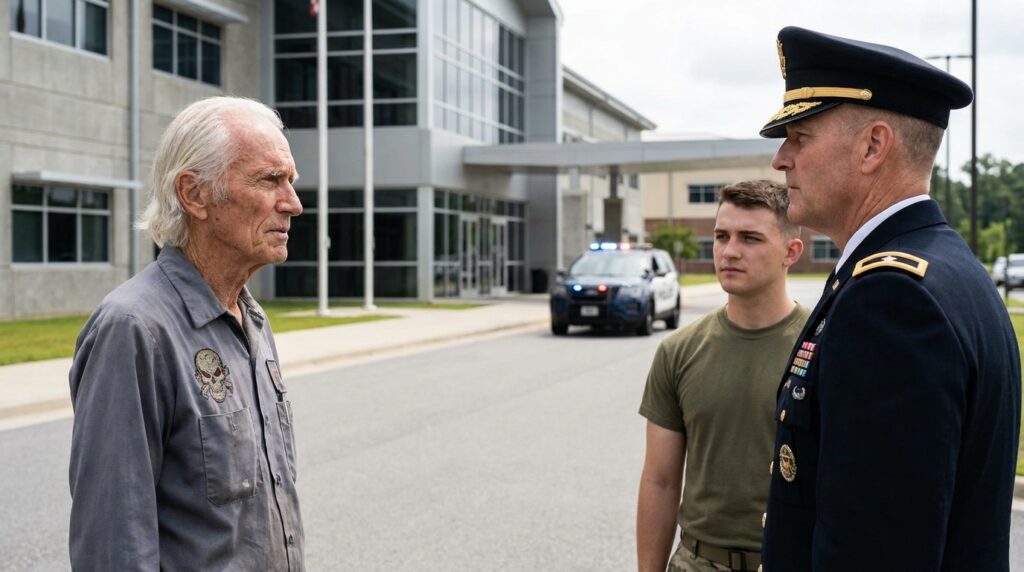
CHAPTER 4: THE WITNESS GLARE
The overhead strobes ignited with a wet, hydraulic click. Instantly, the bleached white lane of the checkpoint dissolved into a rhythmic, violent oscillation of crimson and cobalt light. The glare caught the edges of the galvanized chain-link fence, turning the steel wire into a vibrating matrix of red and blue teeth. The driver of the patrol vehicle shoved his door open, the heavy steel-reinforced panel catching the parched wind with a hollow groan.
“Step away from the guard line! Place your hands flat on the hood of the cruiser now!”
The second officer didn’t approach through the soft margin of the road; he used the concrete Jersey barriers as a lane block, his leather utility belt creaking under the weight of his high-tensile zip-ties and operational gear. Elias Vance did not drop his hands, but his fingers slowly curled around the edge of his paper ID card until the old lamination popped faintly under the strain. The red flashes swept across his lined face, casting deep, ink-black shadows into the hollows of his cheeks.
“I have the tracking voucher inside the bag line,” Elias said. He kept his feet planted in the soft tar groove, but the compression of the air brakes behind him shook the worn leather of his splitting boot. “The ledger number matches the secondary shelf in the logistics annex. It’s the old nineteen seventy-four roster. You don’t have to pull the piece.”
The young gate guard’s thumb was still locked onto the retention snap of his holster, his knuckles turning a sharp, bloodless white against the olive drab nylon. He didn’t look at the patrolmen behind him; his eyes stayed fixed on the faded black skull patch on Elias’s shoulder. The blue light split the skull’s stitched jawline in half every half-second. “He’s non-compliant, Sergeant. He reached for his pocket when the perimeter alert went active. He’s claiming he has an archive key.”
“I have the key,” Elias repeated, his left arm remaining steady as the old dog-tag chain rattled softly against his wrist. He didn’t move toward the pocket this time. He knew the math of the distance. At twenty feet, with two young men trained on a standard reactive loop, any sudden motion through the dusty gray air would end with three ounces of lead breaking through his gray work shirt before he could clear his wallet. “The key fits the box with the carbon ledger. The digital portal didn’t carry the names forward because the platoon was run under a blind billing index.”
The sergeant from the cruiser stopped five paces out, his heavy tactical boots grinding a white chunk of limestone into fine powder. He had his hand resting on the grip of his non-lethal deployment tool, his eyes assessing the length of Elias’s white hair, the frayed canvas strap of the utility bag, and the distinct lack of a modern identity badge. “Old man, I don’t care if you have the key to the mint. You walked past two distinct federal warning markers to stand in a primary operational lane. This isn’t an information desk. Turn around and give me your wrists.”
Beyond the perimeter gate, the heavy glass door of the main administrative annex swung inward with a low, vacuum hiss. Elias’s gaze shifted past the guard’s shoulder. A senior figure stepped out into the light, his polished peaked cap cutting a sharp line across the glare of the building’s tinted windows. The dress uniform was dark, the silver stars on the shoulder straps catching the sun with a hard, mirror-like flash.
“What is the delay on the primary lane, Sergeant?” The voice was crisp, carrying the dry, unhurried weight of forty years of command presence. The senior officer didn’t look at the flashing lights; he looked at the obstruction.
Elias braced his heels against the asphalt. He reached his left thumb up, catching the small tear in the inner lining of his canvas bag. His fingernail scraped against something stiff and dry—the brittle corner of a forty-two-year-old carbon manifest form tucked behind the canvas seam. He didn’t pull it out. He needed the officer to move three feet closer. He needed the man who wore the regiment’s crest to see the physical ink before the patrolmen forced his weight down onto the gravel.
“We have an unverified civilian blocking the transit grid, Colonel,” the sergeant called back, his body slightly obscuring Elias’s frame. “Claims he’s looking for old platoon files. He’s refusing to clear the barrier.”
The guard took a half-step back, his chest dropping as he fell into a rigid attention line, his hand finally dropping from his holster hood as the commander entered the active zone. The red strobe light washed over the colonel’s clean-shaven jaw as he stepped onto the sun-baked asphalt, his eyes scanning the lane with a cold, professional detachment that Elias had seen on a hundred different field desks before the world went digital.
“The lane is closed to civilian inquiries,” the colonel said, his voice level as he approached the yellow boundary line. “Take him down to the processing hut.”
“Look at the patch, sir,” Elias said, his voice flat against the thrum of the cruiser’s engine. He stood his ground as the sergeant’s hand reached for his shoulder. “Look at the registration line on the sleeve.”