CHAPTER 2: TWO MILES OF ASHPHALT
The heel of Elias’s left boot was splitting. Every step across the state highway route took a fraction of a millimeter more of the vulcanized rubber, leaving a faint, dark smudge on the white shoulder line of the asphalt. The heat didn’t just come down from the midday sun; it rose directly from the road bed, thick and laden with the smell of boiled tar and old motor oil. Two miles on the shoulder of a Texas transit corridor was a math problem measured in structural friction and the rhythmic, hollow rattle of the silver dog-tag chain against his skin.
Elias kept his thumb hooked inside the strap of his canvas utility bag. Inside, wedged behind a packet of yellowed medical receipts, his fingers brushed the worn fold of his leather bifold. Buried deep within the silk lining of the bill compartment sat a small, notched brass key. It had no tag, no stamped inventory number, and no modern digital barcode. It was simply five ounces of cold metal that had remained silent for forty-two years. The teeth of the key were cut to fit a dual-bolt lockbox at the old logistics depot—the kind of locker they stopped building before the current gate guard’s parents had even met.
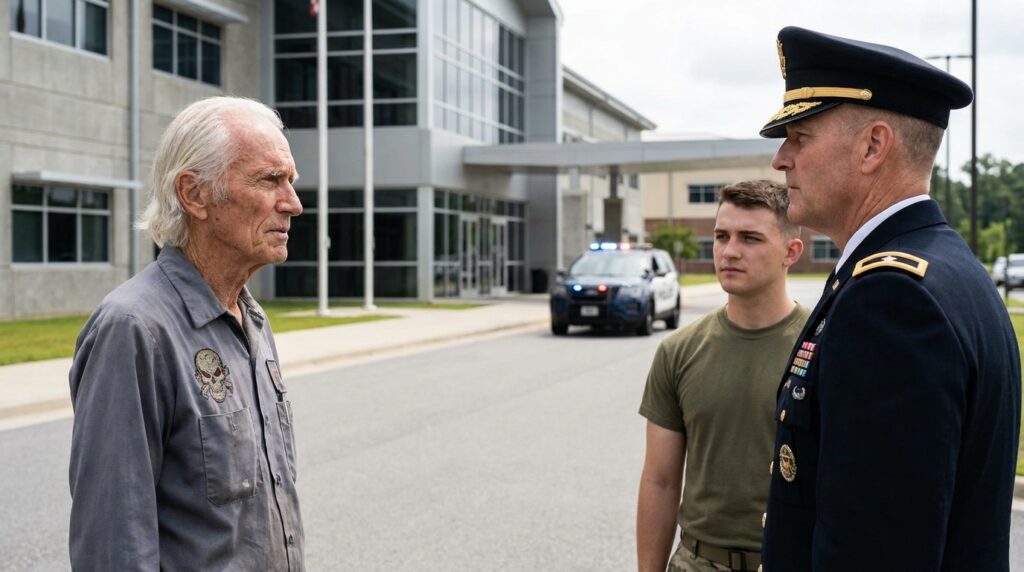
A tractor-trailer roared past, its air brakes hissing a sharp, concussive blast that caught the loose white strands of his hair and whipped them across his eyes. Elias didn’t flinch. He wiped a streak of gray road-grit from his cheek with the back of his hand, his fingernails catching on the coarse fabric of his gray work shirt. The black skull patch on his shoulder felt heavy, the dense embroidery holding the heat like a small iron plate.
To a casual driver passing at sixty miles an hour, he was merely a piece of highway debris—an old man walking because his truck had died or his mind had wandered. But Elias’s eyes remained fixed on the horizon, where the shimmer of the heat waves began to break against the clean, gray concrete shapes of the operational command perimeter. The base didn’t look like the fort he remembered from 1974. The old timber guard shacks and pine-board barracks were gone, replaced by low-slung, blast-resistant structures of aggregate concrete and high-tensile steel.
He reached the first approach marker—a yellow diamond sign reading SECURITY CHECKPOINT 500 YARDS—REDUCE SPEED. The gravel beside the road was white and sharp, crushed limestone that crunched under his weight with a dry, splintering sound. His breath was steady, drawn through the nose, timed to every four paces. It was a habit from the delta, a rhythmic oxygen preservation cycle that his lungs remembered long after they had forgotten the names of the men who had marched beside him.
As the perimeter fence line drew closer, the chain-link gave way to heavy anti-ram cables woven through steel I-beams. Elias could see the gatehouse now. It sat in the middle of a triple-lane approach, surrounded by yellow concrete pillars that looked like oversized teeth driven into the earth. A single soldier stood under the corrugated metal awning of the main lane, his uniform crisp, his posture tight with the artificial importance of a man who believed the entire safety of the nation depended on a plastic swipe-card reader.
Elias stopped twenty feet before the yellow painted line on the pavement. He reached into his pocket, his hand passing over the brass key, and pulled out his faded, paper-laminated veteran ID—the one the digital terminal at the Annex had refused to read. His fingers left a faint smudge of road-dust on the plastic edge. He knew the young soldier was already watching him through the reinforced glass of the shack, his hand likely moving toward the small, black radio housing on his chest.
The air between them was dead, heavy with the smell of parched grass and the electric hum of the automated barrier arms waiting to drop. Elias took one more step, his boot heel grinding into the white limestone dust at the margin of the lane. He didn’t look down at his trembling hand. He looked straight at the reinforced glass, waiting for the iron to clear.