
CHAPTER 6: THE SETTLING OF THE SHALE
“They’re using his name to clear the dirt,” Reynolds said. His leather folder slipped an inch against the laminate table, the plastic grain scraping against his knuckles with a sound like gravel rolling under an incoming tide. The iron discipline that had kept his shoulders square for thirty years didn’t shatter; it slowed down, dilating into a cold, heavy precision as the true weight of the manifest settled behind his eyes.
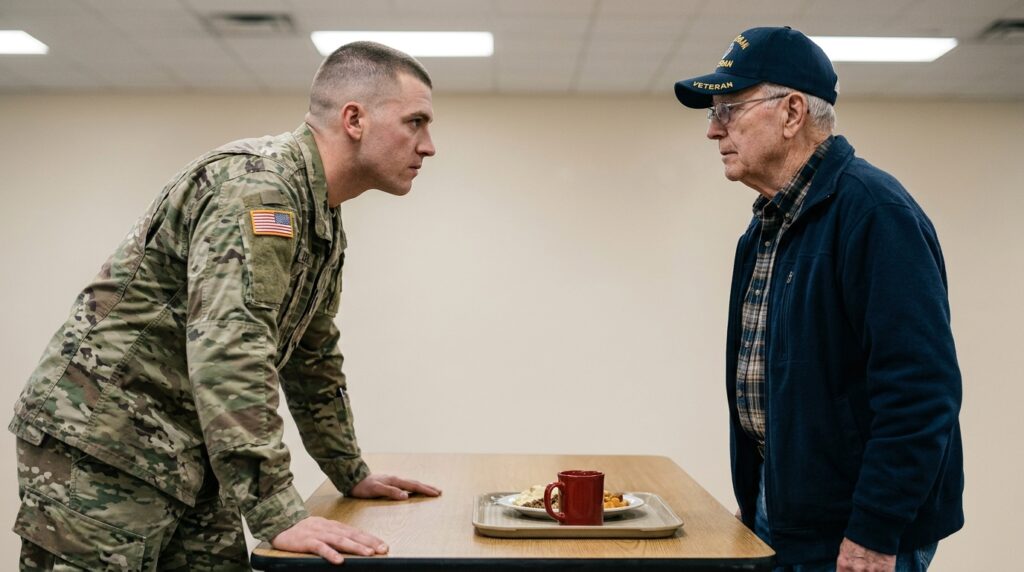
Frank didn’t shift his hand away from the cold rim of the red ceramic mug. Outside the window, the blue-gray plume of Miller’s transport truck had already thinned into the heat shimmer over Highway 24, leaving nothing but the smell of burnt sulfur and the steady, dry vibrations of the railyard switchers a mile south.
“They’ve used his name since seventy-two, Thomas,” Frank said, his voice flat as the limestone shelves under Ridge Six. “When the old logistics colonel realized the sulfur water was reaching the civilian wells by the creek, he didn’t sign the excavation block. He had your father do it under a special ordnance voucher. If the EPA checks the mud tomorrow, the digital trail stops at a dead man’s pension file in Salina.”
The Command Sergeant Major looked at the hand-filed brass key lying between them on the brown plastic tray. The three irregular, hand-filed teeth caught the raw glare of the fluorescent tube overhead, their edges showing the faint, yellow sheen of exposed alloy beneath the decades of pocket oil and zinc dust. It was an object that had no function in a modern, digitized army, yet it carried the exact spatial geometry of his father’s lifetime of labor—the slow, unseen poison that had settled into his skin long before the state ever granted him a retirement medal.
Reynolds slowly reached out, his thumb covering the parallel file marks on the eye of the key. “If the boxes are already on the highway, Frank… the command won’t let the transport log clear Gate 3 without a signature from my office. They sent Miller out here to find the baseline pass so they could seal the ledger before the auditors sit down.”
“Then you don’t sign it,” Frank whispered. He didn’t lean across the table. He didn’t offer a tactical suggestion. He simply sat perfectly upright behind his silver-framed glasses, his old spine anchored against the vinyl bench with the unblinking mass of a man who had watched five base commanders come and go through the same gate. “The key isn’t for the vault, son. It never was. It fits the lock on the master cabinet inside the old railyard station—the one the logistics office abandoned when they built the new concrete siding in ninety-eight. The original log sheets are still in the bottom drawer, rolled in paraffin paper behind the track schedules. Your father didn’t hide them to save the army. He hid them to save you.”
The silence that followed was different from the tight friction of Miller’s confrontation. It was the vast, hollow space that opens up when an old machine finally comes to a dead stop after years of grinding its own gears. Reynolds looked up, his iron-gray eyes finding Frank’s face behind the lenses. In that look, the entire hierarchy of the base—the crisp creases of the khakis, the unblemished camouflage sleeves, the unearned authority of the active deployment detail—shrank into a handful of salt and dry earth.
“They’ll close the road if the audit fails, Frank,” Reynolds said quietly.
“The road’s been closed to the people who built it for forty years,” Frank replied, his fingers finally dropping from the handle of the mug. He reached down and took his black veteran cap from the bench, placing it back onto his head with a slow, measured movement that pulled the brim low over his forehead. The bronze infantry pin caught the low daylight through the grease-filmed glass, casting a solid, unmoving bar of shadow across his eyes. “Let them walk the gravel.”
Reynolds stood up. He didn’t salute this time; he simply took his leather logistical folder from the table, tucked it under his arm, and picked up the hand-filed brass key from the center of the brown tray. He didn’t look back at the aisle or at the two privates who were still lingering by the gravel lot outside. He walked toward the diner door, his heavy boots striking the linoleum with the flat, unhurried cadence of a man who was no longer measuring his life by the base clock.
Frank Vance remained in the booth. He picked up his cold red mug, tilted it slightly to clear the residual grounds from the rim, and took a slow, deliberate sip. The plastic tray beneath his hand was still pitted, the raw white scratch still visible where the knife had slipped five years ago, but the boundary line was clear. The town was exactly as it had been at sunrise—gray, salted, and entirely unmoved by the young men who thought they owned the dirt.








