
CHAPTER 3: THE FRICTION LINE AT THE BOOTH
The blast of thick, August heat from the open doorway carried the grit of unwashed gravel and the bitter tang of raw JP-8 fuel from the transport idling near the highway. It sheared through the air conditioning’s cold film, causing the grease-filmed window beside Frank’s shoulder to break into a sudden, weeping sweat.
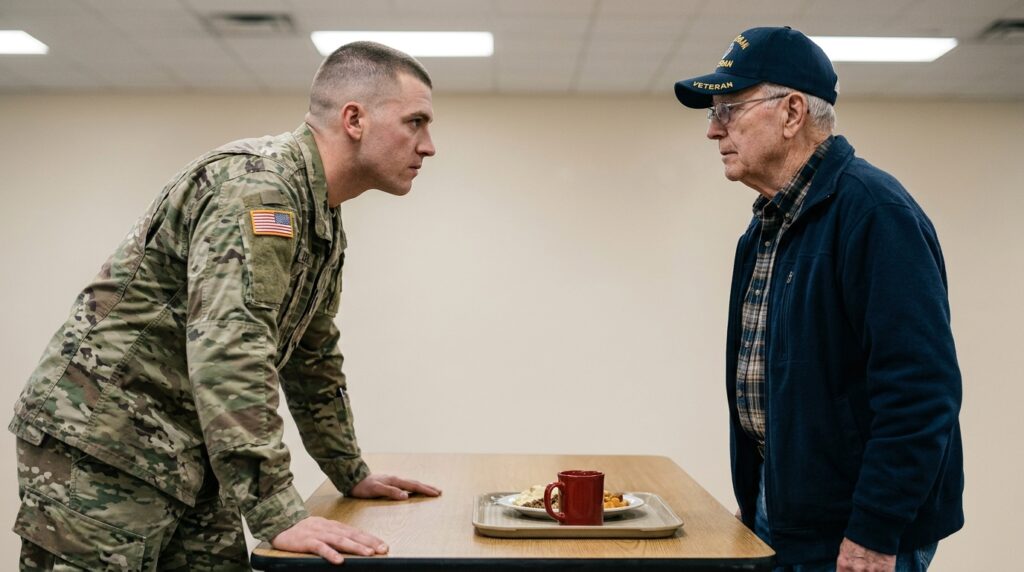
Miller didn’t turn his head toward the door. His weight remained braced, his boots dug into the linoleum with the heavy, stubborn intent of a machine designed for simple displacement. His hand hovered directly over the tray, the shadow of his thick fingers falling across the dark drop of coffee that had rolled into the plastic molding.
“The pass,” Miller repeated, his voice dropping below the rattle of the exhaust fans. His knuckles didn’t yield an inch. “Un-serialized brass. You don’t get to walk out of the line with ordnance property, Pop. My detail is short two transport blocks for the subterranean lockers on Ridge Six. If that’s what’s sitting in your flannel pocket, it’s going back to the base. With or without the provost marshal.”
Frank let his hand slide down the rough, pitted edge of the plastic tray, his fingertips tracking the worn texture where thousands of thumbs had rubbed the synthetic surface smooth over forty years. He didn’t defend his shirt pocket. He didn’t lean away from the sour smell of mints and adrenaline coming off the specialist. Every piece of his old long-range reconnaissance training—the parts that had survived the damp earth of foreign valleys and the long, silent winters of the Cold War—remained frozen in his lower spine.
“You’re missing two blocks for Ridge Six because your logistics clerk doesn’t know how to read the old manual ledger,” Frank said. His tongue didn’t stumble on the nomenclature. He kept his gaze flat against Miller’s left collarbone, where the fabric was slightly frayed from a heavy pack strap. “The locks on Ridge Six were re-keyed in October of eighty-four. This tooth arrangement isn’t a transport block pass, Specialist. It’s an original field master for the dry-storage cells behind the old battery.”
Miller’s fingers twitched. The specific mention of Ridge Six’s dry-storage history was a piece of base geography that didn’t exist on the modern digital layout sheets his platoon used. It was old dust—the kind of information that survived only in the yellowed paper manifests kept in the lower crawlspaces where the rats nested.
“The battery was filled with concrete after the deployment shift,” Miller said, though his shoulder dropped by a fraction of a millimeter, the muscle losing its hard, initial lock. His eyes darted to the two privates by the pie case. They hadn’t moved. They stood with their thumbs hooked into their gear belts, their faces blank with the specific, survivalist caution of low-ranking enlistees who could smell a senior tactical error developing before them. “It’s cold storage. Dead space.”
“The space is only dead if you think the earth doesn’t remember who dug it,” Frank muttered. He slowly shifted his left heel back against the iron base of the table leg, his boot heel finding the exact point where the metal met the floorbolt. He wasn’t preparation-killing; he was setting his anchor. If the specialist attempted a wrist-lock or a collar-grab across the Formica, Frank’s center of mass would stay down, pulling the younger man’s balance across the table until his chest hit the sharp plastic edge of the tray. “Your sergeant didn’t send you here for a table, Miller. He sent you out here to find the old log blocks because the convoy manifest didn’t match the weight on the scale at Gate 3.”
The realization hit the young soldier’s face like a physical blow. The skin around his high-and-tight haircut tightened, turning a mottled, sun-scorched red that spread down into his collar. He hadn’t told his men why they were stopping at the Highway 24 Diner during a deployment cycle; he had told them it was for the ham and eggs. But Frank had watched the way Miller’s eyes had scanned the parking lot before he crossed the threshold—the way his fingers had kept touching the heavy leather ledger-folder tucked under his arm.
“You’ve been talking to someone on the inside,” Miller whispered. The arrogance was completely gone now, replaced by the dangerous, narrow focus of a junior NCO who believed he was standing over a leak. “That’s base intelligence business. You’re eighty years old, sitting in a grease trap, and you’re tracking the convoy weight?”
“I don’t need to track the weight,” Frank said, his hand remaining motionless on the brown plastic. “I can hear the springs on the transport trucks when they slow down for the railyard crossing. They’re heavy by four tons. That means you’re hauling the old wet-cell batteries out of the lower vault, the ones that were supposed to be decommissioned when Reynolds’ father was still a first lieutenant.”
Behind Miller, the shadow from the doorway suddenly grew wide, blocking out the glare of the highway asphalt. The sound of heavy, spit-shined leather boots struck the linoleum—not the quick, light scuff of a low-ranking soldier, but the measured, rhythmic thud of a man who carried forty pounds of institutional authority in his stride.
The two privates near the pie case didn’t just drop their forks; their heels snapped together with a sharp, dry clack that rattled the glass shelves of the pastry display. Their arms went rigid at their sides, their chins tilting upward toward the water-stained ceiling tiles.
Miller froze. His hand remained hooked over the red mug, his fingers still locked in the middle of his aggressive lean, his body caught between the old man’s table and the sudden, freezing drop in the room’s pressure. He didn’t turn around yet, but his neck muscles went stiff, the veins along his throat pulsing against the camouflage fabric of his collar.
“Specialist Miller,” a voice barked from the aisle. It wasn’t loud, but it had the hollow, metallic ring of a heavy spade hitting frozen sod. “Explain to me why your detail is out of the vehicle lane while the transport engines are burning fuel on state time.”








