
CHAPTER 1: THE ACCURACY OF RESIDUAL MASS
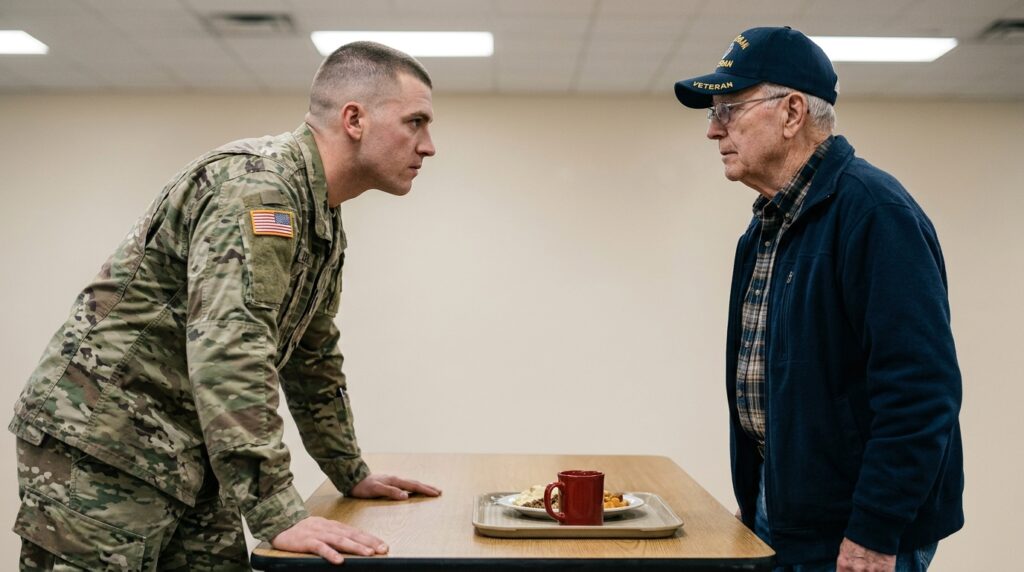
“This booth is for people who actually have a modern mission, old man,” Specialist Miller said, his palm hitting the Formica with the heavy, dead thud of wet sandbags.
Frank Vance did not look up from the scratch on the rim of his brown plastic tray. The line was raw, showing the pale, fibrous polymer beneath the dark laminate—the result of a serrated steak knife wielded by someone who had been gone from this town for five years. The diner smelled of old fat, damp rags, and the faint, cold scent of iron filing that drifted from the railyard across Highway 24.
He didn’t move his fingers from the handle of the red ceramic mug. The heat was shifting out of the porcelain now, settling into the rough skin of his palm, a slow, transactional bleed against the air conditioning that whistled through the rusty overhead vent.
“You’re tracking dirt into the aisle, Specialist,” Frank said. His voice didn’t carry the rasp of the old men who sat near the register discussing weather. It was flat, leveled like a straightedge over concrete. “And you’re leaning on my bread.”
Miller didn’t recede. Instead, the camouflage material of his sleeve ground against the edge of the booth, the stiff, unwashed cotton of the OCP uniform crackling like dry brush. He was twenty-eight, maybe nine. He had the hard, clean jaw of someone who believed the state owned his muscle and that the muscle gave him the right to select his own square footage. His boots were caked with the red, sulfurous clay of the training ranges down by the creek, a thin crust breaking off onto the linoleum with every micro-shift of his weight.
“The whole county’s short on seats today, Pop,” Miller said, his teeth catching the low light from the grease-filmed window. “We’ve got a four-hundred series detail moving out of Gate 3 at eleven. You’ve been sitting on this same corner since the Carter administration. Move the cap. Let the people who work the line have the table.”
Through his silver-framed glasses, Frank watched the young man’s knuckles turn the color of salt. Miller’s hand was braced three inches from the red mug, his thumb hooked over a heavy black tactical watch. The watch ticked with a small, dry click that Frank could feel through the vibration of the table leg.
The two younger privates behind Miller had stopped laughing. They stood by the pie case, their forks balanced over plates of cold eggs, their eyes darting toward the counter where the waitress had stopped her glass coffee pot mid-air. The silence in the room wasn’t polite; it was the rusted, heavy silence that falls over an old engine right before the belt snaps.
Frank didn’t shift his spine against the bench. He felt the cold iron pin through the wool of his black veteran cap—the tiny, sharp point of the bronze infantry clasp pressing into his thumb as he reached up and adjusted the brim by a fraction of an inch. Beneath his shirt, tucked into the narrow seam of his plaid pocket, a small, hand-filed brass key shifted against his ribs. It was an old key, notched with three irregular teeth that didn’t match any modern ordnance lock on the base three miles north. Miller’s gaze dropped to that pocket for a split second, his eyes narrowing as he caught the faint, metallic outline of the edge.
“The table stays exactly as it is, son,” Frank whispered.
He didn’t lift his eyes to meet Miller’s until the young man shifted his shoulder forward, preparing the leverage to shove the plastic tray aside. When Frank finally looked up, his pupils were perfectly still behind the glass, cold and dark as river stones beneath an inch of ice.








