
CHAPTER 2: THE COLD IRON BOUNDARY
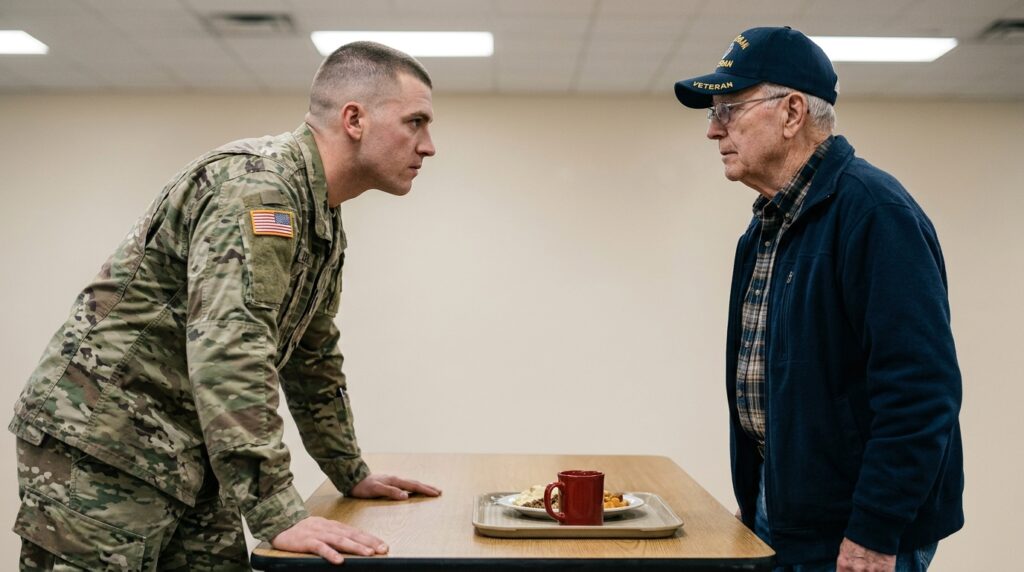
“You’ve got five seconds to take your hands off my table, Specialist,” Frank said, his thumb remaining flat against the bronze infantry pin of his cap.
The silence in the booth didn’t shatter; it simply tightened, drawing down like an old steel cable under a winch. Miller didn’t pull back. The younger man’s chest remained pitched forward, his green camouflage uniform casting a heavy, split-shadow across the Formica that completely swallowed the pale scratch on the laminate. His athletic build gave him the leverage of mass, but his knuckles were vibrating now, a subtle, high-frequency tremor that spoke of adrenaline turning sour in the blood.
“Or what, Pop?” Miller’s voice dropped an octave, losing its performative loudness for the benefit of the privates by the pie case. It became sharp, transactional, a tool meant to probe for weakness. “You going to write a letter to the editor? You going to call the sheriff? The county’s under active transport orders until midnight. Every square inch of civilian concrete within five miles of Gate 3 is base property if we need it for staging. Read the municipal code.”
“I don’t need to read the code,” Frank said. He didn’t blink. His eyes remained locked behind the thick, silver-framed lenses of his glasses, tracking the slight twitch in Miller’s left eyelid. “I helped lay the gravel for the staging lane behind Gate 3 forty-two years ago, back when your father was still trying to clear his lungs of the salt in the recruit depot. Your sleeves are rolled past the third knuckle, Miller. Your platoon sergeant hasn’t looked at your profile since Tuesday, has he?”
Miller’s jaw went hard. The reference to his uniform wasn’t a casual insult; it was an institutional strike, delivered with the dry precision of an inspection report. The two privates near the counter shifted their boots, the leather squeaking against the linoleum. One of them lowered his fork, his eyes tracking the dark blue windbreaker Frank wore. They were starting to notice the architecture of the old man’s spine—the way his shoulders didn’t slouch, the way his breath was timed to the rhythmic clink-clink of the loose metal ventilation grille overhead.
“You think you know my command, old man?” Miller leaned an inch lower, his face close enough that Frank could smell the sour tobacco and commercial mints on his breath. Then his eyes drifted. They didn’t go to the red ceramic mug or the brown plastic tray. They fixed on the small, tight line beneath the plaid fabric of Frank’s chest pocket—the sharp, unmistakable contour of the hand-filed brass key.
To a civilian, it was a house key or an old padlock anchor. To a soldier trained in logistics and security sweeps at the base perimeter, the length of the bit and the three irregular, hand-filed teeth suggested something else entirely: a Master-Level override pass for the older, heavy-iron lockers in the subterranean concrete bunkers beneath the old artillery ridge.
“Where’d you get that?” Miller asked. The arrogance vanished from his tone, replaced by the flat, suspicious gravity of an MP at a checkpoint. His hand moved, his fingers hooking into a tight, defensive claw an inch above the Formica. “That’s an un-serialized master blank. Those were turned in during the ’98 inventory cycle when they sealed the old munitions storage. You’re carrying base property, civilian.”
“It’s my key,” Frank said, his voice remaining level, an unmovable layer of gray shale. “It’s been in this pocket since before your uniform pattern was drawn on a drafting board.”
“That’s a Class-Four security marker,” Miller muttered, his eyes narrowing as he calculated the risk. In his mind, the old man wasn’t just a stubborn civilian anymore; he was a soft-target soft-security leak, an old timer who had walked away with an active military asset that belonged to the logistical chain he was currently sweating to protect. “You give that across the table right now, or we’re going to have three sedans from the provost marshal’s office sitting in this gravel lot before your coffee goes cold.”
“The coffee’s already cold, Specialist,” Frank whispered. He slowly let his left hand fall from his veteran cap, placing his palm flat against the brown plastic tray, his fingers bridging the gap between his chest and the red mug. He felt the coarse, pitted surface of the tray—the grease-resistant texture that had been scrubbed down with cheap ammonia until the gloss was entirely gone. “And you’re still standing in my light.”
Miller’s hand dropped. His fingers didn’t touch Frank’s shirt, but they clipped the edge of the brown plastic tray, the impact causing the remaining black liquid in the red mug to slosh against the porcelain rim. A single dark drop rolled down the side, pooling in the small, circular indentation meant for a bowl.
“I’m not asking you again, old man,” Miller said, his body weight shifting into his heels as he prepared to reach across the boundary. “The pass goes on the tray.”
Frank didn’t pull back his chest. He didn’t reach for the key. He simply tightened his core, his old muscles remembering the exact physics of a counter-brace, his center of gravity dropping six inches into the booth’s bench. He knew the friction of the floor; he knew the exact distance between Miller’s boots and the iron pedestal of the table. If the boy lunged, he wouldn’t hit a frail old civilian; he would hit eighty-two kilograms of dense, unyielding salt and iron that had survived three decades of gray earth.
Behind them, the front door of the diner gave a sharp, metallic rattle as the heavy iron latch cleared the frame, allowing a sudden gust of humid, diesel-heavy air to cut through the smell of grease.








