
CHAPTER 4: THE ERUPTION OF OLD IRON
“Specialist Miller,” the voice cut down the central aisle like a cold chisel hitting sheet metal.
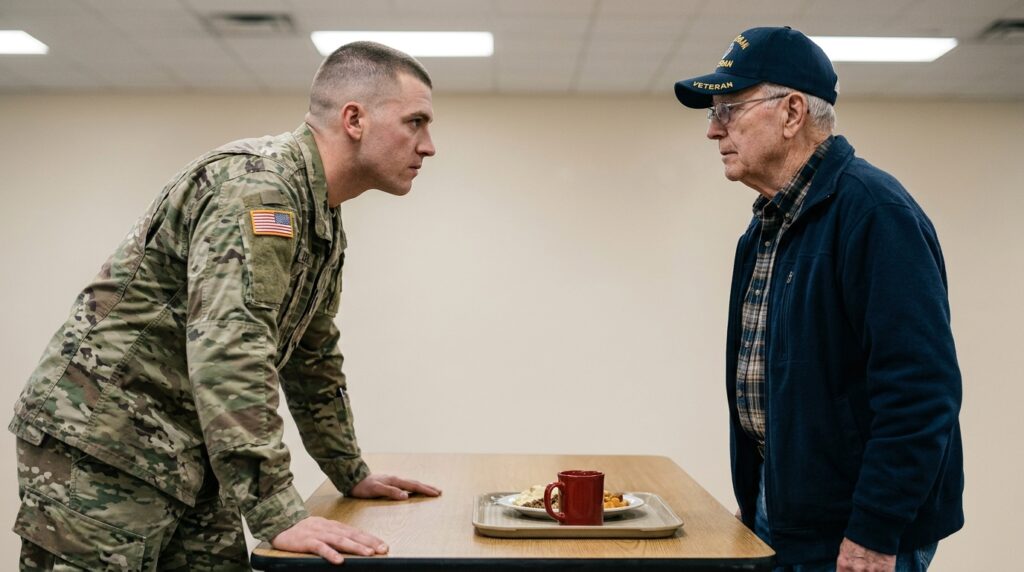
Miller did not turn. The momentum of his lean—the aggressive forward weight he had thrown across the Formica table—hung suspended in the damp, air-conditioned draft of the diner. His knuckles, still jammed against the pitted rim of the plastic tray, went white, then a gray, bloodless yellow. His tactical watch gave three tiny, frantic clicks against the laminate before his arm went perfectly rigid, locking his elbow into a hard, trembling pillar of defense.
“Command Sergeant Major,” Miller whispered. The words didn’t come from his chest; they leaked from the side of his mouth, flat and dried out by the sudden, massive drop in the room’s air pressure.
Behind him, Command Sergeant Major Reynolds did not stop. His heavy, low-quarter leather shoes met the linoleum with the measured, hydraulic cadence of an inspection officer clearing a barracks floor. He was fifty-eight, short-cropped iron-gray hair visible beneath his campaign cap, his summer-weight khakis pressed with sharp, razor-like creases that didn’t yield to the heavy August humidity. He carried a leather-bound logistical folder under his left arm, his right hand swinging in a short, deliberate five-inch arc that stopped the moment his chest cleared the back of Miller’s shoulder.
“Stand down, Specialist,” Reynolds barks, his voice dropping into the lower registry where commands become structural vibrations. “You aren’t fit to clear this man’s tray.”
Miller snapped backward. The movement was purely kinetic—a survivalist recoil that pulled his boots through the thin crust of red range clay he had deposited on the floor. His spine hit the vertical iron support pillar of the neighboring booth with a hard, hollow thump that rattled the sugar dispensers three rows over. He brought his hands down to his sides, his chest swelling as he tried to find the formal alignment of attention while trapped in the narrow space between the laminate tables.
The diner had lost all civilian sound. The young waitress with the coffee pot remained frozen by the pie case, the dark brew dripping from the spout onto her apron in slow, rhythmic thuds. The two junior enlistees behind Reynolds stood like stone monuments, their eyes drilled into the water-stained acoustic tiles above the register.
Reynolds didn’t look at Miller. He didn’t look at the two privates who had abandoned their breakfast. His gaze dropped to the center of the booth, tracking the pale scratch on the brown plastic tray, then moved to the red ceramic mug, and finally lifted to the silver-framed glasses resting beneath Frank’s black veteran cap.
For three seconds, the old NCO’s face remained a mask of hardened leather and deep, historical scar tissue. Then, with a slow, heavy deliberation that seemed to draw all the mass out of the room, Reynolds brought his right hand up to the brim of his cap. His fingers were perfectly flat, his palm turned inward by the exact degree required by the 1984 field manual, his forearm forming a rigid, horizontal bar of unyielding brass across his chest.
He saluted. He held it while the loose ventilation grille overhead gave two metallic clicks.
“Master Sergeant Vance,” Reynolds said, the rasp in his throat softening into something dense, historical, and heavy with the salt of old campaigns. “The regiment didn’t track your arrival on the morning log.”
Frank didn’t rise. He didn’t return the salute with his hand; he simply tilted his head forward by a fraction of an inch, his fingers remaining flat against the pitted surface of the plastic tray. The bronze pin on his cap caught the cold glare of the fluorescent tube above them, casting a long, narrow shadow across his forehead that touched the rim of his glasses.
“I don’t register with the base anymore, Thomas,” Frank said, his voice flat as river slate. “I just came for the coffee. Your boy here thinks my key belongs to his detail.”
Reynolds’ arm came down. His hand didn’t drop; it snapped to his seam with a dry, leather-on-cloth strike. He turned his head forty-five degrees to the left, his eyes locking onto Miller’s face with the crushing weight of a hydraulic press.
“You’ve been clearing Ridge Six, Specialist?” Reynolds asked.
“Sir, yes, sir,” Miller stammered, his chin tucked into his throat until the skin went white. “The logistics ledger showed a manifest discrepancy at Gate 3. Four tons over-scale on the wet-cell haul. We were told to sweep the local perimeter for old master keys or un-serialized blanks that could clear the old munitions cells.”
“You were told to check the digital registry at the transport office,” Reynolds said, his voice rising by a fraction of a decibel—a shift that caused the two privates by the counter to draw their shoulder blades even closer together. “You were not told to enter a civilian establishment and attempt to extract property from a retired command figure who was running reconnaissance details before your mother was clearing high school. Hand over the ledger.”
Miller’s fingers shook as he reached for the leather-folder tucked under his arm. He held it out, his arm trembling under the weight of his own sudden, absolute ruin.
Reynolds took the folder, but he didn’t open it. He kept his eyes on Frank’s plaid pocket, where the hand-filed brass teeth of the key were still visible through the thin flannel. A strange, dark complication passed across the Command Sergeant Major’s eyes—a sudden look of recognition that wasn’t structural, but personal. He knew the notches on that key. He had seen the same three-toothed pattern in his own father’s old footlocker down in the cellar of the family home in Salina.
“Master Sergeant,” Reynolds said, his voice dropping into a quiet, guarded vulnerability that Miller wasn’t meant to hear. “The logs from seventy-two… they aren’t in the transport office. We’ve been looking for the original battery manifests for six months. The base command wants them burned before the environmental audit on Friday.”
Frank’s hand tightened on the tray. He looked at the leather folder in Reynolds’ hand, then back to the key in his own pocket. The victory over Miller was a false flag; the real pressure wasn’t the booth or the young soldier’s arrogance. The real danger had just walked through the door with an iron salute, carrying the weight of a seventy-year-old secret that was about to be turned into ash.
“They won’t burn, Thomas,” Frank whispered, his eyes narrowing behind his lenses. “Not while I’m sitting at this table.”








