
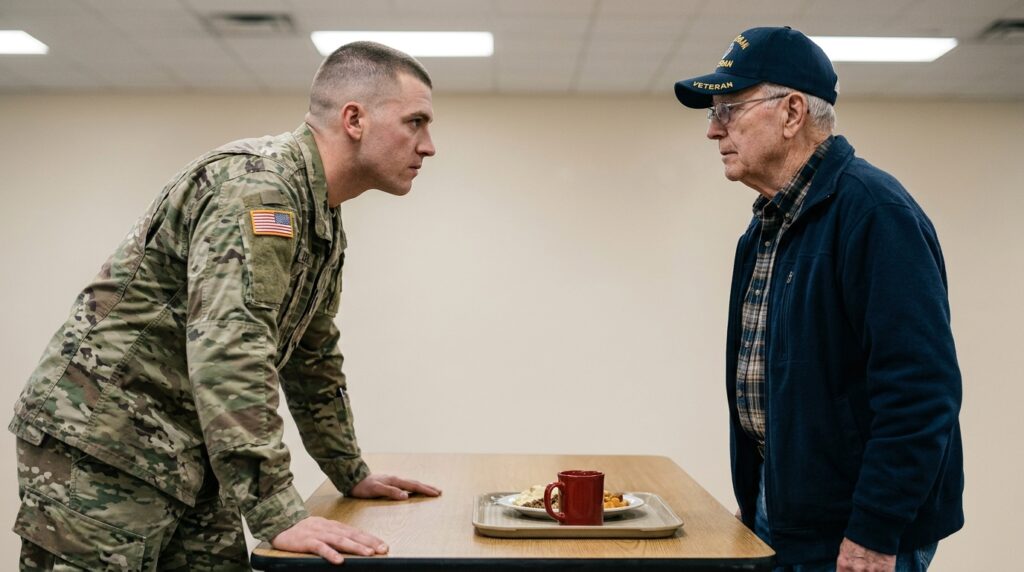
CHAPTER 5: THE SHATTERING OF THE DECOY
“A fire doesn’t care about the registry, Thomas,” Frank said. His palm stayed flat on the brown plastic tray, his fingers bridging the gap between his chest and the cold rim of the red mug. “And an audit only looks at the columns that are currently open. Your father didn’t spend three weeks down in the limestone damp just so a civilian sub-contractor could check a clean box on a Friday afternoon.”
Reynolds’ boots didn’t shift, but his chest went rigid under his starch-stiffened khakis. The leather folder under his arm gave a short, dry crease against his ribs.
“The order came down from the logistics center at Fort Liberty, Master Sergeant,” Reynolds said. He didn’t drop his chin, but his voice lost its public bark, settling into the flat, heavy timbre of a man who knew every line he spoke was being measured by the three young soldiers still pinned against the diner walls. “The dry-storage units on Ridge Six are designated as toxic ground now. Anything with a seventy-two stamp is classified as unstable ordinance residue. We clear it, or the county closes the road down to the railyard.”
“The ground isn’t toxic, son. The record is,” Frank whispered.
He slowly reached his right hand toward his flannel shirt pocket. Specialist Miller’s shoulders gave a small, reactive twitch, his boots sliding back half an inch through the dry range clay. He was still waiting for the old man to produce an identity card or a base pass, some standard piece of plastic that would justify the Command Sergeant Major’s salute and restore the universe to a structure he understood.
Instead, Frank pulled out the hand-filed brass key. He laid it flat on the center of the brown plastic tray, right next to the dried circle of black coffee. The three irregular teeth pointed directly at Reynolds’ leather folder.
“Take a look at the bit, Thomas,” Frank said, his voice flat as zinc sheeting. “The third ridge isn’t a locker notch. It’s an old ordnance stencil index. Your father filed that himself in the winter of seventy-three when the third battery leak started coming through the floorboards. He didn’t turn his logbook over to the company clerk. He locked it in the battery vault because he knew if the division saw the chemical counts on the water lines, they’d bury the whole grid under six feet of gravel and forget the names of the men who were holding the pumps.”
Reynolds looked down at the brass piece. His gray eyebrows came together, the skin between his lenses turning the pale, granular color of old salt. He recognized the specific, rough file-marks on the base of the key’s eye—the two tiny, parallel scores that matched his father’s old bench-vise down in the Kansas shop.
Miller cleared his throat, his youth and his panic leaking out in a sudden, sharp rasp. “Sir… if that’s an active battery key, it belongs in the transport block manifest. If the old man won’t hand over the entry pass—”
“Shut your mouth, Specialist,” Reynolds said without turning his eyes from the tray. The words were quiet, but they carried the heavy, crushing mass of a hydraulic ram. “Get your men out to the transport truck. You’ve got five minutes to check the straps on the four-ton container. If I see a single drop of condensation on those battery cases when you hit Gate 3, I’ll have your platoon clearing the grease traps at the motor pool until your contract expires.”
Miller didn’t stand on ceremony. He snapped a frantic, uncoordinated salute that nearly clipped his own cap brim, spun on his heel, and moved down the aisle with a quick, desperate scuffle of rubber soles. The two privates by the pie case followed him out like shadows caught in a sudden draft, their forks clinking against the plates as they abandoned their breakfast. The heavy iron latch of the diner door cleared the frame with a loud, dry clack, leaving the interior entirely to the old master sergeant and the man who had been a boy when the secrets were still fresh.
Reynolds slowly dropped his logistical folder onto the Formica table, his fingers remaining on the leather trim. He looked at the empty seats across the aisle, then slid his heavy frame into the booth opposite Frank, his knees knocking against the rusted iron pedestal beneath the laminate.
“My father died with the salt in his skin, Frank,” Reynolds said, the formal ‘Master Sergeant’ disappearing into the low hum of the refrigerator unit behind the counter. “The VA wouldn’t look at his charts because the seventy-two logs were marked as missing during the divisional transfer. If you’ve had the master index in this diner for thirty years, you let him sit in that hospital room in Salina without the paperwork.”
“I didn’t have the logbooks, Thomas,” Frank said, his silver-framed glasses reflecting the yellow light of the pastry case. He reached down, his old fingers picking up the hand-filed brass key, his thumb tracing the score-marks. “Your father didn’t leave them in the battery vault. He gave them to the logistics colonel—your current base commander’s predecessor. The decoy secret was the key, son. Everyone thought the keys opened the vault. But the vault’s been empty since the day they poured the concrete.”
Reynolds froze, his hand tightening on the edge of his folder until the leather groaned. “If the vault is empty… what’s Miller hauling in the four-ton container right now?”
Frank looked out the grease-filmed window, watching the heavy transport truck roar as its diesel engine caught the gear line for the highway. “They aren’t hauling batteries, Thomas. They’re hauling the original soil boxes from the ridge. The current base command is moving the evidence out to the commercial dump before the EPA inspector sets foot on Gate 3 tomorrow morning. And your father’s signature is on every manifest they’re using to clear the yard.”
The information gap opened beneath Reynolds like a dry well. The institutional salute, the pride of the uniform, the discipline of the regiment—it all cracked under the weight of a seventy-year-old operational fraud that was still active, still moving down Highway 24 at fifty miles an hour.








