
CHAPTER 8: THE RECOGNITION AUTHORITY
The high-pitched hydraulic screech of the main yard gate rolling open cut through the dead silence of Bay 4. Outside, a dark gray government-issued sedan rolled past the material flats, its tires crunching heavily over the wet gravel before coming to a stop directly outside the bay’s open sliding doors. The engine cut out, replaced by the wet, rhythmic hiss of air brakes from a nearby flatbed.
Arkwright’s hands shook so violently that a stack of yellow loose-leaf inspection slips slipped from his leather clipboard, drifting down into the damp grease near Miller’s boots. He didn’t bend to gather them. His eyes were locked on the three men who stepped out of the vehicle. Two wore dark, insulated windbreakers with the block letters of the Defense Contract Management Agency stamped across the shoulders. Between them walked an older man with silver hair and a heavy canvas trench coat, carrying a ruggedized aluminum digital caliper case.
“That’s the shipyard acceptance team,” Arkwright whispered, his throat so dry the vowels clicked. “They’re twenty minutes early.”
Vance attempted to straighten his spine against the unpainted iron workbench, his breath still coming in ragged, shallow gaps. The bright orange high-visibility shirt was twisted at the collar where Miller’s grip had anchored his mass. “Arkwright,” he muttered, his voice cracking as his eyes darted toward the administrative trailer at the back of the lot. “We need to clear the floor. We can’t have them testing the unrated flats while we’re standing around a broken workbench.”
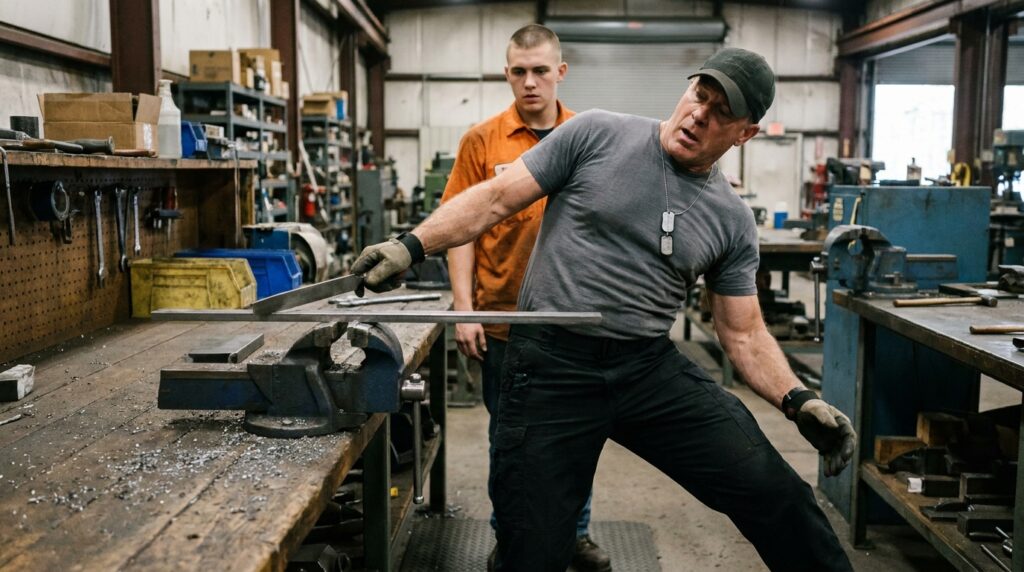
“The flats stay exactly where they are,” Miller said. His voice was low, carrying an iron-plated authority that stopped Vance from reaching for his tool belt. He released his containment grip completely, stepping back three inches to restore a cold, professional distance. He didn’t look at the welder. He reached down, picked up his scuffed leather work gloves from the iron bench, and pulled them back over his fingers, smoothing the seams with his thumbs.
The silver-haired inspector entered the bay first, his heavy leather boots making a distinct, hollow thud against the concrete plates. He stopped five feet from the workbench, his gray eyes scanning the raised safety shields of the grinding crew, the loose grade-eight bolt lying on the floor, and finally the dark alloy bar secured in the heavy bench vise. He didn’t look at Arkwright. His gaze stopped directly on Miller’s face.
“Miller,” the inspector said, his voice deep and leveled by thirty years of maritime yards. He set the aluminum caliper case down on a clean wooden crate near the lane line. “I heard you were pulling shifts out here in Ohio, but I didn’t believe the master registry until I saw the signature on the pre-inspection manifest.”
Arkwright blinked behind his thick spectacles, his glance shifting between the government representative and the quiet machinist who had spent six winters clearing mill scale in his shop. “Commander Vaughan? You two… you know each other?”
“Knowing him isn’t the term, Arkwright,” Vaughan said, pulling a pair of thin inspection glasses from his trench coat pocket. He didn’t smile. “This is Master Chief Miller. He spent twelve years running the hull validation trials for the Atlantic Fleet submarine construction program at Newport News. If a weld had a micro-fracture within three hundred miles of his deck, the navy didn’t pay for the iron. He literally wrote the omnidirectional hand-draw specification you’re supposed to be executing on these stabilizer plates.”
A heavy, absolute drop in room temperature seemed to pass through the grinding crew. Henderson, the senior millwright, let out a slow, low whistle, his eyes dropping to the dull silver dog tags that were still visible beneath the collar of Miller’s gray shirt. Vance’s face went entirely white beneath his fresh buzz cut. His hands dropped flat against his tactical pants, his fingers trembling against the seam as he realized the old man he had spent three weeks mocking as an obsolete laborer had spent decades training the instructors who certified his own trade school licenses.
“Arkwright,” Miller said, his tone entirely devoid of personal triumph as he pointed a gloved finger toward the heavy blueprint sheets lying near the vise. “The shipyard team doesn’t need to hook up the magnaflux current to these plates. The delivery batch from warehouse four is commercial structural grade iron—suffix X-seven-four-zero. The contract hand signed it out at dawn using a raised corporate logistics stamp.”
Commander Vaughan’s expression hardened instantly. He didn’t touch the file or the bar in the vise. He stepped directly to the workbench, picked up the crisp blueprint document, and held it to the green light of the mercury lamps, his thumb running over the glossy blue imprint line at the bottom.
“This is an unrated steel batch,” Vaughan said, his voice dropping into a dangerous, institutional register that bypassed the shop floor completely. “Who authorized the warehouse release for a primary naval defense assembly using an uncertified material stamp?”
Arkwright’s clipboard slipped from his armpit, hitting the concrete with a loud, ringing slap that caused two of the younger grinders to jump. He looked toward the corporate administrative trailer, where a dark silhouette was now visible against the lit office window, watching the bay through the horizontal blinds.
“I… I have the personnel ledger in my office,” Arkwright stammered, his face completely drained of color as he took two steps backward toward the exit line. “Vance signed the pull order. I didn’t see the suffix.”
“Vance didn’t generate the blue line override stamp from a field terminal,” Miller said, his eyes locking onto the dark silhouette in the distant office window. “The signature on the master log belongs to the regional director who cleared the procurement ledger last night. The welder was just the hand that loosened the bolts to make sure the verification failed on my shift.”
Vance sank against the iron frame of the bench, his chin tucked into his chest, unable to look the government inspector or the veteran in the eye. The silence of the bay was absolute, broken only by the cold, steady drip of sulfur coolant from the machine lines, as the true scale of the corporate fraud began to crack the facility wide open.








