
CHAPTER 1: THE FRICTION LIKENESS
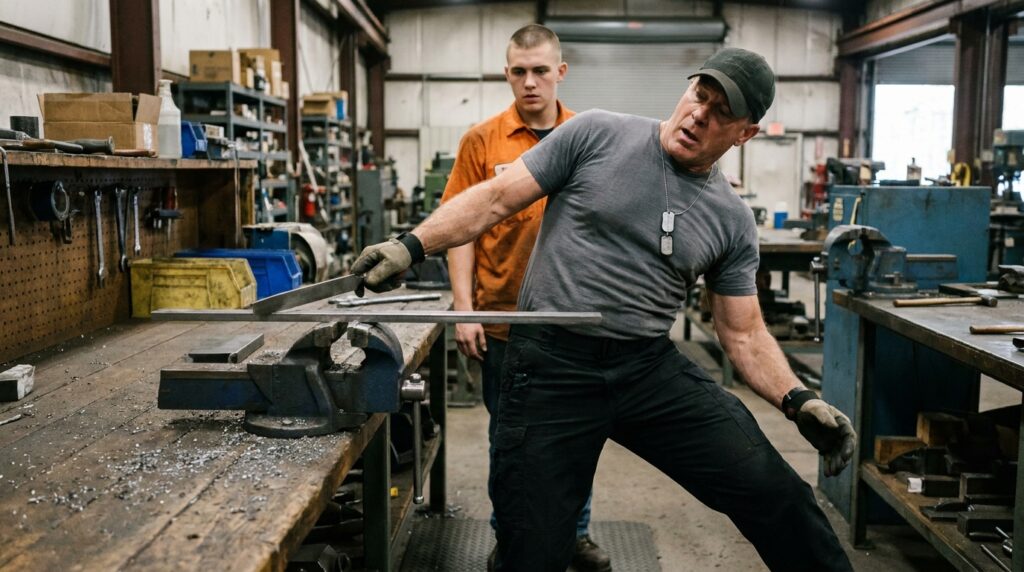
The air in Bay 4 always smelled of burnt oil, sulfur, and the cold, mineral dust of shaved iron. It was a heavy atmosphere, one that settled into the fabric of a gray fitted T-shirt and stayed there long after the shift whistle blew. Miller liked the weight of it. It was a predictable kind of friction, unlike the damp heat of the lowlands or the sharp, static hiss of a shipboard tactical deck he had left behind six winters ago. Here, if a piece of steel was warped, you knew exactly how many tons of hydraulic pressure it took to straighten the spine.
“The old man’s still counting threads,” a voice cut through the rhythmic, pneumatic thuds from the next bay.
Miller didn’t pause his hands. He kept his scuffed leather gloves wrapped around the wooden handle of his fourteen-inch bastard file, his movements steady, his spine locked at a precise forty-five-degree angle relative to the iron workbench. To his right, three feet away, the young contract welder—the one the crew called Vance—was leaning against a rack of oxygen cylinders. Vance’s orange high-visibility shirt was pristine, free of the dark grease rings that marked the clothes of the men who actually worked the cold-rolling mills.
“We’re paid by the piece on this assembly, Miller,” Vance said, his athletic frame shifting as he tucked his thumbs into his tool belt. His fresh buzz cut caught the harsh glare of the overhead mercury-vapor lamps. “Every minute you spend checking the scale with that antique micrometer is a minute the crane operators are sitting on their hands. Some of us have production bonuses to hit.”
Miller drew the file back, the teeth making a clean, raspy shhhk against the hardened steel bar clamped in the bench vise. He didn’t turn his head. Internal calculation was an old habit; you didn’t waste oxygen or attention on low-yield variables. Vance was twenty-seven, clear-eyed, and fast with a MIG torch, but he lacked the internal rhythm that came from surviving machinery that didn’t care about human flesh. Vance thought speed was a virtue because the metal hadn’t pushed back against him yet.
“The tool works fine if you don’t rush the steel,” Miller said. His voice was sparse, leveled by years of giving commands that had to be heard over the roar of twin-propeller turbines.
He reached down to adjust the rusted micrometer calipre resting on the corner of the bench. As his fingers touched the cold, knurled adjustment knob, he noticed a minute discrepancy—a shadow beneath the heavy iron foot of the workbench where it met the concrete floor. The grade-eight anchor bolt looked flush, but there was a faint ring of bright, unoxidized silver metal around the washer, as if the threads had been backed out within the last hour. A fraction of an inch of play. In a shop where an impact wrench could rattle a three-ton frame off its blocks, that tiny gap was an intentional error.
Miller didn’t call it out. He simply shifted his footing three inches back, widening his base to account for the loose foundation before his next stroke. Before he could reset his grip on the file, the heavy iron door of the office rattled open, and the shop supervisor stepped onto the iron catwalk above.








