
CHAPTER 5: THE SEATED COMPOSURE
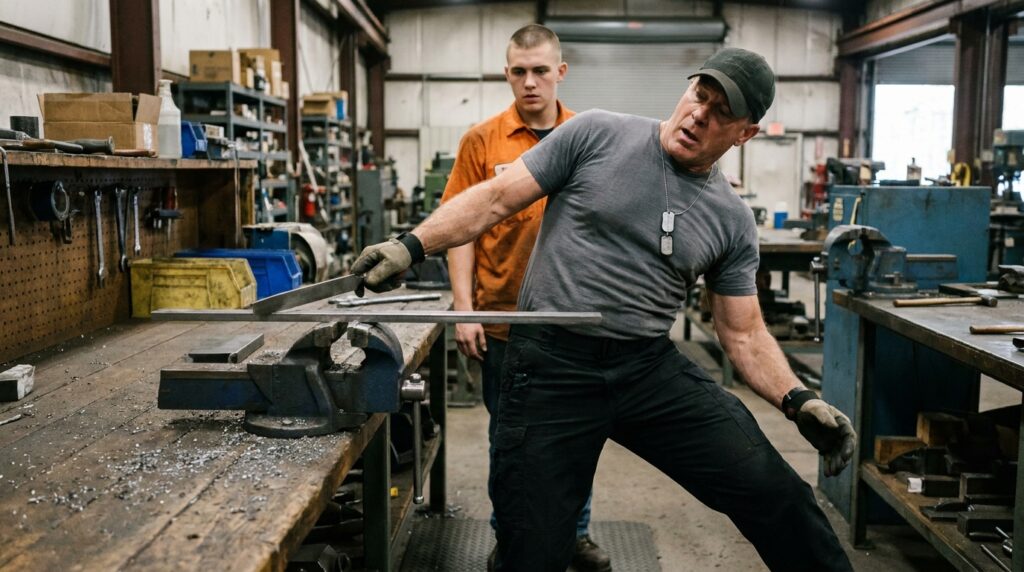
Miller planted his left gloved hand flat against the cold concrete slab. The grease-darkened surface was rough, scored with decades of heavy equipment tracks, and the coarse steel filings bit hard into the leather of his palm. He didn’t rush. He adjusted his posture, drawing his right heel back until his center of mass re-aligned over his base of support. He sat upright, his spine straightening into a rigid, deliberate line under the green glare of the mercury-vapor lamps.
His dark twill cap lay upside down three feet away near the base of the material racks, its inner rim white with salt lines from long summer shifts. Miller didn’t look at it yet. He looked at the bottom edge of the iron workbench frame where his fingers had slipped during the fall. Smeared along the unpainted lower flange was a thin, oily trace of black graphite grease—not the standard amber lithium compound used by the yard’s morning maintenance crew. It was a friction reducer, applied precisely to the anchor seating to ensure the bolt would break torque under heavy vibration without making an uninsulated squeal.
“Look at him,” Vance said, his voice dropping an octave as he moved deeper into the active safety lane. He crossed his arms over his unsoiled orange high-visibility shirt, his tactical boots crunching into a small pile of mill scale. “Arkwright, the guy can barely sit up straight. His eyes are glassy. If you let him stay on this line, he’s going to drop a five-hundred-pound alloy blank on his foot and sue the company before the week is out.”
The surrounding grinding hands remained motionless at their stations, their faces shadowed beneath their raised safety shields. None of them spoke. The unwritten etiquette of the yard was brutal but simple: when a lead hand went down, you didn’t interfere until the power dynamic re-stabilized. But the silence in Bay 4 was growing heavy, thick with the smell of sulfur coolant and the persistent, low-frequency rumble of the rolling mills in the next building.
Miller picked up his cap, shaking a small cluster of gray shavings from the peak before slipping it back over his clean-shaven head. He pulled the bill down low, casting his eyes into a deep shadow. “The bench didn’t slide because of my knees, Vance,” he said. His voice was quiet, completely clear of the mechanical panic that had gripped the supervisor. “The grade-eight anchor gave way because the threads were cleared of their friction coefficient.”
Vance laughed—a short, sharp bark that lacked any real weight. He stepped closer, his forward-leaning posture crowding the small pocket of space between the workbench and the floor drains. “Oh, I get it now. It’s the equipment’s fault. The concrete’s crooked, right? The air lines are leaking? Come on, old man. Just take your pension and clear out your locker so the guys who can still pull a tool can hit their numbers.”
Arkwright moved into the gap, his fingers trembling slightly as he held the leather-bound master clipboard. “Vance, shut it. Miller, if you need to go down to the medical trailer to get checked out, I’ll have Henderson run the sample piece. We can’t have the shipyard rep see a lead machinist sitting on the slab.”
“I don’t need the trailer,” Miller said, his gloved hand reaching out to grasp the cold, unpainted iron leg of the workbench.
He drove his heels into the concrete, his leg muscles locking into an efficient, biomechanical lever system that brought his entire frame up from the floor in one smooth, unhurried motion. He stood at his full height, his broad shoulders squared against the glare of the lamps, his gray fitted T-shirt damp with oil rings but his posture entirely centered.
As his tactical pants settled, his fingers brushed against the thick, crisp fold of the blueprint documents tucked inside his pocket. The paper was stiff, a different weight than the standard digital prints Arkwright usually generated from the office terminal. The material codes listed at the bottom of the ledger—the ones Vance had signed out from the yard’s central warehouse at six-thirty this morning—contained an extra alphanumeric suffix. A code that didn’t exist in the naval defense sub-contract specifications.
Vance took another step forward, his chest inches from Miller’s face, his face flushing red under his buzz cut as he realized the older man wasn’t retreating toward the office. He raised both hands, palms flat and fingers extended, initiating a heavy, intimidating shove designed to force the veteran back down against the iron frame.
“I told you to step away from the iron,” Vance hissed.
Miller’s eyes didn’t widen. He watched the younger man’s shoulders lean into the thrust, his internal tracking systems calculating the velocity, the leverage, and the lack of balance in the contract welder’s forward drive before the palms could even touch his shirt.








