
CHAPTER 2: THE BACKED ANCHOR
“Miller! Vance! Kill the chatter and double up on Bay 4!”
The supervisor’s voice came down from the galvanized iron catwalk like a rusty shear through sheet metal. Arkwright was fifty-eight, his skin stained with forty years of cutting-fluid mist and the deep, permanent charcoal lines of embedded iron filings beneath his fingernails. He was clutching a leather-bound master clipboard against his oil-smeared canvas vest, his boots clacking hard against the open-toe grating as he came down the spiral stairs.
Vance didn’t drop his posture immediately. He allowed himself one long, deliberate second to exhale a stream of winter breath into the unheated air of the bay, his jaw tightening as he looked from Miller back to the catwalk. “We’re on it, boss,” Vance called out, his tone carrying that smooth, unearned confidence common to contract hands who knew they could pack their rigs and find another yard by Friday if the foreman got too loud. “Just making sure the old head’s calibrated for the titanium run. Don’t want him stripping the teeth on those premium blanks.”
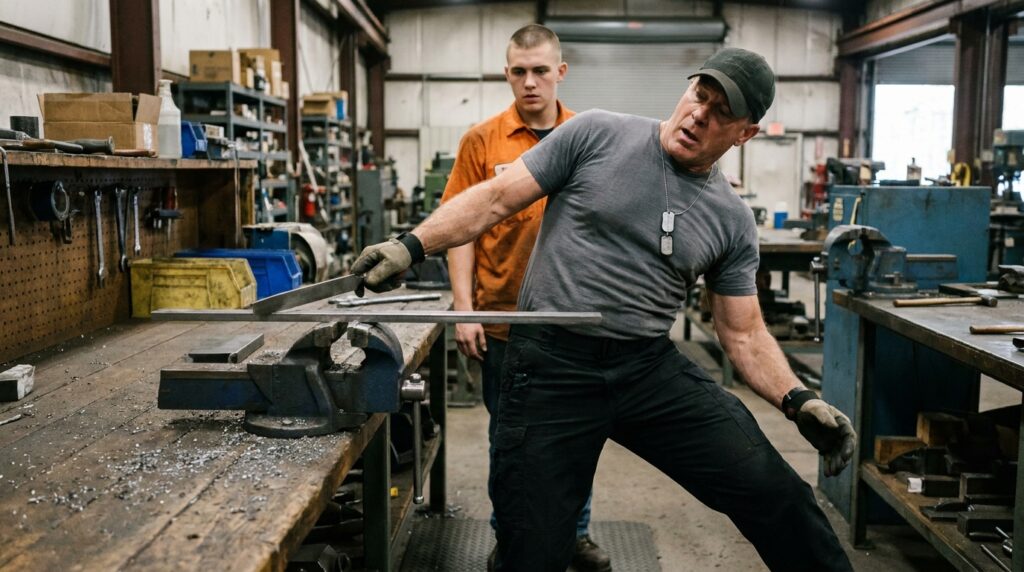
Miller didn’t answer. He turned his back to Vance, his gloved fingers clamping down on the knurled locking dial of his dual-scale micrometer. The metal of the tool was ice-cold against his palm, a familiar, unyielding reference point. He slipped the instrument back into his tactical pants pocket, his thumb brushing the rough fabric edge of his hidden dog tags where they lay flat against his chest under his gray shirt.
The shop floor was vibrating. Thirty feet away, the heavy three-hundred-ton hydraulic press brake began its stroke, a deep, bone-rattling thug-chuuurn that sent ripples through the puddles of sulfur-base coolant near the floor drains. With that vibration came the shift. Miller watched the iron foot of the workbench. As the floor plates shuddered under the press’s stroke, the loose washer beneath the grade-eight anchor bolt did not just jiggle—it turned. It was a smooth, oiled rotation, moving counter-clockwise by less than half a millimeter.
An anchor bolt under standard shop vibration didn’t back out with that kind of greasy ease unless the threads had been thoroughly scrubbed with graphite spray and deliberately relieved of their torque. Someone had spent five minutes with an uninsulated slugging wrench during the pre-shift maintenance window, masking the noise behind the morning compressor blowouts.
“Listen up,” Arkwright said, dropping his heavy clipboard onto the corner of the iron workbench with a sharp slap that sent a small cloud of gray metallic dust into the air. The small circle of mixed-age laborers from the surrounding grinding stations began to drift over, dropping their safety shields onto their foreheads, their faces pale under the green-tinted mercury lamps. “Corporate just pushed the delivery schedule forward on the maritime stabilizer plates. The inspector from the shipyard is coming through the gate at fourteen-hundred hours. If these titanium-alloy edges aren’t hand-finished to a three-point-two micron tolerance, the whole lot gets red-tagged.”
“Hand-finished?” Vance scoffed, crossing his muscular arms across his orange shirt. “We’ve got two automated radial sanders sitting idle in Bay 2. Why are we wasting time with manual bastard files?”
“Because the sanders leave directional micro-grooves that cause stress fractures under forty tons of hydraulic shear,” Arkwright snapped, his eyes drilling into Vance’s fresh buzz cut. “The naval spec explicitly demands an cross-hatched, omnidirectional draw-file finish. It takes a steady hand, perfect leverage, and patience. That’s why Miller’s taking the lead on the sample piece. You lot watch his stroke, copy his angle, and don’t deviate by a single degree.”
Vance’s face darkened, the patronizing smirk vanishing from his lips as he felt the eyes of the older shop hands shift toward him. He looked down at the iron bench, his fingers twitching against his tool belt. “A file’s a file, Arkwright. You push, you take off metal. It’s not rocket science.”
“It’s material science, kid,” Arkwright said flatly. He turned to Miller, his expression softening into the guarded, professional deference he only showed to the few men in the yard who didn’t complain about the tolerances. “Whenever you’re ready, Chief. Show ’em how we clear the mill scale without glazing the core.”
Miller stepped up to the bench. His boots found the familiar oil-slicked grain of the concrete floor. He reached out and verified the vise pressure on the hardened steel alloy bar; it was clamped tight, four inches of dark, unpolished metal protruding from the hardened serrated jaws. He knew the bench was compromised. He knew that the moment he leaned his full eighty-five kilograms of frame into the forward stroke, the loose back leg would give way, transferring the kinetic energy of his thrust back into his own spine and destroying his center of gravity.
He could stop. He could point to the silver ring around the washer and expose the sabotage right now in front of Arkwright and the entire crew. But in the environment of the yard, an unproven accusation was just text; it didn’t carry the weight of a physical fact. Vance would claim ignorance, the crew would see it as an old man being paranoid about his footing, and the structural tension on the floor would remain unresolved.
Miller drew the file back, his left hand cupping the tip of the steel blade, his right hand locking around the wooden handle. He looked across the iron bar, his eyes locking directly onto Vance’s intense, unblinking stare. The young welder was leaning forward slightly, his tactical boots planted, his chest rising and falling with a shallow, expectant breath. He was waiting for the drop.
“Watch the wrist orientation,” Miller said to the gathered crew, his voice low, steady, and entirely devoid of hurry. “If you don’t lock the forearm bone to the tool spine, the metal will fight you back.”
He tilted the file exactly twelve degrees, verified the friction against the rough mill scale, and prepared to strike.








