
CHAPTER 3: THE PRECISION RUN
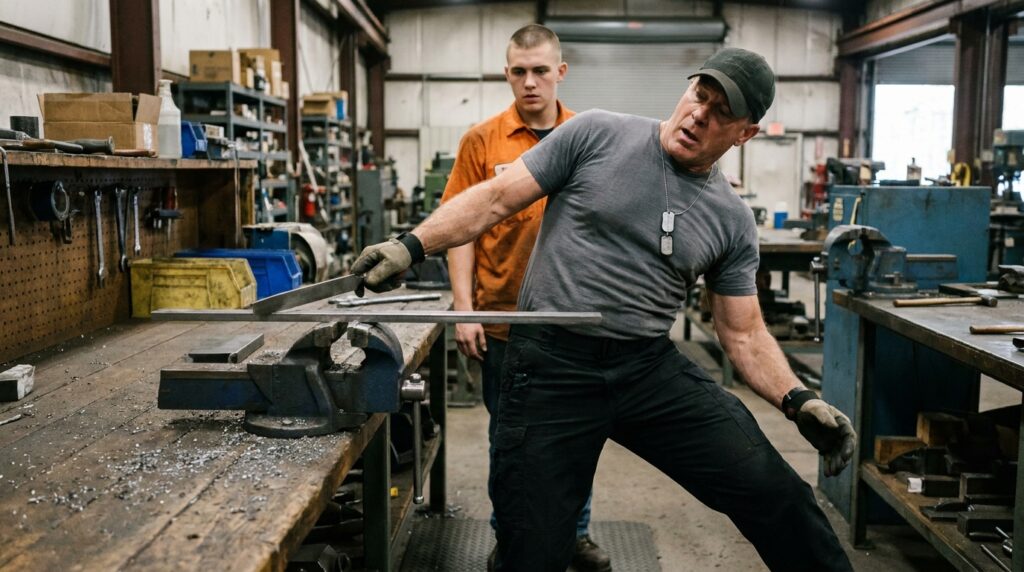
The first stroke was purely a diagnostic measurement. Miller pushed the fourteen-inch file forward with a steady, deliberate translation of weight from his back heel through his locked shoulder, keeping his forearms parallel to the unpainted iron workbench. The heavy steel file grated against the unpolished crown of the titanium-alloy bar, producing a dry, rhythmic shhhk that vibrated through the dense meat of his palms.
It didn’t feel right.
The resistance was too soft. True naval-grade titanium-alloy met a bastard file with an unyielding, glass-like stubbornness that glided before it bit, requiring a constant adjustment of manual pressure to avoid glazing the tool’s teeth. This material gave way with an oily, granular compliance, shedding fine gray curls that clotted the grooves too quickly. It was the characteristic signature of cheap, high-sulfur structural steel—re-rolled commercial stock masquerading under a military certification tag. Miller didn’t change his expression, but his fingers registered the tolerance anomaly to the millimeter.
“See how he controls the drag?” Arkwright’s voice boomed above the persistent whistle of the shop’s primary air lines. The supervisor stepped closer, his heavy leather clipboard tucked beneath his armpit, his spectacles catching the low, green hue of the mercury lamps. “He isn’t bouncing the heel. He’s utilizing the center five inches of the blade to ensure an even thermal distribution across the grain. Vance, look at his posture.”
Vance didn’t move from his position by the oxygen rack. His muscular arms remained tightly crossed over his bright orange high-visibility shirt, his clean tactical boots planted square on the grease-stained concrete. His jaw worked on a piece of tobacco, his eyes tracking the slight, rhythmic movement of Miller’s shoulders with a hard, calculative focus. He wasn’t looking at the finish on the steel. He was watching the bottom left leg of the workbench, waiting for the oscillation of the third stroke to catch the unseated thread of the backed-out anchor bolt.
“Looks like a lot of slow motion to me, Arkwright,” Vance said, his voice flat, carry-over bravado from the younger shift hands who had gathered behind him. “The mill schedule is dropping three more pallets into Bay 4 by noon. If we spend twenty minutes per block performing a manual cross-hatch, the night shift is going to be buried under dead weight. The automated sanders would have cleared that scale in sixty seconds.”
“And the automated sanders would have introduced micro-fractures that fail a magnaflux test the moment the inspector hooks up the current,” Miller said, his tone low and level. He didn’t break his stroke. He drew the file back on the recovery path, his left thumb clearing the clotted metal filings from the tool’s face with a single, practiced swipe of his leather glove. “Speed without calibration is just an efficient way to manufacture scrap iron, son.”
A faint murmur went through the grinding hands behind Vance. An older millwright named Henderson cleared his throat, nodding toward the workbench, but Vance’s face flushed a deep, unvarnished crimson beneath his fresh buzz cut. The young contract welder took a step into the active safety lane, his hands dropping to his tool belt, his chest swelling beneath his orange shirt.
“I’m not your son, old head,” Vance hissed, his voice dropping into a quiet, territorial register that bypassed the supervisor entirely. “And my welds don’t fail inspection. You spend more time staring at your rusted micrometers than you do running production. The only reason Arkwright keeps you on the lead line is because you’ve been drawing a paycheck since the foundation plates were poured.”
Arkwright stepped between them, his clipboard coming up like a barrier. “That’s enough, Vance. Back off the lane. Miller’s got thirty years of specialized naval spec work behind his belt. You’re here to absorb the instruction, not litigate the quota.”
“He’s thirty years past his prime,” Vance muttered, but he stepped back an inch, his eyes dropping back to the base of the workbench.
Miller ignored the heat in the younger man’s voice. His attention remained fixed on the mechanical feedback coming through his boots. The floor was vibrating harder now; the distant three-hundred-ton press brake had increased its cadence, sending long, low-frequency harmonics through the concrete plates. With every pulse, the unseated washer on the rear leg shifted another fraction of a degree. The workbench was beginning to lean, its entire dead weight resting on the three remaining points of contact.
Miller adjusted his grip for the fourth stroke—the heavy, definitive cut intended to smooth the structural bevel. He knew the bench would shift the moment he applied forty kilograms of forward torque. He could feel the latent imbalance through his locked left knee. But beneath that immediate physical hazard, a larger discrepancy was mounting in his mind. He looked down at the gray shavings accumulating on the unpainted iron surface. They were too dark, too brittle.
He reached into his pocket, his fingers brushing past the cold metal dials of his micrometer to touch the worn edge of a master blueprint fold tucked into his belt. There was something wrong with the material delivery codes Arkwright had received from corporate. The specs didn’t match the iron on the bench. If he allowed himself to be distracted by Vance’s small-time shop sabotage, he would miss the larger failure currently moving through the yard’s logistics line.
He tightened his jaw, locked his spine at forty-five degrees, and pushed the file into the center of the bar.








