
CHAPTER 6: THE MEASURED RESTRAINT
“Don’t lean your weight into a strike you aren’t prepared to carry,” Miller said.
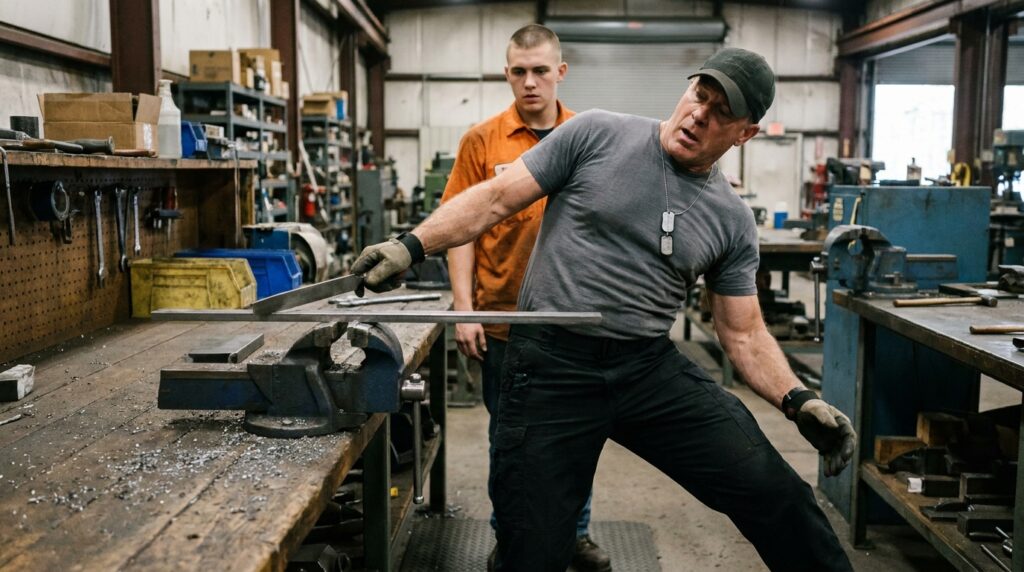
The words left his mouth before Vance’s palms even made contact with his gray T-shirt. The younger welder’s drive was heavy but overextended, his hips trailing behind his chest in a desperate, short-sighted play for physical dominance. It was the kind of uncalibrated aggression Miller had spent twenty years parsing on crowded military decks—predictable, top-heavy, and entirely reliant on the target remaining static.
Miller didn’t take a step back. He didn’t drop his center of gravity into an aggressive fighter’s crouch. Instead, his left boot slid a mere three inches outward on the grease-grained concrete, widening his skeletal base just enough to alter the angle of entry. As Vance’s right wrist locked to deliver the thrust, Miller’s gloved left hand intercepted the forearm. It was a precise, defensive connection—not a violent strike, but a heavy manipulation of momentum using the rigid, unyielding bone of his own locked forearm.
With a split-second rotation of his hip, Miller caught Vance’s lead wrist in a secure, leather-clad grip. He didn’t punch; he shifted his mass backward by an inch, absorbing the kinetic energy of Vance’s rush and redirecting it downward toward the cold iron foot of the compromised workbench. The physics of the movement were clean, economic, and completely non-graphic. The young man’s forward acceleration became his own trap. Miller’s thumb found the nerve cluster between the welder’s radius and ulna, applying a steady, mechanical compression that forced the joint to lock up to the shoulder.
Vance’s torso buckled forward instantly. His chin dropped, his tactical boots skittering across the unpainted shavings on the floor as his balance evaporated into a painful compliance hold. He was completely immobilized, his arm pinned at an unnatural, unyielding angle across his own chest, his face turning a dark, mottled purple beneath his fresh buzz cut. He tried to pull back, to wrench his frame out of the mechanical vise of the veteran’s grip, but the more he struggled, the deeper the torque settled into his shoulder joint.
The entire bay plummeted into a profound, suffocating silence.
The three-hundred-ton hydraulic press brake in the next building finished its stroke with a distant, hollow thug-chuuurn, but within Bay 4, every grinding wheel and automatic sander cut out one by one. The surrounding crew members stood entirely frozen, their tools held dead at their sides, their eyes wide beneath their raised safety shields as they watched the loud-mouthed yard bully held completely motionless by a single hand. Miller’s gray shirt shifted slightly with his breath, allowing the dull silver edges of his hidden dog tags to slip from his collar, catching the harsh, green mercury glare above.
“Let go of me,” Vance choked out, his arrogance crumbling into a dry, panicked rattle as his boots lost traction against the slick sulfur-coolant film near the floor drain. “Arkwright—get this psycho off me!”
Arkwright didn’t move. He stood three feet away, his leather-bound master clipboard clutched against his canvas vest like a shield, his jaw slack as his eyes moved from the loose bolt on the floor to the flawless discipline of the veteran’s posture. He had seen bar fights in the yard before, but this wasn’t a fight. This was a clinical calibration—a total containment of a threat performed without a single blow being thrown.
Miller kept his grip tight, his eyes tracking Vance’s shoulder position to ensure no structural injury occurred. He wasn’t looking for vengeance; he was holding a line. But as his fingers maintained the lock, his right hand reached into his tactical pocket, pulling out the crisp, heavy fold of the blueprint orders he had pulled from the shift desk earlier.
The paper crinkled in the silence. He dropped the sheets onto the unpainted iron surface of the workbench, directly beside the loose anchor bolt. Under the green light, the bottom margin of the ledger was now fully visible to Arkwright. The master stamps from the corporate logistics office weren’t standard ink; they were raised, glossy blue line imprints—the kind used to override naval defense specifications during warehouse material swaps.
Vance’s eyes darted toward the papers on the iron bench, the panic in his expression sharpening into something older and far more dangerous than simple shop floor embarrassment. He knew what those extra alphanumeric suffixes meant.
Miller leaned in slightly, his voice dropping into a register that only Vance could hear over the low hum of the ventilation units. “The benchmark isn’t the only thing you loosened this morning, kid. Let’s see what Arkwright thinks about the grade-three iron you signed out under a naval hull designation.”








