Chapter 9: The Space That Belonged to Everyone
By early autumn, the Texas heat had softened enough for people to linger outside without immediately seeking shade.
The Cedar Ridge supermarket was hosting its annual community appreciation day.
Local organizations set up tables near the entrance.
Volunteers collected canned goods.
A veterans’ assistance group distributed information about transportation services, home modifications, and community resources.
Daniel attended with his mother.
Ruth had recovered enough from surgery to walk short distances with a cane.
She insisted on carrying her own small shopping bag.
Daniel knew better than to argue.
They arrived shortly after ten.
The accessible parking area was clear.
Daniel transferred from his car into his wheelchair, then helped Ruth retrieve her cane.
She looked down at the blue stripes.
“That’s where it happened?”
“Right there.”
Ruth studied the space.
“It doesn’t look like much.”
Daniel smiled.
“That’s the point.”
They made their way toward the entrance.
Near the donation table, Daniel noticed a familiar figure.
Brenda Whitcomb was wearing a bright turquoise blouse, white pants, and her unmistakable pink cat-eye glasses.
Her electric-blue hair had been replaced by a more subdued auburn style.
She was helping organize boxes of canned food.
Daniel stopped.
Brenda looked up.
For a moment, neither spoke.
Then she approached slowly.
“Mr. Mercer.”
“Mrs. Whitcomb.”
She glanced toward Ruth.
Daniel introduced his mother.
Brenda greeted her politely.
There was no dramatic confrontation.
No gathering crowd.
No demand for forgiveness.
Brenda simply thanked Daniel for replying to her letter.
Then she told him that she had been volunteering with the food drive for several weeks.
“I needed to spend less time telling people how things should be done,” she said, “and more time actually helping.”
Daniel nodded.
He did not know whether the statement reflected a permanent change.
But it was a better beginning than another argument.
Ruth looked toward the donation table.
“Do you need help sorting anything?”
Brenda smiled.
“We could use another pair of hands.”
Ruth handed Daniel her shopping bag.
“Then I suppose you can manage without me for a little while.”
Daniel laughed.
His mother followed Brenda toward the table.
He watched them for a moment.
Then he rolled toward the veterans’ assistance booth.
There, he spoke with several older veterans about transportation challenges.
One man described difficulty finding accessible medical appointments.
Another had recently begun using a walker.
A woman whose husband had suffered a stroke asked about vehicle modifications.
Daniel listened.
He offered practical suggestions where he could.
He also shared information about the supermarket’s updated accessibility procedures.
The conversation reminded him why he had continued pursuing the matter after the original confrontation.
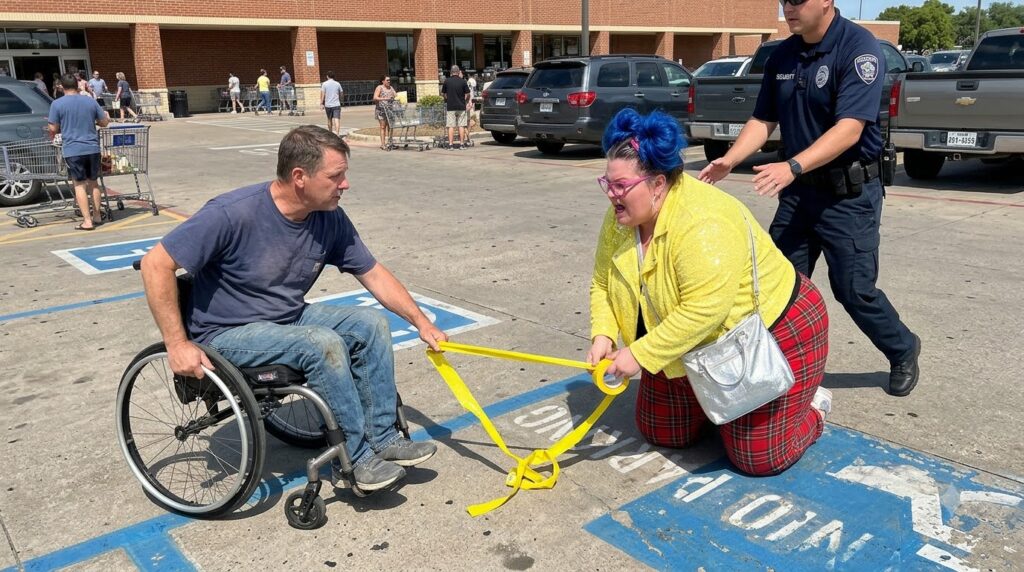
The issue had never been a strip of yellow tape.
It was the assumption behind it.
The belief that someone else’s access could be sacrificed for convenience.
That a person with a disability should wait, move aside, or accept whatever space remained.
Daniel had spent years rebuilding his independence after the accident.
He knew how much effort ordinary activities could require.
He also knew that dignity was not something another person could grant or withhold.
It existed whether others respected it or not.
What society could do was remove unnecessary barriers.
Near noon, Ruth returned carrying a small paper plate of cookies.
She offered one to Daniel.
He accepted.
“How was volunteering?”
“Very nice.”
“And Mrs. Whitcomb?”
Ruth considered.
“She listens more than she talks.”
Daniel smiled.
“That’s new.”
Ruth gave him a look.
“People can learn.”
He nodded.
Across the parking lot, a driver pulled toward the accessible spaces.
For a brief moment, the vehicle slowed near the blue-striped aisle.
Daniel watched automatically.
The driver checked the markings, adjusted the steering wheel, and parked correctly within the adjacent space.
The access aisle remained open.
Nothing remarkable happened.
No one shouted.
No one intervened.
A man using a walker stepped out of the vehicle and made his way toward the store without obstruction.
Daniel looked away.
For him, that quiet moment was more satisfying than any public apology could have been.
Because the purpose of the entire struggle had never been to humiliate Brenda.
It had been to make sure the next person did not have to fight the same battle.
Later that afternoon, as the event ended, Brenda helped carry the final donation boxes into the store.
She passed the accessible parking area on her way back.
The blue stripes were clean and unobstructed.
She stopped briefly.
Months earlier, she had looked at those markings and seen unused pavement.
Now she understood what they represented.
Room to open a door.
Room to lower a ramp.
Room to move safely.
Room for someone to live an ordinary life without asking permission.
Brenda continued toward her car.
She parked farther from the entrance these days, in an ordinary space with plenty of room.
It was not a sacrifice.
It was simply the right place to park.
Daniel and Ruth left a few minutes later.
As he drove through the supermarket exit, Daniel glanced once toward the front row.
The accessible aisle was still clear.
He thought about the confrontation that had started everything: a woman in a yellow jacket, a roll of tape, and a demand that he surrender a space she had no right to claim.
The argument had lasted only seconds.
Its consequences had taken weeks to unfold.
A security guard had been vindicated.
A store had improved its procedures.
Several customers had finally been heard.
A woman had faced the consequences of her actions and begun changing her behavior.
And Daniel had returned to the simple routine he had wanted all along.
Shopping for groceries.
Caring for his mother.
Living his life.
He turned onto the main road.
Beside him, Ruth was already discussing what they should make for dinner.
Daniel listened, smiled, and headed home.
Behind them, the blue-striped aisle remained exactly as it was meant to be.
Open, protected, and available to everyone who needed it.
Because fairness is not measured by how much space we can claim for ourselves.
Sometimes, it is measured by the space we make sure to leave for someone else.