Chapter 4: The Woman Behind the Proposal
The parking proposal had been submitted eleven days earlier.
Its stated purpose was to improve traffic flow and create additional short-term parking near the supermarket entrance.
At first glance, the document looked ordinary.
It included a diagram, photographs, and a recommendation to reorganize several spaces along the front row.
But Daniel noticed the problem immediately.
The proposed diagram reduced the usable area beside one accessible parking space.
The blue-striped access aisle had been labeled as an “underutilized buffer.”
Elaine read the phrase aloud.
Daniel almost laughed.
Underutilized.
It was the kind of word that could make a necessary feature sound like wasted space.
A fire exit might look underutilized on an ordinary afternoon.
So might an emergency ramp.
That did not make either one unnecessary.
The proposal had been submitted by Whitcomb Community Consulting.
Brenda’s name appeared at the bottom.
Elaine searched the company online.
Whitcomb Community Consulting was a small business that described itself as specializing in neighborhood improvements, property organization, and commercial-space efficiency.
Its website featured photographs of attractive homes, landscaped entrances, and neatly arranged parking lots.
Brenda appeared in several pictures, smiling beneath different elaborate hairstyles.
Daniel studied the screen.
“She does this professionally?”
Elaine shook her head.
“Apparently she advises people on it.”
The distinction mattered.
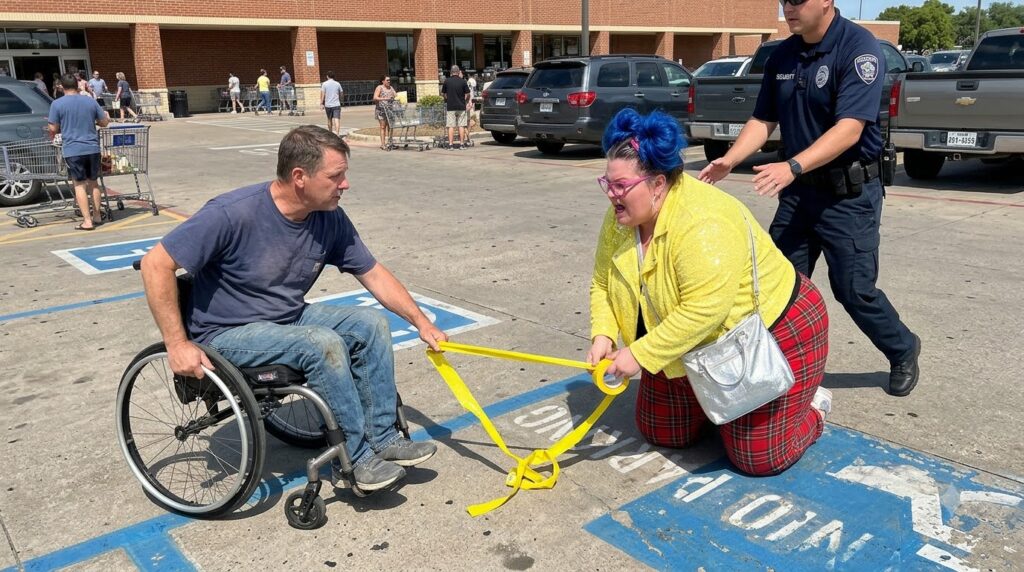
Brenda was not simply a frustrated customer improvising with tape.
She had been trying to demonstrate a parking arrangement she wanted adopted.
And she had chosen an accessible aisle as her example.
The white sedan suddenly made sense.
Brenda had likely been showing someone how the new space would work.
Elaine contacted the property manager again.
This time, she asked about the proposal.
The answer came quickly.
Whitcomb Community Consulting had no contract with the property owner.
Brenda had submitted an unsolicited recommendation and requested a meeting.
The proposal had not been approved.
In fact, the property manager had already replied that any change affecting accessible parking would require review and could not be implemented by a private individual.
Brenda had received that response three days before the confrontation.
Daniel stared at the date.
She knew.
She had been told not to alter the parking area.
And she had done it anyway.
That changed the character of the incident.
It was no longer possible to explain her behavior as a misunderstanding about the markings.
Elaine printed the email correspondence and placed it in a folder.
“We’ll preserve the video,” she said. “And I’ll make sure corporate gets the full account.”
Marcus looked relieved.
But Daniel still had a question.
“Who was the woman in the white sedan?”
Elaine hesitated.
“The property manager mentioned Brenda was trying to recruit local business owners to support the proposal.”
The woman might have been one of them.
Daniel decided not to speculate.
He had learned long ago that assumptions could become obstacles of their own.
Instead, he asked Elaine whether she would document the repeated complaints and review the parking area for accessibility.
She agreed.
Then he asked for one more thing.
“Please don’t make this about me being a veteran.”
Elaine looked surprised.
Daniel continued.
“I appreciate people respecting my service. But I shouldn’t need a military record to use a wheelchair ramp or an access aisle.”
He paused.
“Neither should anyone else.”
Elaine nodded slowly.
“You’re right.”
For Daniel, that was the heart of the matter.
He had served his country before the accident.
He had worked afterward, raised a daughter, paid taxes, cared for his parents, and contributed to his community.
But his right to enter a grocery store safely did not depend on any of those accomplishments.
It belonged to him simply because he was a person.
When Daniel finally returned to his car, the afternoon heat had intensified.
He transferred into the driver’s seat, folded his wheelchair, and secured it beside him.
His groceries were waiting in the back.
As he started the engine, he noticed Brenda standing near the far end of the parking lot.
She was no longer shouting.
She was speaking with a gray-haired man in a business shirt.
The man held a folder.
Brenda gestured repeatedly toward the accessible spaces.
Daniel recognized him from a photograph in the manager’s office.
He was Thomas Keene, the regional property manager.
Daniel watched as Thomas examined the blue stripes.
Then Thomas looked toward Brenda and shook his head.
Brenda’s expression changed.
Her shoulders stiffened.
Her mouth opened.
Even through the closed car window, Daniel could tell she was furious.
He drove home.
He did not know that the meeting he had just witnessed would cost Brenda something she valued far more than a parking space.