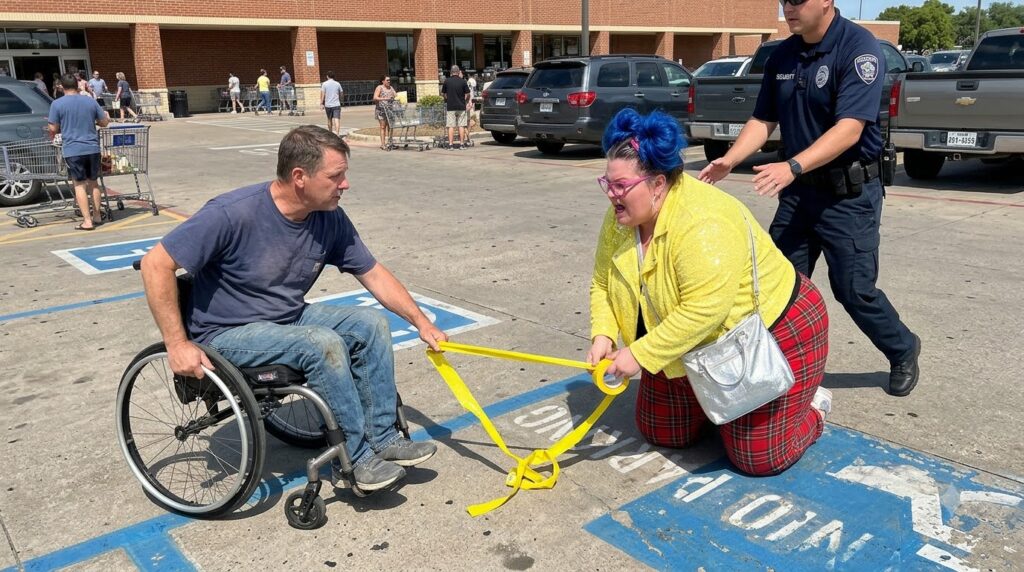
Chapter 7: The Price of Being Right
Brenda’s second complaint did not produce the apology she expected.
Instead, the supermarket’s corporate office sent her a formal response.
The letter stated that the available evidence supported the security guard’s account.
It confirmed that no customer had permission to alter the accessible parking area.
It also advised Brenda that future interference with marked access routes could result in removal from the property and referral to appropriate authorities.
The letter did not insult her.
It did not threaten her unnecessarily.
It simply documented the facts.
Brenda hated it.
She read it three times at her kitchen table.
Richard watched from the doorway.
“What does it say?”
“They’re taking his side.”
Richard approached.
“Whose side?”
“The wheelchair man.”
Richard looked at the letter.
“Maybe they’re taking the side of the evidence.”
Brenda pushed the paper away.
For several days, she had been telling friends that the supermarket had treated her unfairly.
Some sympathized before hearing the details.
Others asked questions she did not want to answer.
One neighbor asked whether she had actually placed tape over an accessible aisle.
Brenda insisted she had been demonstrating a temporary parking concept.
The neighbor asked why she had done it while someone in a wheelchair was trying to pass.
Brenda ended the conversation.
The most painful consequence arrived later that week.
The neighborhood business forum confirmed that it would not reschedule her presentation.
Its organizers explained that they could not endorse a parking-efficiency proposal that interfered with accessibility.
Brenda had hoped the event would help her consulting business grow.
Instead, the controversy made potential clients cautious.
A property association postponed a meeting.
A local shopping-center owner declined a proposal.
Another organization requested clarification about her qualifications and prior projects.
Nothing suggested that Brenda was being punished simply for expressing an unpopular opinion.
Her prospective clients were concerned about her judgment.
She had attempted to alter a parking area without authorization, ignored a clear safety purpose, and confronted a customer who needed the route.
Those were relevant facts for anyone considering hiring her to advise on property organization.
Richard tried to explain that distinction.
Brenda refused to listen.
Then their daughter, Allison, came to visit.
Allison was twenty-four and worked as an occupational therapy assistant in San Antonio.
She had heard about the incident from a family friend.
At first, she assumed the story had been exaggerated.
When she asked her mother what happened, Brenda gave the familiar explanation.
The aisle was wasted space.
The parking lot was crowded.
The man had been rude.
The guard had overreacted.
Allison listened.
Then she asked whether Brenda understood why the striped aisle existed.
“Of course I do,” Brenda replied.
Allison nodded.
“Then why did you block it?”
Brenda looked offended.
“I didn’t block anything permanently.”
“Mom, it doesn’t have to be permanent to stop someone.”
Allison sat across from her.
She explained how wheelchair users needed adequate clearance for transfers and ramps.
She described patients who had regained enough independence to shop alone, visit friends, and attend appointments, only to encounter barriers that made those activities difficult again.
“People work incredibly hard to get that independence back,” Allison said.
Brenda stared at the table.
Allison continued quietly.
“When someone blocks access, they’re not just taking up space. They’re making decisions about what another person can do.”
The words settled between them.
For the first time, Brenda did not interrupt.
Allison did not demand a public apology.
She did not lecture her mother about being a bad person.
She simply asked her to imagine needing assistance every time she wanted to enter a store.
Then she left the room.
That evening, Brenda sat alone in the kitchen.
The letter from corporate remained on the table.
For days, she had been furious that people were questioning her authority.
Now, beneath the anger, another feeling began to emerge.
Embarrassment.
Not because she had been caught on camera.
Not because her consulting opportunity had disappeared.
But because her own daughter had looked at her with disappointment.
Brenda had always thought of herself as someone who helped improve her community.
She remembered organizing storm donations.
She remembered delivering meals to an elderly neighbor.
She remembered the satisfaction of being thanked.
Then she pictured the man in the wheelchair.
She had seen him approaching.
She had known he needed the aisle.
And she had placed the tape anyway.
Brenda covered her face with both hands.
For the first time since the incident, she stopped thinking about how she had been treated.
She began thinking about what she had done.