Chapter 3: What the Camera Saw
Elaine Foster did not begin by asking Daniel to defend himself.
Instead, she invited him into her office, offered him water, and explained that the store had received conflicting accounts of the incident.
Daniel appreciated the courtesy.
He had spent enough time dealing with institutions to know the difference between being heard and being interrogated.
Marcus stood near the door.
Elaine opened the security recording.
The footage showed the parking lot at 11:42 that morning.
A silver Cadillac Escalade occupied the space next to the accessible aisle.
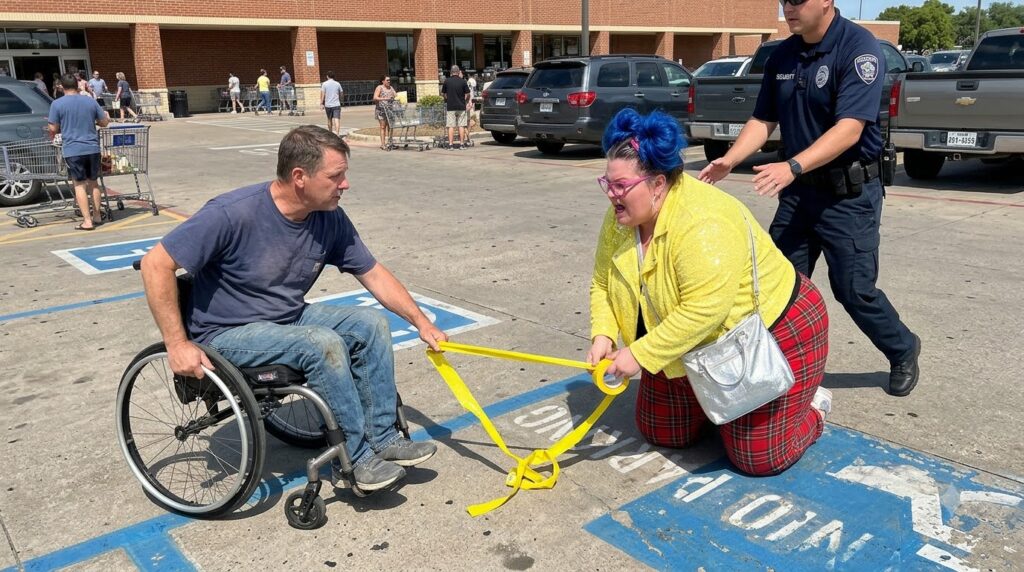
Brenda emerged from the driver’s side, opened the rear cargo compartment, and removed a large roll of yellow adhesive tape.
She looked around.
Then she began laying strips across the blue markings.
Daniel watched silently.
The camera angle was wider than he expected.
It showed something he had not seen while approaching from the sidewalk.
Before he arrived, Brenda had already directed another driver toward the striped aisle.
The vehicle was a white sedan.
Its driver appeared to be a woman in her sixties.
Brenda gestured toward the newly marked rectangle, apparently encouraging the woman to park there.
The driver hesitated, looked toward the accessible parking sign, and shook her head.
She drove away.
Brenda responded by throwing both hands into the air.
Then she returned to her tape.
A minute later, Daniel appeared in the frame.
The rest unfolded exactly as he remembered.
Brenda knelt in front of his wheelchair.
She blocked his path.
She shouted.
Daniel peeled away the tape.
Marcus intervened.
Elaine paused the recording.
“Well,” she said quietly, “that settles the basic facts.”
Marcus exhaled.
Daniel remained focused on the screen.
“Can you go back a little?”
Elaine rewound the footage.
Daniel pointed toward the white sedan.
“Who was she trying to park there?”
Elaine enlarged the image as much as the system allowed.
The license plate was not readable.
But the woman behind the wheel looked familiar.
Daniel had seen her earlier near the supermarket entrance, standing beside Brenda and holding a large envelope.
Elaine noticed his expression.
“Something wrong?”
“I’m not sure.”
The manager replayed another section.
Brenda opened her silver handbag and took out a folded sheet of paper.
She held it against the accessible parking sign, photographed it, then returned it to her bag.
Elaine frowned.
“That’s strange.”
Marcus leaned closer.
“She told me she had authorization to use the space.”
Daniel turned.
“From whom?”
“She said the property owners had approved temporary parking changes.”
Elaine shook her head.
“No one authorized that.”
The store leased its building from a regional commercial-property company. Parking maintenance was handled through the landlord, but changes affecting accessible spaces required proper review and compliance.
A customer could not simply declare a new parking arrangement.
Elaine picked up the phone and called the property manager.
While she waited, Daniel looked around the office.
On the wall hung photographs of the store’s employees volunteering at local food drives, school events, and veterans’ fundraisers.
One picture showed Marcus standing beside a group of veterans outside the supermarket.
Daniel recognized the event.
It was an annual holiday donation drive for the local veterans’ assistance center.
He had volunteered there twice.
The realization made the confrontation feel even more absurd.
This was a community where neighbors regularly helped one another.
Yet one woman had tried to turn a public accessibility feature into private territory.
Elaine ended the call.
Her expression had hardened.
“The property manager says they’ve received several complaints about unauthorized markings in that parking area.”
Marcus crossed his arms.
“From Mrs. Whitcomb?”
“About Mrs. Whitcomb.”
Elaine opened an email.
The message contained photographs taken over the previous month.
Orange cones.
A folding sign.
A handwritten notice claiming that the striped aisle was reserved for oversized vehicles.
And, in one photograph, Brenda’s silver Cadillac positioned diagonally across part of the accessible area.
Daniel felt a slow anger rise.
Not the explosive anger Brenda seemed to carry everywhere.
Something colder.
More deliberate.
He thought of Linda’s husband waiting in a car because he could not safely get out.
He thought of his mother, who had recently needed a walker.
He thought of older veterans who avoided crowded stores because every obstacle demanded more strength than they had to spare.
“This has been going on for a while,” he said.
Elaine nodded.
“Apparently.”
Marcus looked toward the security monitor.
“Then why wasn’t it stopped?”
No one answered immediately.
That silence troubled Daniel more than Brenda’s shouting.
Because it suggested the problem had continued not because nobody knew, but because nobody had taken responsibility.
Elaine finally spoke.
“I’m going to find out.”
Daniel believed she meant it.
But before he could leave, her computer chimed with a new email.
She opened it.
The sender was the commercial-property management office.
The subject line read:
Formal Notice: Proposed Reconfiguration of Parking Spaces
Elaine read the first paragraph.
Then she sat back.
“You’re not going to believe this.”