Chapter 6: The People Who Had Been Waiting
The supermarket’s accessibility review began the following Monday.
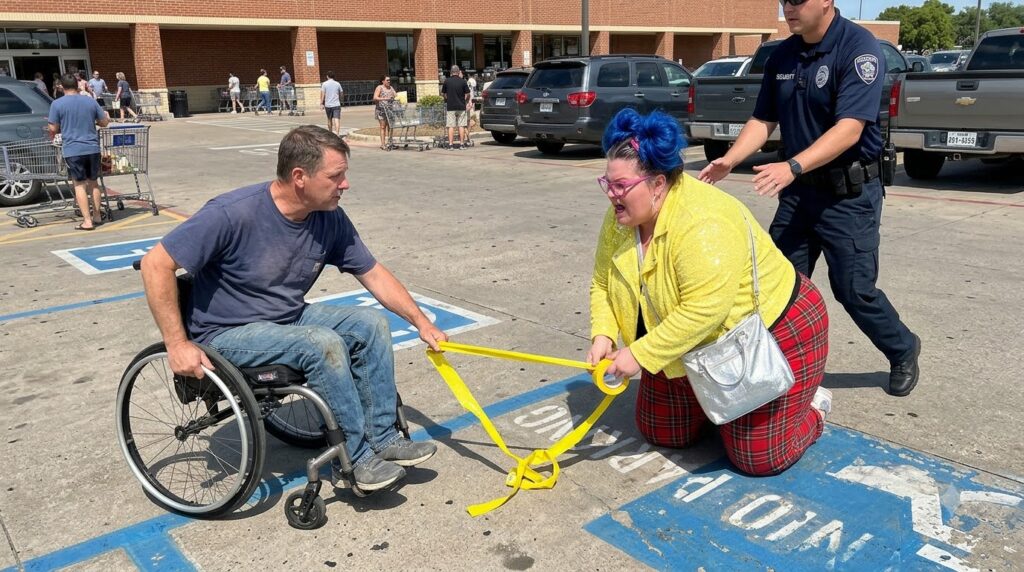
Elaine Foster expected a straightforward inspection of parking markings, signage, curb ramps, and pedestrian routes.
Instead, the review exposed a problem that had been building for months.
Several accessible parking spaces were correctly marked.
But the area around them was not consistently protected.
Shopping carts were sometimes left in the access aisles.
Delivery vehicles occasionally stopped near the curb ramp.
And customers had repeatedly complained about unauthorized cones and temporary signs.
The store had responded to individual incidents.
What it had failed to recognize was the pattern.
Elaine invited a small group of customers and community representatives to discuss the situation.
Daniel agreed to attend.
So did Linda Carver and her husband, Frank.
Frank was seventy-one, a retired firefighter whose arthritis made getting in and out of vehicles painful.
He walked with a cane and moved slowly, but his voice remained steady.
At the meeting, he described an incident that had occurred three weeks earlier.
He and Linda had parked in a designated accessible space.
When Linda returned with their shopping, another vehicle was positioned across the adjacent striped aisle.
Frank could not open his passenger door wide enough to enter comfortably.
The driver had refused to move for several minutes.
Frank remembered the humiliation more clearly than the inconvenience.
“I stood there holding my cane while people walked past,” he said. “I felt like I was asking permission to get into my own car.”
Daniel understood.
The room grew quiet.
A second customer, seventy-six-year-old Margaret Ellis, described how she had stopped shopping at the supermarket during busy hours.
Margaret used a walker after two knee replacements.
She could manage the store’s wide aisles.
The difficulty was getting from her vehicle to the entrance without encountering blocked pathways.
Another attendee, a younger mother whose son used a wheelchair, explained that access aisles were essential for operating their vehicle’s side-mounted ramp.
A few extra feet of space could determine whether her son could leave the van at all.
Elaine took notes.
Marcus attended as well.
He had initially worried that the meeting would focus on his handling of the confrontation.
Instead, he heard stories from customers who had experienced problems without ever reporting them.
Some assumed nothing would change.
Others feared being labeled difficult.
Several simply did not want to draw attention to themselves.
Daniel listened carefully.
He had expected anger.
What he heard was exhaustion.
People were tired of explaining why access mattered.
They were tired of being told to wait.
They were tired of having ordinary errands turned into negotiations.
Near the end of the meeting, Elaine shared the store’s preliminary plan.
The property owner would repaint faded markings, replace damaged signs, improve monitoring, and establish a clearer procedure for responding to blocked access aisles.
Employees would receive additional training.
Security would document repeated violations.
The store would also coordinate with the property manager to ensure that proposed parking changes received proper accessibility review before implementation.
Daniel appreciated the measures.
But he raised one concern.
“Please don’t make this something that depends on a particular manager being on duty.”
Elaine looked at him.
He continued.
“People retire. Employees transfer. Someone forgets why a rule was created. Then five years later, the same problem comes back.”
He wanted the procedures written down.
He wanted them to survive staff changes.
Elaine agreed.
The meeting ended with quiet conversations and exchanged phone numbers.
Daniel was preparing to leave when Marcus approached him.
“There’s something you should know.”
Daniel turned.
Marcus explained that Brenda had submitted another complaint.
This time, she claimed the supermarket was conducting a campaign to damage her professional reputation.
She demanded that the store retract its incident report and issue a public apology.
Daniel rubbed his forehead.
“She’s still doing this?”
Marcus nodded.
“Corporate legal is handling it.”
Daniel felt frustrated, but not surprised.
He had seen people double down when admitting a mistake threatened their self-image.
Still, something about Brenda’s persistence troubled him.
It suggested that she had not yet accepted the basic facts.
As Daniel left the meeting room, he passed a bulletin board displaying photographs from previous community events.
One showed Brenda Whitcomb smiling beside a group of volunteers at a neighborhood fundraiser.
Daniel stopped briefly.
The woman in the photograph looked cheerful and proud.
He wondered how someone capable of helping neighbors could also be so determined to deny them a few feet of pavement.
The answer, he suspected, had little to do with parking.
It had everything to do with control.
And control was becoming the one thing Brenda could no longer maintain.