Chapter 5: A Reputation Built on Control
Brenda Whitcomb had spent most of her adult life believing that confidence could substitute for authority.
She chaired neighborhood committees, organized holiday decorations, and frequently introduced herself as a community consultant.
Some of her projects had been useful.
Years earlier, she had helped coordinate a successful neighborhood cleanup.
She had also organized a donation drive after a severe storm.
Those accomplishments mattered.
But over time, Brenda had begun confusing participation with ownership.
If she organized an event, she expected everyone to follow her instructions.
If she made a suggestion, she treated disagreement as disrespect.
And if a rule interfered with her plans, she assumed the rule needed to change.
Her husband, Richard Whitcomb, had watched the pattern develop.
Richard was fifty-three, an accountant with a quiet manner and an increasing reluctance to attend public events with his wife.
He had spent years smoothing over disputes that Brenda considered victories.
When she came home that afternoon, he was sitting at the kitchen table reviewing paperwork.
She entered with her silver handbag swinging from one arm.
“That supermarket is going to regret humiliating me.”
Richard looked up.
“What happened?”
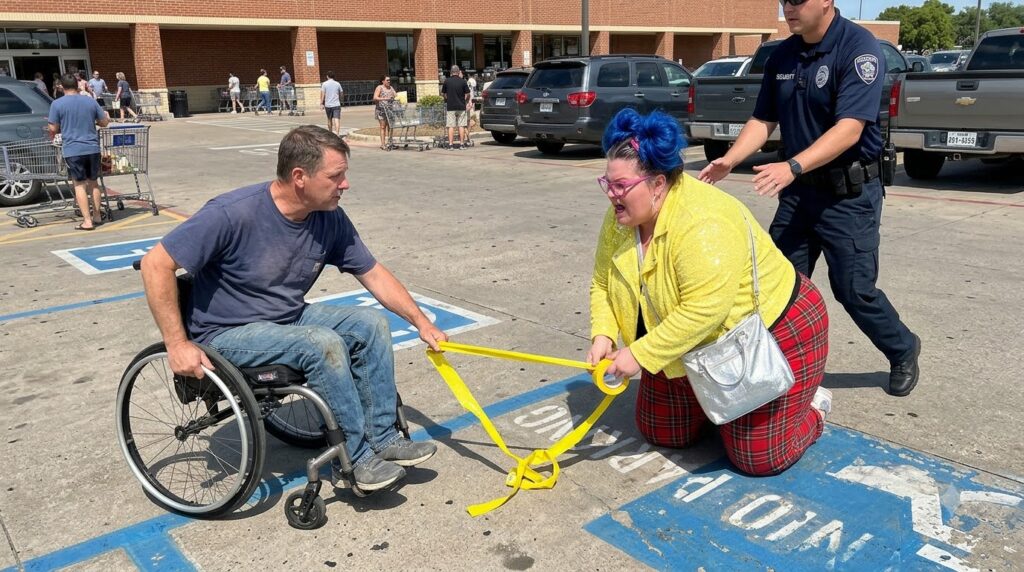
Brenda gave him a version of the incident in which she had been trying to improve parking efficiency when an unreasonable man and an aggressive security guard interfered.
Richard listened.
Then he asked a simple question.
“Was the area marked for wheelchair access?”
Brenda stopped.
“It was striped.”
“Blue stripes?”
“That doesn’t mean the whole thing has to sit empty.”
Richard removed his glasses.
“Brenda.”
She looked away.
He had spent enough time with her to recognize the moment when she knew she was wrong but intended to defend herself anyway.
“The property manager told me my proposal was being considered,” she insisted.
“Was it approved?”
Brenda did not answer.
Richard sighed.
That afternoon, Thomas Keene had informed Brenda that her proposal would not be considered further.
He had also told her that the property owner was documenting the unauthorized markings and reviewing whether her actions had created safety or accessibility problems.
Most painfully for Brenda, he had withdrawn an invitation for her to present at an upcoming neighborhood business forum.
The forum had been important to her.
She hoped to use it to attract paying clients.
Now that opportunity was gone.
Richard learned the details when he checked the email Brenda had forwarded to him.
He read the message twice.
Then he placed his phone on the table.
“You tried to create a parking space across an accessible aisle.”
“I was testing a layout.”
“With a man in a wheelchair trying to get through?”
“He could have waited.”
Richard stared at her.
That sentence seemed to settle something inside him.
For years, he had excused Brenda’s behavior as stubbornness, impatience, or an unfortunate habit of speaking too loudly.
But this was different.
She had looked directly at someone who needed an accessible route and decided her convenience mattered more.
Richard stood.
“I’m not calling anyone to fix this for you.”
Brenda blinked.
“What?”
“I’m not contacting the property manager. I’m not threatening the store. And I’m not writing another complaint.”
Her face reddened.
“You’re supposed to be on my side.”
“I am on your side when you’re right.”
He paused.
“But being your husband doesn’t require me to pretend you’re right when you’re not.”
Brenda turned away.
For the first time that day, she had no immediate response.
Across town, Daniel was helping his mother prepare lunch.
Ruth sat at the kitchen table while he arranged groceries on the counter.
She noticed he was quieter than usual.
“Something happen?”
Daniel told her.
He described the tape, the argument, and the security guard.
Ruth listened without interrupting.
When he finished, she shook her head.
“Some people don’t understand what those spaces are for until they need them.”
Daniel sat opposite her.
“She understood.”
Ruth studied his face.
“That makes it worse.”
He nodded.
Then his mother reached across the table and touched his hand.
“Are you going to let it go?”
Daniel considered the question.
He did not want a public feud.
He did not want attention.
And he certainly did not want to spend the next several weeks arguing with strangers about a ten-second encounter.
But he remembered Linda’s story.
He remembered the earlier complaints.
He remembered the proposal describing an accessible aisle as an underutilized buffer.
“I think somebody needs to make sure it doesn’t happen again.”
Ruth squeezed his hand.
“Then do that.”
That evening, Daniel received an email from Elaine Foster.
The store had preserved the recording and opened a formal incident report.
It would also conduct an accessibility review with the property owner.
At the bottom of the message was one additional sentence.
We have received information indicating that this may not have been an isolated incident.
Daniel read it twice.
Then he opened a new document on his computer.
He began writing down everything he remembered.