
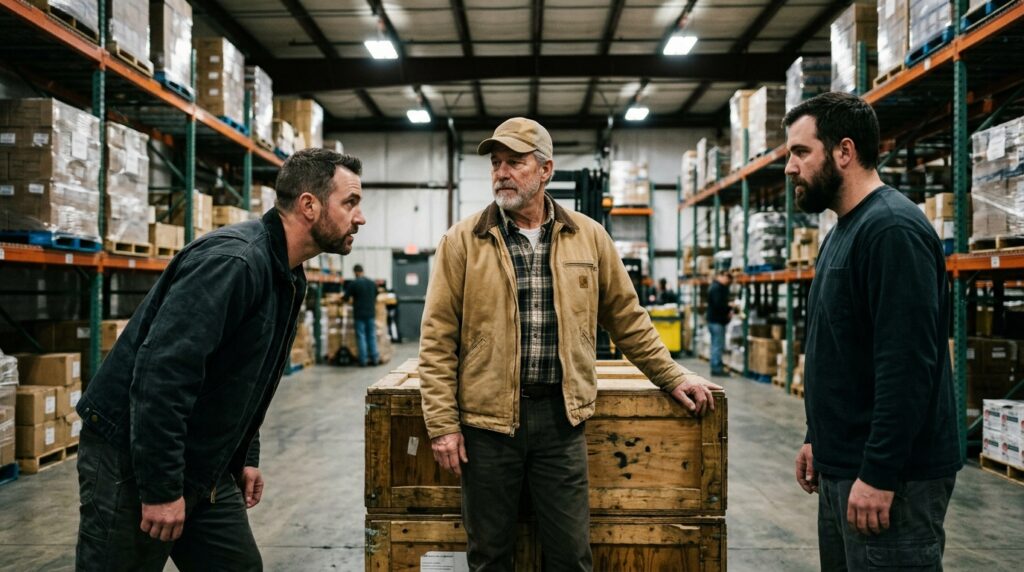
CHAPTER 7: THE RUSTED TERMINAL
“The truck stays,” Miller repeated.
His boots made a ragged, uneven sound against the concrete dust as he walked past Vance toward the primary terminal exit. The puncture in his boot leather was leaking a narrow trail of dark, heavy fluid that mingled with the wet gravel at the threshold. Outside, the Ohio morning had broken as a low, yellow fog that smelled of sulfur, frozen mud, and the exhaust of fifty idling commuter cars.
The chain-link gate at the perimeter fence was already rattling. A dark blue sedan with state government plates sat idling twenty feet from the scales, its windshield wipers cutting clean arcs through the cold moisture. A man in a heavy charcoal overcoat stood beside the hood, his hands shoved deep into his pockets, his eyes fixed on the gray iron trusses of the loading bays. It wasn’t the bank. It was Arrington—the district logistics coordinator who had overseen the state transit grid back when Miller was still logging supply columns out of Fort Meade.
Vance and Hendrick walked three paces behind Miller, their utility jackets gray under the wet light of the dawn. The warehouse behind them was already humming with the morning shift, the roar of the first forklift blade lifting a pallet of sheet metal echoing out through the open bay doors like a low roll of thunder.
“Arrington’s been at the scale house since three,” Hendrick said, his voice dropping into the flat, exhausted cadence of a ledger that had been closed too many times. He didn’t look at Miller’s boots. His gaze remained locked on the blue sedan. “He knew the asset count wouldn’t check out. He’s got the terminal liquidation keys on his ring.”
Miller didn’t answer. He reached down and pulled the cold steel stopwatch from his canvas pocket one last time. He didn’t look at the dial; his thumb simply traced the deep, jagged scratch along the back casing where the metal had caught on an armored transport hatch twenty-four years ago. He let the lanyard drop over his fingers, the weight hanging steady against his hip.
He reached the rusted iron latch of the main gate. The metal was pitted, rough with orange oxidation that left a sharp, blood-colored residue across his calloused palm as he threw the lever back. The hinges groaned—a loud, metallic screech that brought a sudden, absolute silence to the first three rows of cars waiting in the turnaround lane.
Arrington stepped forward, his leather soles crunching methodically through the wet limestone gravel until he stood within two feet of Miller’s cap bill. “The office in Columbus went dark at midnight, Miller. The owner’s signature didn’t clear the clearinghouse.”
“The copper is still on the jack, Arrington,” Miller said. His voice was very slow, the gravel in his throat completely dry. He pointed the edge of his aluminum clipboard toward Bay Seven. “Twelve tons of machined bushings. The foundry marks are clear. They haven’t been loaded.”
Arrington looked past Miller’s shoulder, his gray eyes tracking the split shoulder seam on Vance’s dark jacket, then settling on Hendrick’s empty, coffee-stained hands. He took a long, slow breath of the humid morning air, his chest rising beneath the wool overcoat. “The asset receiver is three miles down the road with the highway patrol, Miller. They aren’t counting the copper. They’re locking the chain. The corporate entity is dissolved as of four-fifteen this morning.”
Vance took a short step forward, his knuckles raw and bleeding where they had dragged across the splintered pine stacks inside. “The crew’s insurance runs through the end of the month, Arrington. The papers were filed.”
“The papers were filed by a shell desk in Delaware that hasn’t had a live phone line since Tuesday,” Arrington replied, his tone as indifferent as an incoming manifest. He didn’t look at Vance. He kept his eyes on Miller’s weathered face. “The facility is scrap, Miller. The land goes to the county for the tax lien. You’ve got twenty minutes to clear the inventory logs before the seal is placed on the office door.”
Miller looked back at the long grid of the warehouse. The corrugated steel walls looked small under the vast, yellow expanse of the morning sky, their seams bleeding rust down onto the foundation blocks. Fifty men were currently unbuckling their tool belts near the time-clock, their voices rising in a sudden, sharp wave of confusion as the facility’s primary circuit box gave a loud, hollow pop and the overhead light tubes died, leaving the interior in the gray, flat gloom of the dawn.
The line had stopped. The numbers didn’t matter anymore.
Miller didn’t drop the clipboard. He walked back to the metal desk at the center of the bay, his torn boot trailing a faint smear of oil and blood across the floor. He picked up the manual ledger—the heavy, canvas-bound book that had recorded every structural pound of steel that had crossed the threshold since the day the concrete was poured.
He didn’t sign the clearance. He didn’t stamp the variance. With a single, heavy movement of his calloused thumb, he tore the entire yellow tracking sheet out of the binding and folded it twice until the block-letter imprint of the liquidation owner was buried inside the fiber. He slid the paper beneath the back plate of his steel stopwatch, snapping the casing shut until the mechanical gears locked against the ink.
“The inventory is clear, Arrington,” Miller said, his gray eyes unblinking beneath the tan cap as he walked past the three men into the open turnaround lane. “The logbook is empty.”
He didn’t wait for the state troopers to clear the turnstiles. He didn’t look back at Vance or the yellow jack parked in the shadows. He walked down the center of the wet gravel road toward the highway, his posture straight, his hand resting light and solid inside his pocket against the old metal that had outlasted every company he had ever served.








