
CHAPTER 3: THE CORRIDOR BLOCKED
The sound of the sheared steel band did not repeat. It didn’t need to. The single mechanical snap vibrated through the web of rusted iron trusses overhead, settling down into the soles of their boots like a small, sharp tremor. Vance’s fingers flinched on the desk, scraping against a flaking patch of orange oxidation before he forced his palms flat again, trying to deaden the resonance.
“That could be anything,” Vance said, his voice dropping an octave, fighting the warehouse hum. “A pallet settling under its own weight. A cold pipe.”
“A cold pipe doesn’t sever four-inch high-tensile strapping, Vance.” Miller didn’t look back at the dark north sector. His eyes remained fixed on Vance’s throat, watching the steady, rapid pulse twitching just above the collar of his utility shirt. “And a settling pallet doesn’t require a hand-held torch to drop its clearance. Garrett, let go of the banding cutter. You’re leaking grease on the manifest.”
Garrett didn’t drop the tool, but his knuckles went white against the pitted rubber grip. He looked at Vance, his head tilting toward the cross-aisle. “The old man is trying to tie us up here while the terminal timer counts down. We need to move the freight now, Vance. The truck in the turnaround isn’t waiting until the morning whistle.”
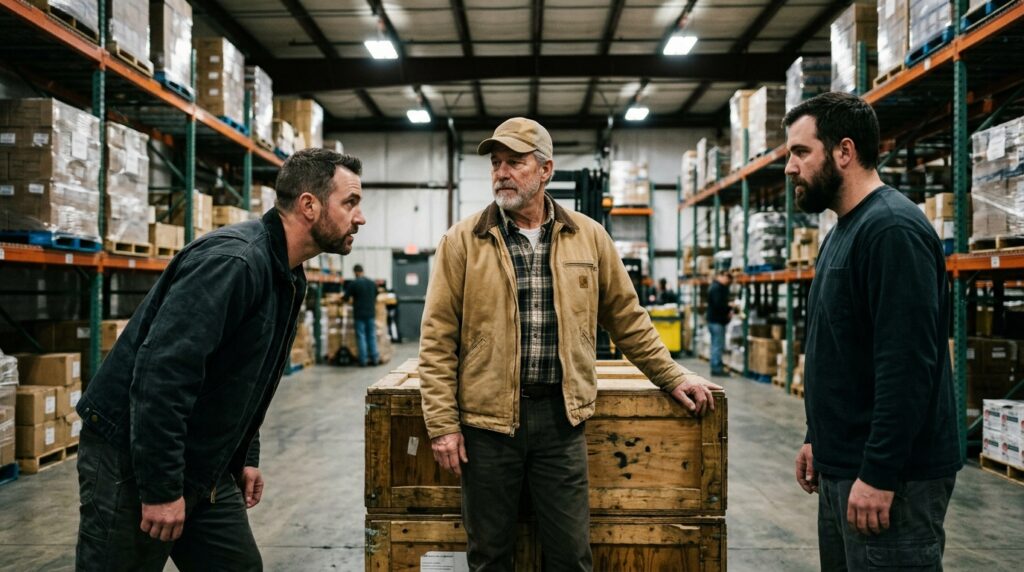
Miller stood up from his stool. He did it deliberately, utilizing the slow, unhurried levers of his hips and spine—a motion that carried no aggressive signal but left his boots firmly planted at the center of the concrete lane. He was a head shorter than Vance, his tan work jacket oil-stained and frayed at the cuffs, but his posture was straight, balanced down through his heels in the way of men who had spent thirty years standing on the rolling steel decks of transport ships.
He picked up the metal clipboard, his calloused thumb resting against the clean, uninked margin of the sheet.
“The truck in the turnaround isn’t your concern anymore,” Miller said, his tone dry as lime dust. “If that driver drops his clutch before the seal is verified, his registration gets flagged at the state line checkpoint. You know the protocol for unlogged cargo leaving an interstate facility. It isn’t an administrative fine. It’s corporate theft under federal transit codes.”
Vance smiled, though the skin around his eyes remained tight and dry. He stepped back from the desk, his hands sliding into the deep pockets of his dark utility jacket. “You think the front office cares about twelve pallets of zinc-coated bolts? They don’t even audit the north bay until the end of the fiscal quarter. By then, these numbers will be buried under five thousand tons of scrap variance.”
“They’ll audit it tomorrow if the logistics tracker shows an unregistered signature,” Miller replied. He walked past the edge of the desk, his boots making a deliberate, rhythmic crunch against the concrete dust. He didn’t head toward the dark sector where the flashlight had been. He headed toward the primary transport line, where a massive yellow pallet jack sat parked across the mouth of the narrow aisle.
The lane was tight. On either side, heavy wooden crates rose fifteen feet into the shadows, their rough-sawn pine faces gray with age and marked with faded black grease stencils from long-defunct manufacturing plants. Vance and Garrett followed, their heavy work boots tracking his cadence, their shadows long and distorted against the corrugated metal siding of the warehouse wall.
Garrett stepped ahead, his shoulder brushing the rough edge of a crate as he took up a position five feet from the parked pallet jack, effectively forming a second wall across the only clear exit route to the main loading dock. “The aisle is closed for maintenance, Miller. Shift manager’s orders. We’re moving three pallets of industrial wire from the overflow rack.”
Miller stopped. His hand stayed in his pocket, his fingers curled around the smooth, heavy casing of his digital stopwatch. He didn’t look at Garrett. He looked at the pallet jack itself. The iron tongue of the jack was coated in a fresh, amber-colored grease that hadn’t yet collected the gray film of warehouse dust. It was the specific lubricant used for the high-capacity hydraulic lifts in the secure terminal—the ones reserved for heavy machinery and sealed government freight.
“The shift manager doesn’t authorize maintenance during the three-to-six window,” Miller said softly. He reached out with his left hand, his index finger tracing a clean line through the fresh grease on the lift bar. “And this jack belongs to the bonded vault in Bay Seven. It doesn’t leave the cage without a three-point signature from the regional safety director.”
Vance stepped up behind Miller, his presence cutting off the air from the main corridor. The smell of his stale coffee and the sour scent of damp wool filled the tight space between the crates. “The vault was re-keyed Tuesday, old man. The rules changed while you were out on medical leave. We don’t need three signatures to shift dead weight.”
Miller turned his head slightly, his analytical gaze catching the slight, rhythmic vibration of the yellow jack’s hydraulic cylinder. It wasn’t dead weight. The jack was under full pressure, its seals whistling with a faint, high-frequency hiss that only someone who had spent forty years listening to the machinery of transit lines would notice. The load it was holding wasn’t wire. It was dense, small-volume freight that sat low to the floor, hidden beneath a coarse burlap tarp that was tied down with standard corporate yellow twine—but the zinc-coated lead seal that should have locked the knot was missing.
“You didn’t re-key the vault, Vance,” Miller whispered, his voice steady against the hiss of the hydraulic fluid. “You just stopped checking the logs altogether.”
Vance’s face darkened, his jaw shifting as he took a final step forward, his chest nearly touching the frayed shoulder of Miller’s tan jacket. “Sign the manifest, Miller. This is the last time I’m asking nicely before we clear the lane ourselves.”








