
CHAPTER 2: THE CALIBRATED LINE
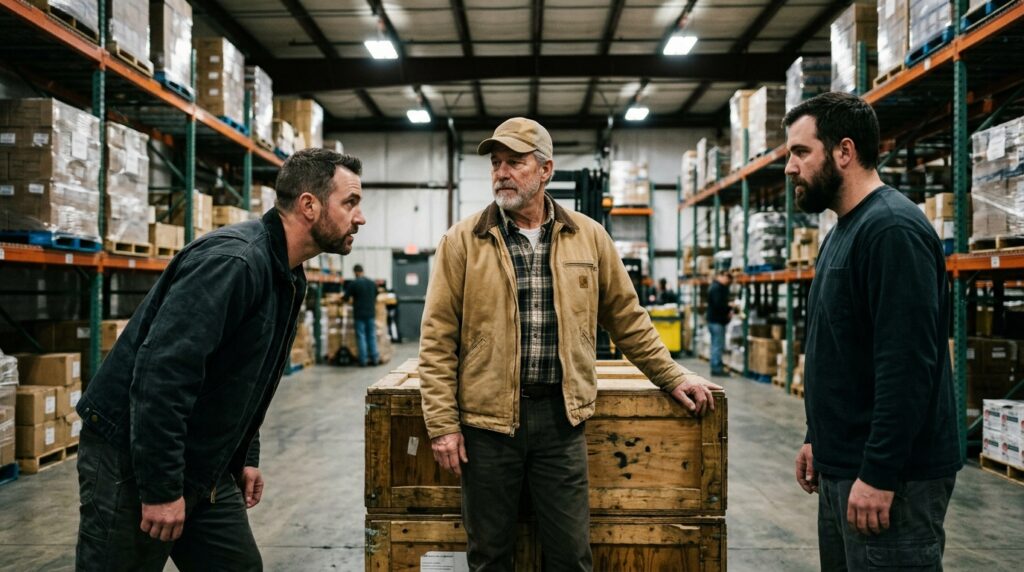
The yellow glint vanished behind a wall of corrugated steel before Miller’s next breath could catch the dust. It left only the cold, unblinking glare of the overhead warehouse lights, each tube humming at a pitch that vibrated against the fillings in his teeth. Vance hadn’t seen it. Vance was still leaning into the desk, his weight grinding his palms against the pitted iron trim, his entire focus narrowed to the three inches of space separating his chest from Miller’s clipboard.
“I’m waiting on that pen, old man,” Vance said. The words came out flat, clipped by the rising heat under his collar. His dark utility jacket rustled as he shifted his stance, his boots finding a firmer purchase on the grit-slick floor. “The drivers don’t get paid to watch you cross out numbers.”
Miller kept his fingers light against the stopwatch in his pocket. The steel casing was cold, its internal gears moving with a precision that didn’t care about the sweat gathering on Vance’s temples. He didn’t blink. He had seen men use this exact lean in assembly areas from Fort Hood to the supply docks at Subic Bay—the heavy-shouldered tilt meant to simulate a collapsing roof. It only worked if the man underneath it believed the ceiling was real.
“The drivers can shut off their rigs,” Miller said. He didn’t raise his voice. He kept it in the low register used for loading lists and equipment checks—a sound that didn’t carry past the immediate circle of their boots. “The freight stays on the concrete until I check the seals myself. Garrett, move away from the junction box.”
Behind Vance, the second man didn’t move. Instead, Garrett’s hand slid down the strap of his tool belt, his fingers curling around the heavy handle of a steel banding cutter. The click of his knuckles against the iron tool was loud in the cavernous expanse of the aisle. The message wasn’t subtle. It was the friction of the floor testing the supervisor’s leverage, a quiet assessment of how much weight an old man’s spine could carry before the corporate rules cracked.
“Garrett isn’t taking orders from a man whose pension is already under review,” Vance sneered, his face dropping lower until Miller could smell the stale chicory coffee on his breath. “You’ve got six months until the company hands you a gold watch and a tracking number, Miller. Don’t make those six months hurt. Sign the bill.”
Miller’s gaze shifted past Vance’s shoulder, tracking the darkness of the unlit northern sector. The flashlight hadn’t reappeared, but there was a distinct rhythmic thud—the muffled, rubbery strike of a manual pallet jack lifting a heavy load without its hydraulic grease. A standard warehouse crew didn’t work in the dark, and they didn’t work silent. Whoever was behind those crates knew exactly which cameras were down for the weekly maintenance cycle.
The calculated calculation inside Miller’s head didn’t take more than a second. If he signed, the trailer rolled, the discrepancy disappeared into the system, and the line kept moving. If he stood up, the circle closed.
“The gate log shows three arrivals after midnight,” Miller said, his voice dropping into an even slower, colder cadence. He let his left hand slide out of his pocket, placing his calloused thumb directly on the disputed signature line of the manifest, covering the ink space completely. “None of them carried a yellow seal. If you want this bill cleared, Vance, you bring me the yard foreman’s pink carbon. The one he keeps in the locked box behind the scales.”
Vance’s hand twitched against the iron desk. His fingers curled into half-fists, the skin over his knuckles turning the color of skimmed milk. “The foreman’s home in bed. You know that.”
“Then the truck waits until six,” Miller replied. He finally looked up, his grey eyes catching the white light of the fluorescent tube directly above them. The weathered lines around his jaw tightened, transforming his face from that of an aging clerk into an unyielding piece of iron framework. “And you and Garrett can explain to the regional manager why twenty tons of grade-four fasteners are sitting in the turnaround lane while the diesel burns.”
Garrett took a half-step forward, the steel banding cutter swinging slightly against his thigh with a dull, heavy clink. “He’s bluffing, Vance. The old bastard doesn’t want the paperwork any more than we do.”
Vance didn’t answer right away. He stayed down, his eyes scanning Miller’s face for the slight flutter of the eyelid or the twitch of the throat that signaled a man preparing to scramble backward. He found nothing but the flat, dead stare of a supervisor who had spent forty years counting things that didn’t belong to him. The silence between them stretched, thick with the smell of forklift exhaust and the heavy, metallic dust that never settled.
Then, from the dark north sector, a sharp metallic snap echoed through the rafters—the distinct sound of a high-tensile steel security strap being sheared by someone who didn’t care about the noise. Vance’s head didn’t move, but his pupils dilated, a sudden, sharp tremor passing through his jaw. He knew the sound. And he knew Miller had heard it too.
Miller shifted his weight on the stool, his hand leaving the clipboard as he prepared the leverage in his heels. “That wasn’t a pallet jack, Vance.”








