
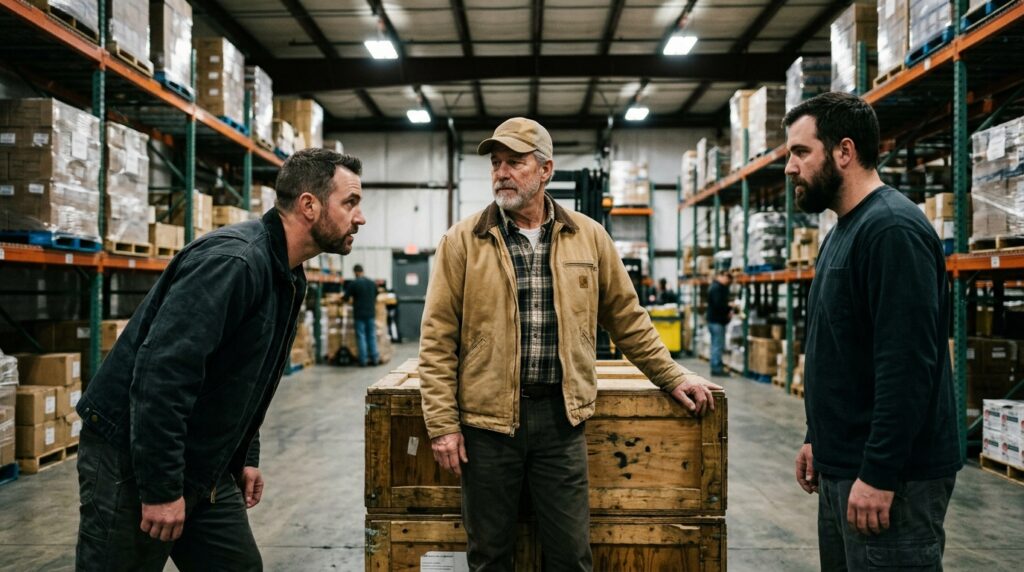
CHAPTER 6: THE DISPUTED BOXES
Hendrick’s leather shoes didn’t yield an inch of the pitted gray concrete floor. His hand remained wrapped around the handle of his ceramic mug, the cold surface of the clay sweating grey drops against his knuckles. “The override is an emergency protocol, Miller. If you pull that lever, the main feeder line reports an immediate load failure to the municipal substation. The state troopers will be at the gate before the security lights cycle.”
“Let them roll,” Miller said.
He stepped wide, his heavy canvas-coated shoulder catching Hendrick’s chest just enough to force the clerk back against the iron rim of the manifest desk. The collision was dry, short, and entirely transactional. Miller didn’t look at Hendrick’s face; his focus stayed locked on the high-voltage distribution locker forty feet down the line, its gray enamel surface peeling from decades of industrial dampness.
Vance didn’t try to loop his arm this time. The lesson from the narrow bay was still rattling through his right shoulder, his dark utility jacket hanging loose where the seam had split under the crates. Instead, he lunged laterally, slamming his entire weight into the iron handle of the yellow pallet jack parked across the threshold. The wheels screamed against the concrete dust as the heavy frame swung around, the front steel plate pinning the toe of Miller’s boot against the lower rail of the cargo rack.
The pain was an immediate, blinding heat that shot up Miller’s shin, but his face didn’t break. His left hand simply tightened around the stopwatch inside his jacket pocket, the mechanical edge of the casing sinking into his palm until his own blood stopped the sliding gear.
“You’re done auditing, old man,” Vance hissed, his breath hot against Miller’s neck as he strained against the iron frame of the lift. “The bill is gone. Garrett threw the yellow sheets into the incinerator hopper five minutes ago. There’s no manifest to show the state police.”
Miller looked down at his pinned foot, then slowly turned his head to look at the burlap tarp covering the low-volume cargo on the jack. The yellow twine was knotted tight, but under the weight of the collision, the coarse fabric had shifted three inches to the left. Through the tear in the weave, the glint wasn’t zinc-coated fasteners. It was the machined, dull luster of solid copper industrial armature bushings—the core capital assets of the facility’s primary milling line, stamped with the original 1984 foundry mark.
The logic click inside Miller’s head was cold and heavy. They weren’t siphoning a surplus order to pad a shift bonus. They were stripping the factory’s operational marrow.
“The incinerator doesn’t burn carbon ink fast enough, Vance,” Miller whispered. He didn’t pull his foot back. He reached down with his right hand, his calloused fingers locking around the release valve of the jack’s hydraulic tongue. “And Hendrick didn’t get these manifests from the regional desk.”
Hendrick dropped his mug. The ceramic broke into four flat pieces on the concrete, the dark chicory coffee spreading through the dust until it touched the edge of Miller’s pinned boot. “Miller, let go of the pressure valve. You don’t know who owns that steel.”
“The company owns it,” Miller said.
“The company hasn’t paid its transit tax since October,” Hendrick replied, his voice losing its smooth administrative edge and cracking down to the dry gravel beneath. He took a short step back toward the platform steps, his fingers twitching against his empty palm. “The bank isn’t auditing the inventory tomorrow, Miller. They’re locking the gate. The owner is liquidating the bay before the receivers arrive at noon to chain the doors. Vance isn’t stealing from the line. He’s trying to get his last three weeks of back pay before the checks clear as red ink.”
The warehouse hum seemed to drop into a dead, freezing hole. Behind them, the turnstiles at the main gate began to click—a rapid, rhythmic rattle as the first twenty workers of the morning shift punched their cards into the old mechanical time-clock. The voices of men talking about coffee and the weather drifted down the high corridor, completely ignorant of the three men standing in the pool of oil and broken clay.
Miller’s hand stayed on the iron release valve. His mind raced over forty years of logistics grids, calculating the weight of the machines, the cost of the transit lines, and the quiet face of the owner who had signed his pension voucher three months ago. The decoy secret—the regional siphon—shattered into gray dust, leaving behind a raw, systemic rot that his clipboard couldn’t fix.
Vance let go of the jack handle. His hands fell to his sides, his shoulders dropping until his chin nearly touched the frayed collar of his utility shirt. “My boy’s got an operation scheduled in Cleveland next month, Miller. If this terminal goes black before the insurance cycles, the policy dies with the corporation. We just needed the copper to clear the balance.”
Miller didn’t turn the valve. He looked down the long, empty bay toward the distribution locker, its master circuit stamp missing from the casing, its gray doors locked with a common padlock that any bolt cutter could clear. The victory he had won beside the cargo crates felt small, cold, and entirely compromised. He had protected the line, but the line was already dead under the floorboards.
“The morning crew is on the floor,” Garrett said from the shadow of the columns, his voice shaking as the first forklift engine cranked to life in the adjacent bay. “What do we do with the truck?”
Miller slowly pulled his foot out from beneath the steel plate. The leather of his boot was torn, the gray canvas of his sock darkening with grease and the first seep of dark blood. He picked up his metal clipboard from the desk, the bare aluminum frame reflecting the hard white light of the fluorescent tube above.
“The truck stays,” Miller said.








